Inspired by divine femininity, ancient artifacts, and spiritual symbolism, the New York artist recreates her dreams in her fantastical paintings.
By Megan O'Sullivan
Photos by Tiffany Nicholson
Published
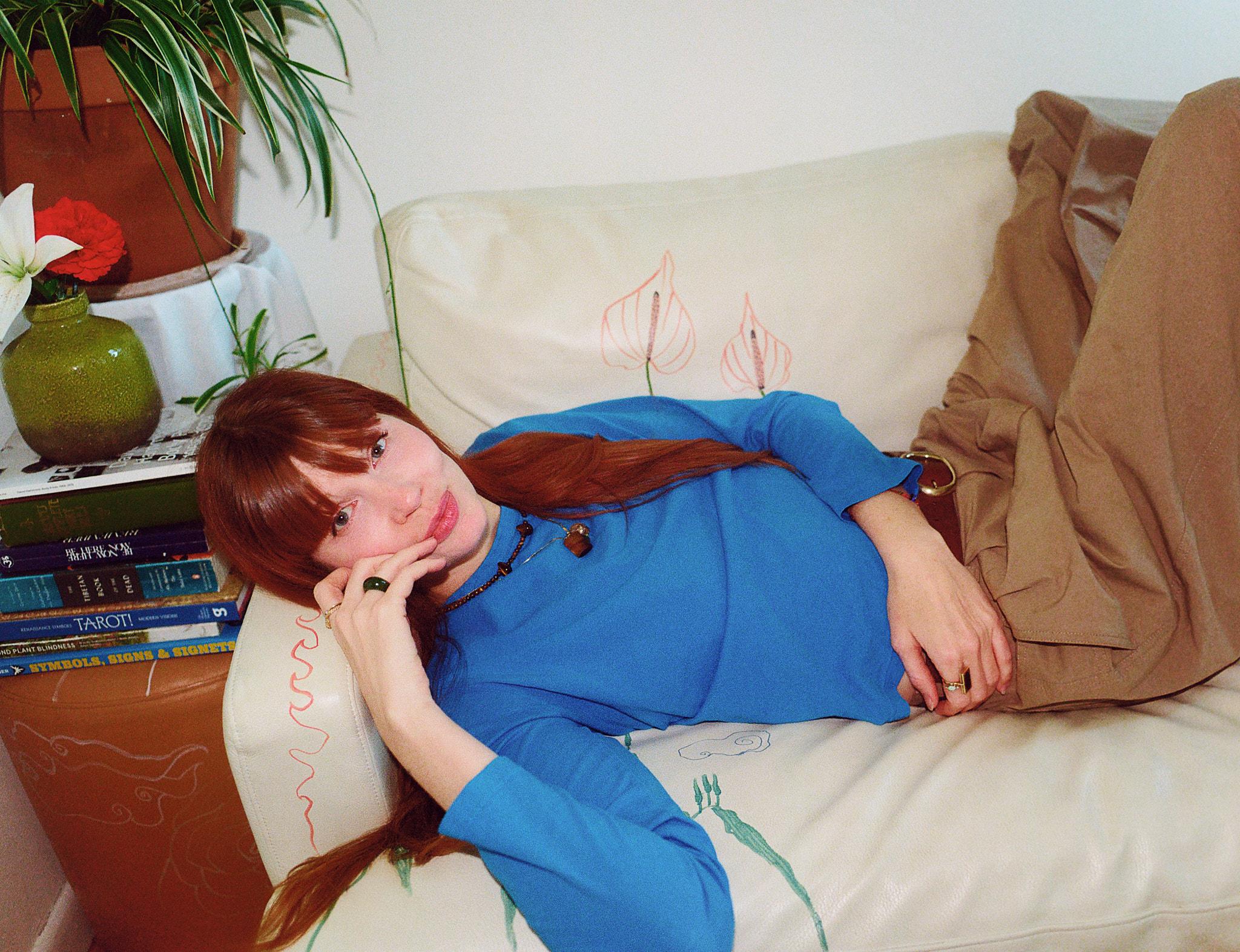
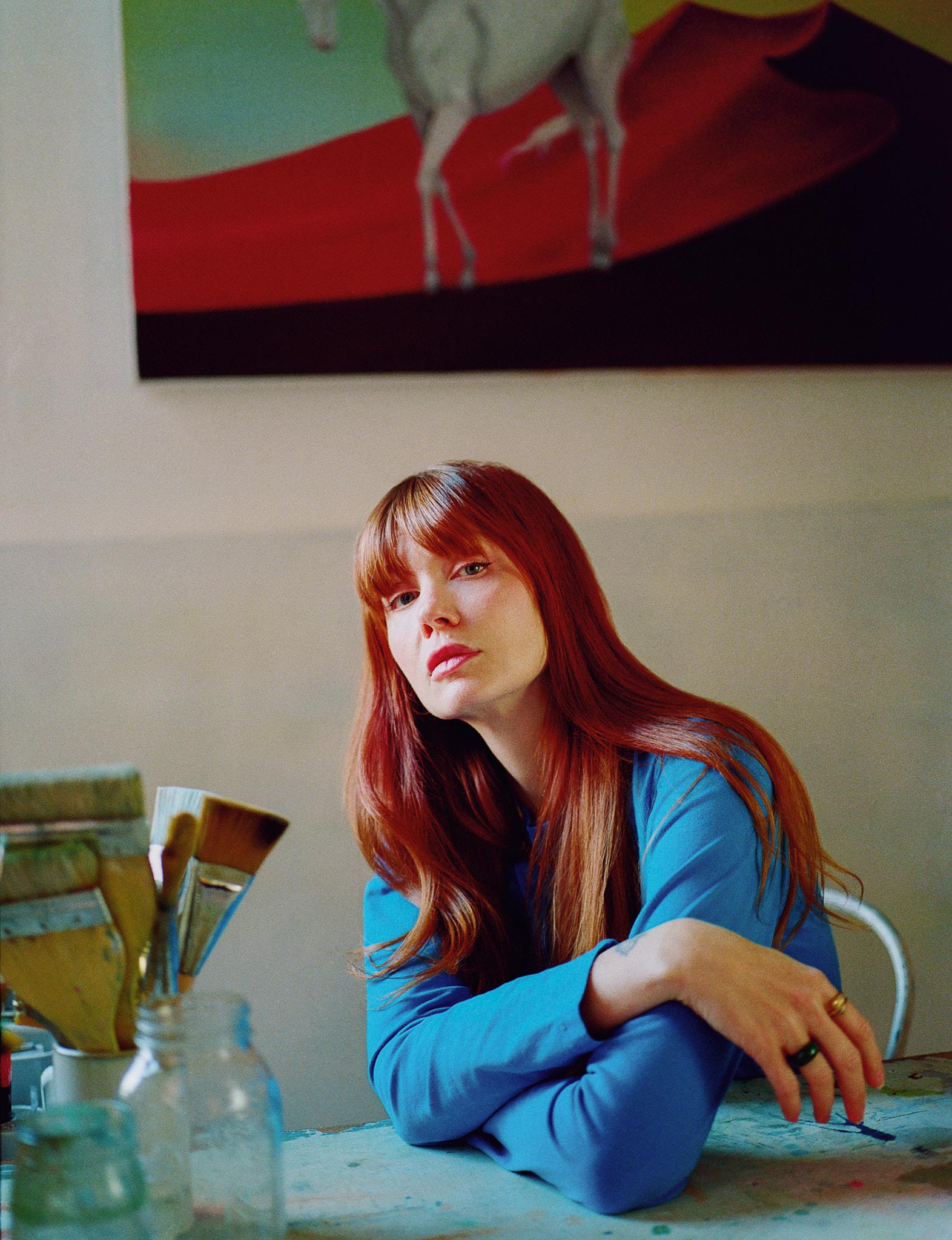
Brianna Lance has Texas blood. I know this because I can sense it in her warmth and in the subtle lilt in her voice, and also because she told me over coffee in her Manhattan apartment. New York is Brianna’s home now. The walls of the artist’s apartment are decorated with her works, each marking a different era of her practice. Many of her paintings are surrealist by nature. A twisted tree has candles as leaves. Another storybook-like tree is draped in pearls and ornaments. A range of motifs decorate the canvases: a lotus flower, a cloud, an artichoke, a horse. The setting seems to be a West Texas-inspired desert or Mars. And then there are the eggs. Black, blue, or white, one appears in almost every piece. Brianna says that each egg holds a universe. It’s whole and perfect. It’s a vessel for life, the divine feminine, the eternal energy. Inside is a world unknown but soon to hatch.
Brianna’s New York life started when she moved at 19 to study fashion at Parsons. After dropping out with a semester left because she didn’t want to pay tuition anymore, she landed at Reformation as one of the brand’s first employees and wound up as the head of design, then creative director. In a sense, this was her gestation. “My granddad taught me to paint when I was young. I used to paint in high school and knew I was a good illustrator, but I never thought I could have a career as a painter,” she tells me. She gained confidence in her artistry during her tenure as a creative director and decided to go out on her own, consulting for fashion brands. When the pandemic hit, she found herself without work and began making art more regularly. “I always say that my work is channeled through me,” she says. “I kept hearing voices in my head telling me to paint. I had to ask my therapist if something was wrong with me because I knew the voices weren’t real. But I’ve learned that it’s just an inner knowing. This is basically my alter, my meditation.”
Brianna is one of those people who is connected to the source. She’s an old soul and possesses ageless wisdom. As a kid, she remembers feeling scared of the dark. “I always thought it was ghosts. We grow up unaware of this other realm. We’re not accustomed to knowing that there is something else out there, and sometimes it’s friendly guides leading the way.”
The artist often turns to her guides, but she also finds direction in reading, learning, and absorbing new information. “I paint for like, ten hours straight, so people always wonder if I listen to music. But I prefer listening to people talking,” she says she most recently listened to the audiobook Other Minds: The Octopus, the Sea, and the Deep Origins of Consciousness while painting. She reread The Book of the Dead for archaeological inspiration. She’s interested in symbolism, Greek mythology, Egyptian tarot, mysticism, and where they all intersect. “Almost every culture or religion has a code of symbols, whether archaeological or historic,” she explains. “I like to integrate those motifs into my work. Sometimes I’ll see images or become obsessed with a specific symbol. I’ve been painting horses a lot, and then a tarot card reader told me I could talk to horses if I wanted to. I felt spiritually connected to them.”
Turning toward her fears has been a theme in Brianna’s artistic journey. “I used to be scared of mountains,” she tells me. “I don’t like the feeling of being trapped or in desert mountains, far away from water. But then I spent time in the Sierra Madre in Mexico. There was something magical about them.” She references Georgia O’Keeffe, famously inspired by the Sangre de Cristo mountains in Santa Fe and driven by earthly symbols of spirituality, as well as Frida Kahlo, Hilma af Klint, and even Gustav Klimt as one of the “most feminine painters on earth.” Brianna says that when she first began painting, the only people who took her work seriously were women. “I had a lot of men tell me it's illustrative or children’s book work,” she says. “I had to fight for a long time, but I believe in a hyper female perspective of art, and a lot of the best paintings in the world are hyper feminine.” Brianna cites a study stating that 70-80% of all art collectors are female, and that generally speaking, women are more tapped into divine femininity and the world of mysticism. She hypothesizes that men who reject mysticism in art are likely just afraid of it because they don’t understand it—that their way of dealing with something outside of their comprehension is to belittle it.
The experience of degradation by an intimidated man is one known by most talented and spiritually aware women. Eventually, it becomes uninteresting. Brianna has seen the same dynamic play out in her personal life. “Up until recently, I realized with a lot of relationships, there was a lot of underlying jealousy or a need to make me feel smaller. Especially if they were doing something creative,” she says. “My partner now is the first person I’ve dated where they want no ownership of my success, they don’t need credit. A lot of straight men are going to want you to be smaller than them, less powerful, and I never want to make my life worse for a man so that I can feel desired.”
At 44, Brianna has cultivated an inner sanctuary rooted in values and practices that make her feel strong, safe, secure. Many of those grounding principles show up in her work. One example is the braid she used in the Byline cover piece. “I once did a self-portrait, which was the first time I ever put the braid in something,” she says. “At the time I was doing a lot of kickboxing, and every time I went I would wear my hair in a braid.” She was kickboxing so often that the braid became a recurring theme in her work, and then it became a symbol of physicality, the body, strength, and self-protection.
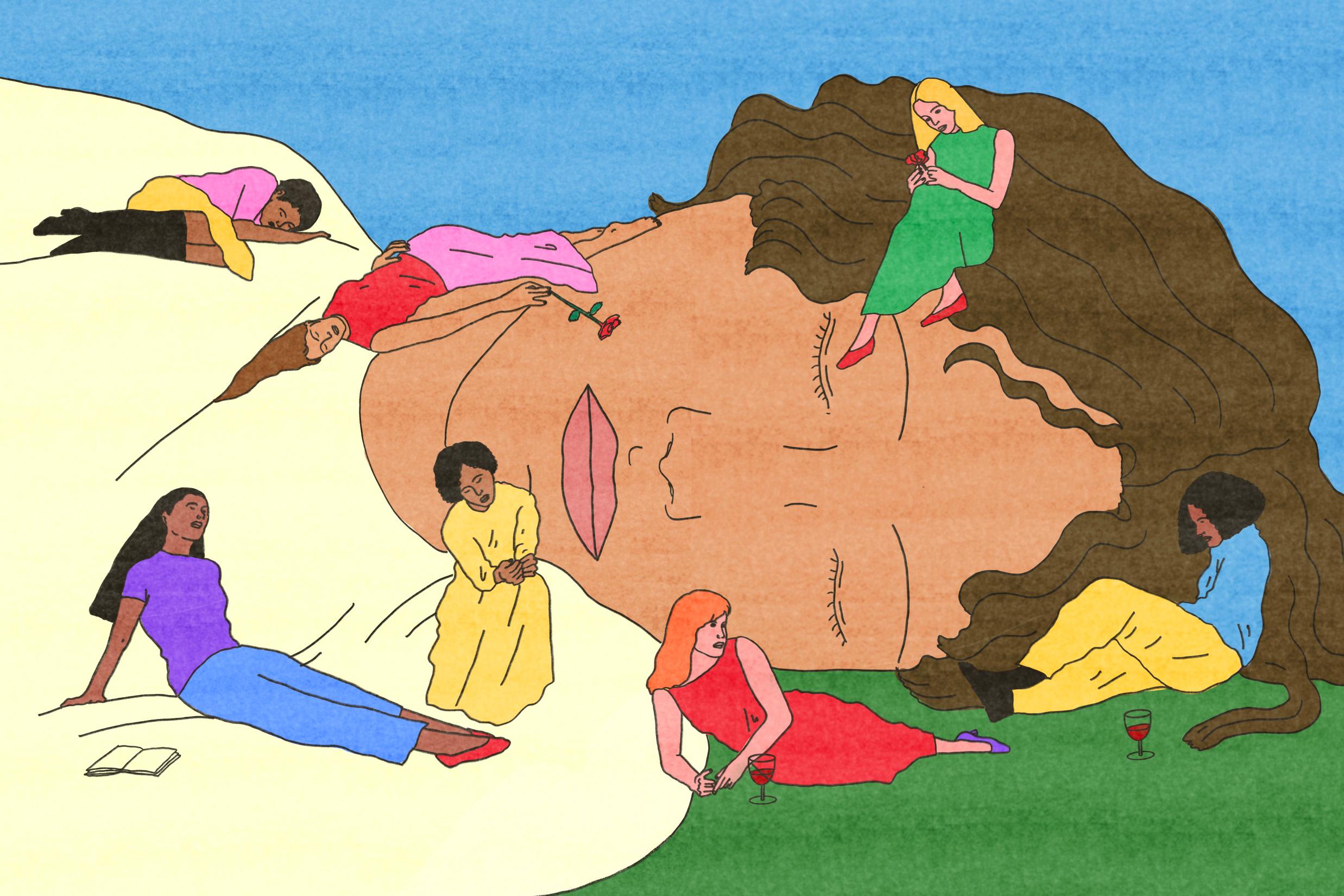
“The Byline cover was so fun because, ever since I was a kid, I’ve known about artists doing covers for magazines,” she says. “It felt like an artistic rite of passage.” Brianna mentions the Salvador Dali Vogue 1939 and 1944 covers as sources of inspiration. Generally, she embraces placing her art in a commercial setting, saying the more you can share your perspective in different mediums, the better. “I did a whole different version of this painting—it was very blue.” Brianna walks to the other side of the studio and shows me a cooler-toned version of the cover piece. “I dropped water all over the painting and ruined it. But then I realized the sky needed to be orange instead. And originally the egg wasn’t black, but I thought it was beautiful to have these dark elements against this soft background.” The Garden of Earthly Delights, the triptych by Hieronymus Bosch, was another reference Brianna spoke about. “For me, he is one of the best storytellers with painting. You can keep discovering new narratives in his work,” she says. “One of the things I think a lot about is how someone can find a story in my pieces. A story you can follow and live with for a very long time. I’ve always wanted that to be part of my work.”
Since leaving Texas, Brianna’s ideologies have morphed and coalesced into her inner compass. Her belief system draws upon her origin story— taking the kindness of the South with her—and her New York life. “Many people here have in some way been cast outside of a tribe,” she says. “In Texas, there’s this fear of being cast out, and New York is the only place I’ve ever been where it’s just everybody, every culture, and that is so beautiful to me.” Brianna says that although the outside world told her that you have to hit specific milestones as a woman to be a viable person, she knows that is a distraction from something bigger. She knows that women are more powerful than that. “Oppressed groups are better at tapping into their inner femininity and masculinity because they have to,” she says. “And as a result, you have more power. You have a more expansive world inside of you.”
At the core of her belief system, though, is one truth. At the center of everything, she says, is love: be nice to people, do no harm, set your ego aside. “Everything is ruled by this,” she tells me. “It’s a moral guidance.” She leans on that truth in everything she does, in how she follows her instincts and interests. “Now I know that when I’m being moved toward something in any way, it’s a spiritual guidance and not my own,” she says. Creating any world, after all, is a divine act of love.