The Dream House
A recurring childhood dream becomes an adult investigation into reincarnation, imagination, and the strange authority of the stories children tell.
By Mary Neely
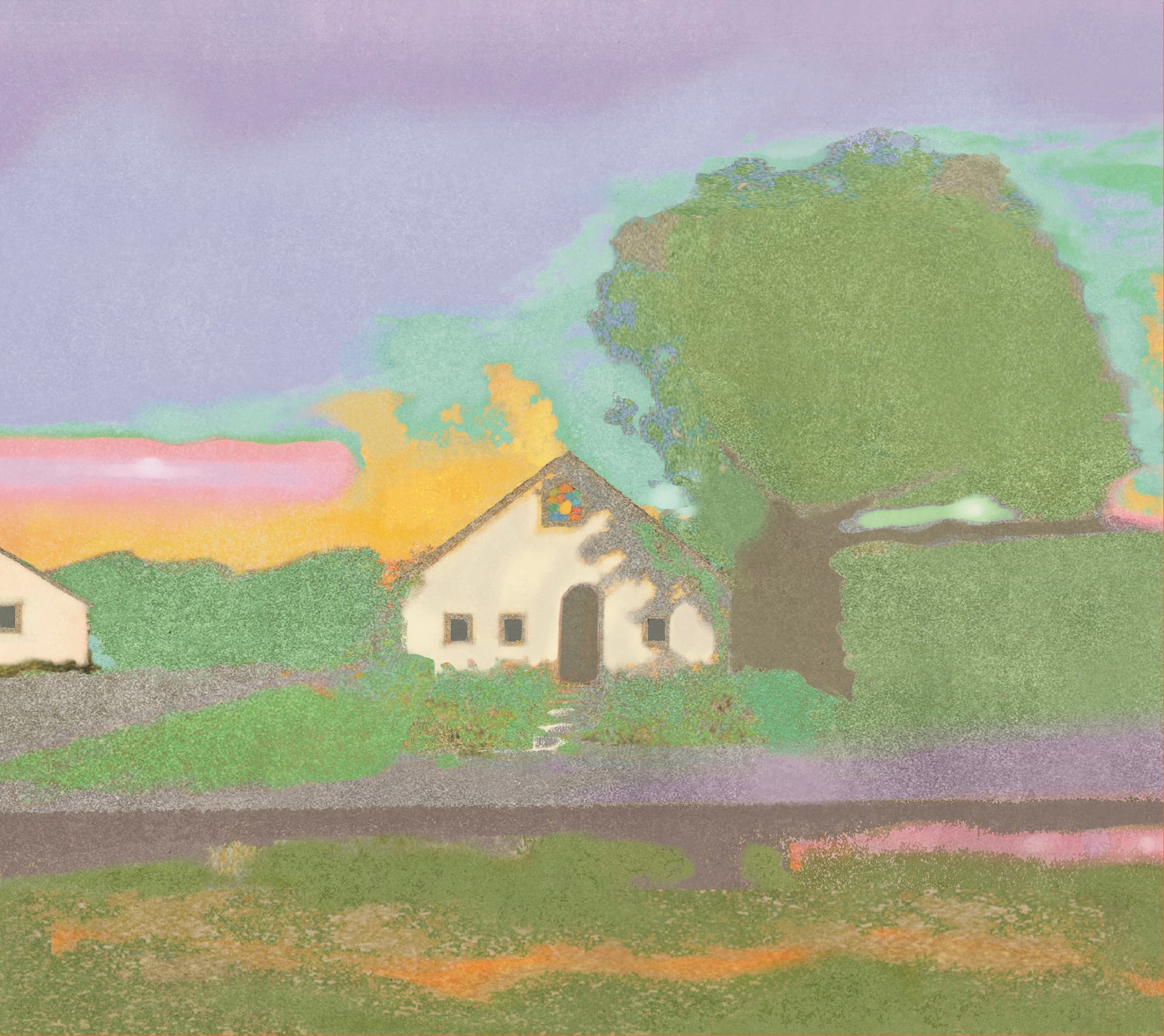
Illustration by Vincent Longhi
Published
This essay appears in our Out of Body issue, on stands now. Order your copy here or visit our Instagram for the latest updates in stockists.
My first dream was a nightmare. It took place inside my hippy-adjacent Southern Californian preschool, where a girl with tattooed parents routinely convinced me that she needed to pour sand in my mouth. In the dream, it was lunchtime. I went to my cubby, where my bright cherry-red backpack always sat, to get the peanut butter and jelly sandwich my father always made. Yet when I opened my backpack, the sandwich wasn’t inside. Looking to my left, I noticed a boy in my class, whose name I have long since forgotten, and I knew he had my sandwich. The type of factual knowing that only occurs in a dream, that calm atmospheric background relaying given circumstances.
When I told my teacher about the theft, I was met with denial–that the boy didn’t take my sandwich. That I was making it up. My stomach churned, throat tightened, lip quivered. I could feel tears fighting to stay inside my eyeballs as I screamed that he took it. Because he did! I know he did! Suddenly, I was wide awake with a puffy face in my grandmother’s Palo Alto apartment, 350 miles away from Altadena. The tears formerly reserved for my stolen peanut butter and jelly were now the manifestation of a horrifying new confusion: how had I just been in my preschool? It was so real, every detail of the space exactly as I had known it to be. I could not reckon with suddenly being somewhere else, at a different time of day, in a different reality. My cries woke my father in the dark. We were sharing a queen bed, and he told me I’d had a dream. He then had to explain the concept of a dream. It was 1995. I was four years old.
The preschool burned down in 2025’s Eaton Fire and my grandmother’s apartment was sold to a Silicon Valley tech magnet in 2017, yet both are still crystal clear in my mind. I’ve always had a vivid imagination. Memories and details are loud. In kindergarten, I tricked my teacher into thinking I could read by memorizing the text of Dr. Seuss’ The Lorax simply by associating what I had heard with the book’s drawings, knowing exactly when to turn each page. My father would often call me at my mother’s house when he was on business trips and ask me to tell him about movies I had recently watched. I could relay every plot point of every film because, as I was telling him, I was watching the whole thing again with my eyes closed. So, when I began to have dreams about the same place, a quaint white house with a pointed roof and stained glass at the top, it became increasingly unclear whether it was somewhere I had actually been, or simply something in my imagination.
They weren’t recurring dreams in the sense that the same thing wouldn’t happen every time, it was just always in the same place. The house was on a pastoral-type street, paved, maybe. There wasn’t a front yard, just wildflowers and grass that hugged the foundation, spilling slightly upward onto the front walls near the main door. The white exterior was textured, smooth with slight defects in the way that concrete isn’t always perfect. There were some windows, small, on the lower half. The kinds with lines in the center going both up and down. Symmetrical. A simple brown pointed roof drew attention to the small red, green, orange, and blue stained glass, which wasn’t a particularly well-defined shape. Not square or round, more like varied shards had been placed together by someone who simply liked the idea of them being there at all.
Once inside, the house remained quaint, inviting. A living room with a taller ceiling than the rest of the house had a protruding, rounded fireplace and a large dark wooden mantel adorned with framed photographs, ostensibly of friends and family members. My family members.
I lived in this house with my two parents—parents who were not my parents in the waking world—and it was calm. I knew this just as I knew the boy had stolen my sandwich. There was a small bedroom we all shared, and sometimes, in the light-yellow-floored kitchen, there was a metal highchair for me to sit in and eat meals. Nothing of note really happened when I dreamt of this place; in fact, it usually felt like I was visiting, observing a familiar tranquility where everything felt quintessentially quotidian. When I would wake up, in the moments before remembering I was a little girl with divorced parents who hated each other in separate Los Angeles apartment buildings, I would ask either my mother or father why we had moved away from the house with the stained glass. They didn’t know what I was talking about, answering with something like, “We never lived in a house like that,” or “What are you talking about?” The dreams ended around second grade, and I moved on. Until adulthood.
I was watching season 9, episode 8 of Unsolved Mysteries on my laptop in bed and I was high. The 80s synthy orchestral theme played under Robert Stack’s eerily rich voice as he described a Labrador who saved a man from drowning before a white-light-transition cut to a reenactment of a mother holding her son on her lap, his eyes closed as if in a trance. “And from the realm of the unexplained, a young boy describes in vividly accurate detail, the death of a Civil War soldier. A mother is stunned by her two-year-old daughter’s chilling account of a freak accident at a watery grave. Are these remarkable stories proof that reincarnation is real?” Mind tingling, mouth dry from the weed, blurred images of a blonde little girl in a car seat and a figure falling feet below a lake’s surface adorned the screen before the show’s iconic logo shimmered through lens-flared smoke.
Robert Stack, in a black suit and a mauve, patterned tie, appeared in a dimly lit room, slowly walking forward. Behind him, a stained-glass window. The hairs on my forearms stood straight up as he spoke directly to the camera, “Reincarnation is a theme that runs through all the cultures of the world. There is no proof, unless you believe the accounts of those who have no reason to lie.” The segment detailed the phenomenon of children accessing memories from their past lives and how the mother of the reincarnated Civil War soldier had devoted extensive time to finding other children with similar experiences.
“Children Who Remember Previous Lives,” “Return to Life,” and “Old Souls” are all names of books that detail those between 2 and 7 years old, who can unexplainably describe spouses, geography, investment firms, plane crashes— things that shouldn’t be in their memory but somehow are. In a separate browser tab, I read about 7-year-old Cade, who reported dying in one of the 9/11 plane crashes; 4-year-old Lisa, who wouldn’t stop talking about her husband Miguel; 5-year-old James, who spoke of a tragedy near Iwo Jima. Turning back to Unsolved Mysteries, Colleen, whose 3-year-old son Blake recounted in vivid detail being hit by a truck, probed her son, insisting that he might have seen what he was telling her about on TV. “No!” he cried, irritated, “It was before.” The use of the word “before” seems to be common among children who experience this phenomenon, usually stated with a staunch calmness. Of course, a skeptic is included in the episode, offering a rebuttal. Barry L. Beyerstein, a neuropsychologist with a blonde mustache and intellectual Midwestern drawl, chalks this all up to one thing: imagination. “We don’t give kids enough credit for being creative, and all kids fantasize, to a certain degree. So, the chances that they’ll come up with something startling and unusual in that kind of rich fantasy life is very high.”
With an original airdate of September 1996, the episode played during the time period of my recurring dreams. I wondered if my parents had seen it on television, if they had made any connection to me and this house I had been describing to them for months. I imagined an alternate reality where my mother was inspired to call a hypnotist to our apartment, just like Carol Bowman, the mother of Chase, the former soldier who died in battle behind a 19th-century cannon. What if I could have gone deeper out of my own body, discovering more about my possible past life that was calm with parents who didn’t yell. Barry L. Beyerstein’s words echoed. Or maybe it was just my imagination creating a coping mechanism for growing up in chaos. Perhaps my mind was protectively transporting me to a place that felt safer.
Robert Stack was back in front of the stained glass. “If you’re not listening to the stories your kids tell you, perhaps you should be.” I debated sending the YouTube link to my mother, but decided against it. If you have any information about a girl with nice parents who lived on a quiet, potentially paved street, in a little white, wildflower-dotted house with a stained-glass window, DM me on Instagram. I’d like to know more about her.