Why Does Acceptance Feel Like a Formula?
The unspoken rules of being an upper-echelon gay involve a theory: to belong, you need two out of three.
By Karan Brar
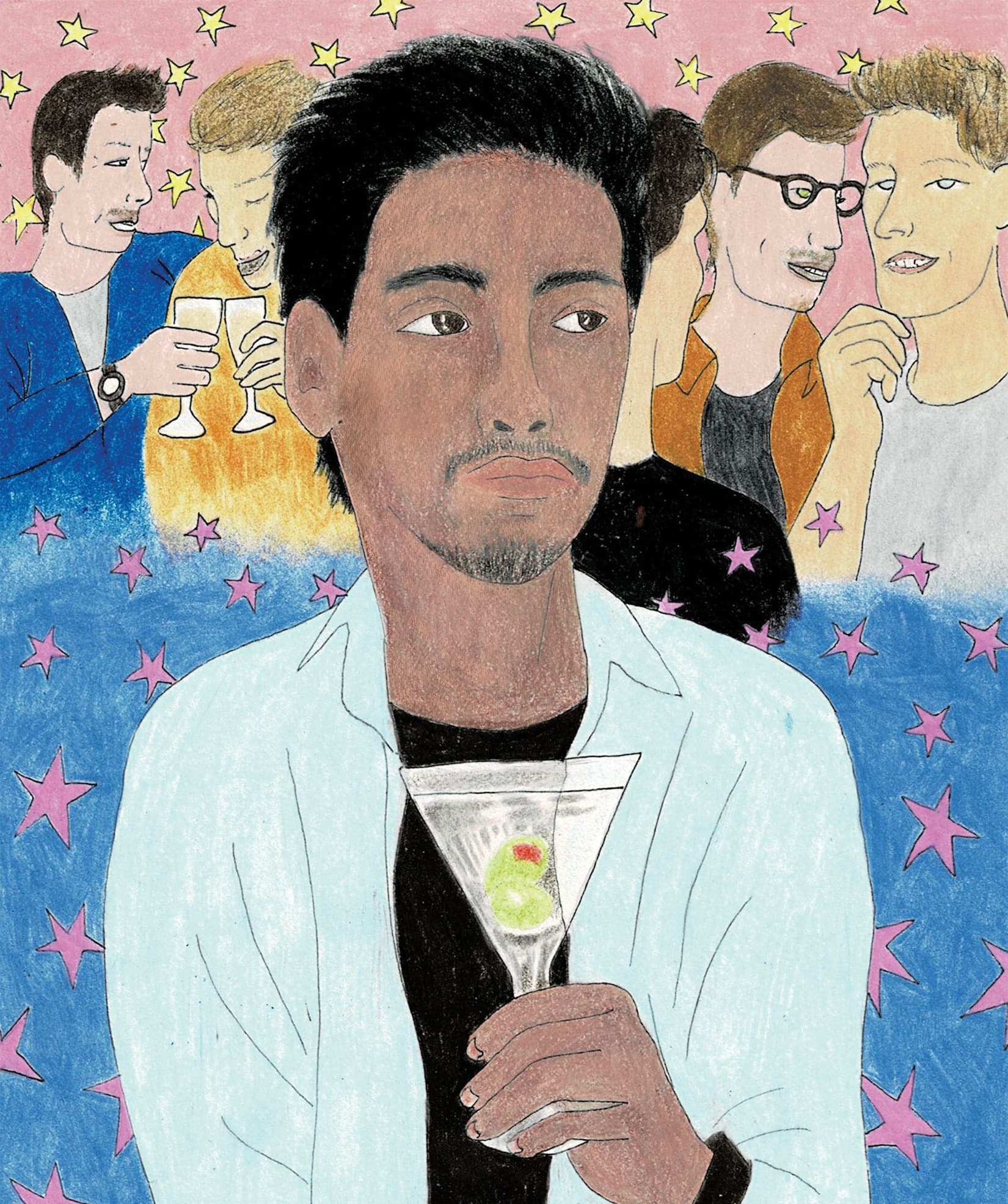
Illustration by Cory Feder
Published
This article appears in our Out of Body issue, on stands now. Order your copy here or visit our Instagram for the latest updates in stockists.
From a distance, I can already hear the song of summer blaring and people mingling with raised voices on the verge of yelling—all signs of a fun evening. Just as I approach the entrance, I freeze in my tracks because I see him. He’s an actor, my current crush, and most importantly, an upper-echelon gay.
This type of gay man—and his accompanying friend group—occupies the top tier of the social hierarchy in gay male spaces. Their good looks leave you unsure if you want to be them or be consumed by them. Their lives on the internet appear so unattainable that understanding how they bankroll it all becomes your “Roman Empire”. And most of all, their social calendar is always stacked with exclusive events you, deep down, want an invite to. In short, they’re the cool kids at the end of the elementary school lunch table. That’s the level of unattainability they exude.
Being in proximity to this man overwhelms me. He’s in his mid-thirties with the stature of an all-American jock, and a presentation that some would consider straight-passing. I prepare myself by reaching for a lower octave in my voice that’s unnatural to me, straightening my back in the hopes of growing a few inches taller, and attempting to recall any big words I know so I can seamlessly insert them into conversation.
But I know this balancing act isn’t sustainable, so I do what any young bisexual man does in this situation: avoid eye contact and walk past my crush. As I squeeze through the crowd, I try to locate my friends to no avail. We’re not at our go-to bar, so I feel like a fish out of water, desperate for them to emerge and save me from my awkward gawking at the crowd around me. After shooting off a “wya” text, I look up and see yet another upper-echelon gay, who has materialized from his glamorous life on the internet and into this room. Before I know it, another appears in my line of sight, and another, and another. This has to be some kind of bizarre coincidence.
Once I finally take in the room properly, I realize I’m surrounded by gay men who had previously only existed on my Instagram, where they share photos of parties, soirees, and trips they only take with each other. Miraculously, they’re all here in one place, right in front of me. Smiling, flirting, and laughing together. Somehow, I’m not on the outside looking in anymore. I had crashed one of their exclusive parties without knowing it.
Regardless of the coincidence, had entering this room without raising an eyebrow been proof that I could now be one of them? Was the universe rewarding me for my years of obsessive self-improvement? Had I finally reached the level of exceptionalism that would make these men notice me?
When I initially came out of the closet, I was forced to face the disappointing reality that there wasn’t a harem of men waiting to date or embrace me like I had hoped. Instead, I felt like I was that little kid again, staring at all the popular guys in my class huddled together at that lunch table. Wondering to myself what I could say or do to get them to accept me, because maybe if they did, I’d finally be able to shed the feeling of undesirability that's always haunted me.
Ever since I was a kid growing up in the white suburbs of Seattle, I’ve felt this divide between me and other boys around me. One accentuated by the food in my lunch box, the lack of American holidays my family engaged in, and most obviously, my South Asian features. My peers were on the other side of this divide, connected by a normalcy I couldn’t obtain no matter how hard I tried.
Similarly, the last few years I’ve felt like I’ve been watching from the sidelines, secretly frustrated as some of my peers got lucky enough to be welcomed (see: selected) into these elusive spaces. The connecting thread amongst them was no longer the shared normalcy from our boyhood, but rather some form of extraordinariness. Maybe this is the opportunity I’ve been waiting for: to charm the space’s gatekeepers into granting me membership by displaying my new and improved self. I’ve been sober for some time now, my body having changed because of it, and with the massive strides I’ve made in therapy, I’m eager for them to meet this version of me that I’m closest to being proud of.
As I excitedly take in these men and consider which one I should approach with my pre-rehearsed conversation starter, I’m hit with the reality that this isn’t a test. There is no perfect combination of words, jokes, or actions to get these men to be interested in me. The decision has already been made. It becomes obvious that all the men in this party aren’t tethered together by an overwhelming inimitability, but because they had at least two out of the three following traits: Whiteness, Beauty, and Novelty. The Whiteness is…well, being white. Not much more to say about that. The Beauty is having a body and face that meet the gay beauty standard (bonus points if you’re a person of color with Eurocentric features). The Novelty is having wealth, a fancy job, or “refined” talent that adds interest or power to your identity (think: a talented singer on the cusp of making it big, an important executive at a tech company, or rich kid with a money-sinking “side hustle.”)
What I’ve been calling “The Two-Thirds Rule” helps articulate why the occasional person of color or odd man out isn’t a sign of true inclusion. Rather, he’s a man who has met the criteria, or a token used to fend off accusations of exclusivity. He’s only allowed to orbit and provide the occasional comedic relief.
It's also hard not to notice that these men seemed to be connecting, regardless of their relationship status, on the basis of attraction. And these three traits form their criteria for attraction. Sure, they might have shared interests, but I’m certain that in the privacy of their own therapy sessions, they, too, could admit that a kernel of attraction exists within the foundation of their connections. It’s why all their friends look eerily similar to their boyfriends. But who can blame them? Haven’t we all tried to defuse a crush by settling for being in proximity to them?
In their world, desirability equates to worth. Only then are they willing to extend the warmth, trust, and curiosity that every new friendship requires. In some ways, this idea brings things into focus for me. Up close, I see the way they avert their eyes when a man they deem lower on the social totem pole attempts to strike up conversation. They’ve done it to me time and time again. As shiny as their world might look from the outside, I don’t think I’ll be offered the relief of acceptance I’m looking for amongst them—the kind that’ll make me feel like I’ve arrived.
My friends eventually emerge, snapping me out of my internal TED Talk, and decide to leave (one of them ran into an ex-situationship and is in desperate need of a venue change). As we cross the street, I stay back a moment longer to take one last look at what I'm leaving behind.
For a moment, I’m disappointed to be leaving. I hate to admit it, but there are still remnants of my desire to be accepted by these men. I fear this might be my only opportunity to make a Hail Mary impression before they disappear back into my Instagram explore page, to feel a sense of worthiness that I deep down believe only holds weight if they offer it to me. I can no longer avoid the fact that my desire to be perceived as special directly contradicts my values around inclusion.
Ending up at that party wasn’t a coincidence. It's naive of me to write it off as a stroke of luck that my friends chose this bar the same night these men are hosting this party. It's actually a reflection of all the ways I’ve been consciously and subconsciously inching towards this room. You can see it manifest in the types of men I fall for—they all look like members of the club. My current crush at the entrance is the prime example. I continue to find immense validation when I become an object of one of their desires. Even if they repeatedly put me through a cycle of being pursued, admired, and inevitably disregarded, leaving me to wonder if their attraction to me was some kind of anomaly they're ashamed of deep down.
In all of this, I’m undermining the fact that, to the outsider’s eye, the way I’m able to exist in this space without raising an eyebrow is proof that I do fit the mold. I’m not saying I’m anything desirable—god knows my dating apps tell me otherwise—but maybe being an upper-echelon gay is just a moving goal post, and there will always be someone at the end of the lunch table we hope will accept us. My own habit of pedestalizing and demonizing these men only enables the dynamic.
All this time spent looking for more has unintentionally led me to ignore where I am welcome, included, and valued now. Maybe this momentary glimpse into a world that has always made me feel like an outsider is a reminder that I just need to look across my table and see who's sitting right in front of me. These individuals—the ones who look, sound, and express themselves similarly to me—are the reflection of myself I need to stop avoiding. If I can just do that, maybe I’ll eventually shed that ever-present feeling of undesirability.