Reducing
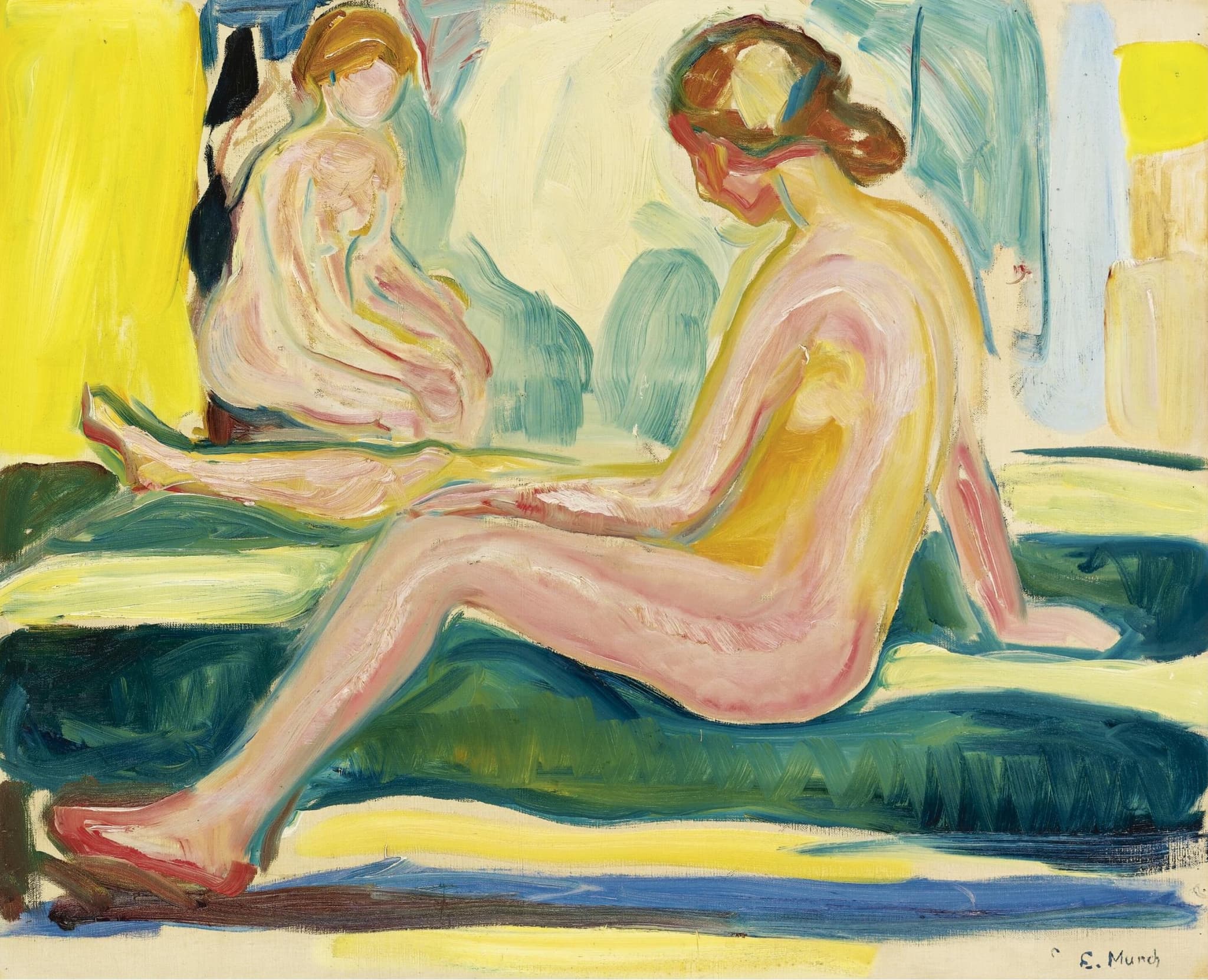 Edvard Munch, Seated Female Nudes, 1917
My father had been painting nudes.
I found out while sitting in the park scrolling the Times arts section. I was looking for a review of my own work at Gallery44. Instead I found a headline announcing “76-Year-Old Bernard Babić will Open New Show in October.”
The first paragraph explained that the Serbian import, known for his abstract junkyard landscapes, had been gathering college-aged women in his swanky Seaport studio and painting them topless.
The piece included a quote from one of the models. “Bernie is a special kind of artist,” she said. “He makes us all feel really confident.”
I had intended to visit my studio in Flatbush that day. I had been intending to visit my studio for several weeks, but a Caribbean take-out place had opened across the street, and the volume at which reggae came from the outdoor speaker made painting difficult. I’d tried to adjust my mind frame to accommodate the noise. “These are the sounds of a city,” I told myself. “I am a city painter.”
This line of thinking proved toothless. I spent days in my studio fantasizing about becoming a country painter, before filing an online noise complaint with the 75th Precinct and returning to my apartment.
I mapped a route to Flatbush from the park. It would take me nearly an hour to get there, and it was already afternoon. I changed the destination to Lena’s address. Fifteen minutes. I called Bernard, but he didn’t pick up.
Lena worked at home as a listings manager for an online advertisement broker. She made an amount of money that confused me.
She buzzed me in and, climbing the stairs, I worried about the review of my opening at Gallery44. Nobody who’d seen my paintings so far had much to say about them, besides noting my father’s influence. My paintings were concerned with vertical space, I told myself, and his were horizontal. Bernard’s agent Jerome, who’d helped me get into Gallery44, said they were “remarkable.”
Lena was wearing her sex outfit when she answered the door. It was a pair of black nylon Adidas shorts which extended perfunctorily below her ass. And a yellow tube top. It wasn’t surprising that Lena was wearing her sex outfit, since we only ever had sex, but for some reason that afternoon it offended me.
I lingered in the entryway, frowning.
“What,” she asked. “Do you want to go to the room?”
I didn’t want to. Lena’s bed was extremely low to the ground which, I had explained to her before, made me feel like I was in hell.
Unable to express my desire to not go to the room, I followed Lena.
She closed the door and pulled the sheer curtain across the window.
“Are you good?” she asked.
I sat on the edge of her low bed. My knees were basically even with my face. I worried that I looked ridiculous.
“My dad has been painting nudes,” I informed her, standing up.
“Women?”
“Yep.”
“Isn’t he like, a hundred?”
“Yeah.”
Lena sat on the edge of her low bed. She looked totally ridiculous, and I was glad to have stood until she started tugging at my zipper. I walked over to the window.
“Have I shown you my paintings before?” I asked.
“I don’t remember.”
“Great.”
I thought about my so-called paintings, their supposed vertical space, my alleged opening at Gallery44. I considered going to Gallery44 in disguise, pretending to be a famous art collector interested in my own work. Then I realized I’d stolen the idea from an episode of a sitcom.
“Are we going to fuck?” Lena asked.
She took off her shorts and yellow tube top. I tried not to picture my father’s nudes, to imagine what they looked like. He’d never painted human figures before.
After two weeks passed during which I neither saw Lena nor visited my studio in Flatbush, I discovered a new source of pleasure. Around seven o’clock one evening it occurred to me that I hadn’t eaten all day. My mind felt sharp and vast. My thoughts articulated themselves confidently, in fully formed sentences.
“If we had a sixth toe on the interior sides of our feet, life would be completely better,” I thought.
Since I wasn’t painting or having sex, my body had been converting food into aimless energy—power without direction—anxiety. A linear relationship had formed between my intake of food and my concern over Bernard’s show.
I ate a small bowl of rice and black beans. For a little while after eating I had to sit on the floor of my apartment and refresh the Times arts section—the review of my opening at Gallery44 still hadn’t materialized—and practice diaphragmatic breathing. Soon the focused hunger returned, and I sketched the refrigerator before watching TV in bed.
The days that followed were animated with a kind of rebellion. Having limited my eating to one hour between seven and eight, I no longer felt oppressed by the nudes. I had my own project.
“Bernard’s show will enshrine him as one of the most important Eastern European American painters of our century,” I thought.
“I will have to go to Bernard’s show and look at his paintings of tits,” I thought.
“I won’t be able to look at a real-life naked woman for many years,” I thought.
Before I gave up eating, these thoughts had caused me great unhappiness. They screamed at me when I thought of Lena. They froze my fingers when I felt the urge to paint. But on an empty stomach, the thoughts simply rolled into my head-screen like title cards and then faded away.
None of my paintings at Gallery44 have sold. I don’t care about them anymore. I’ve lost a considerable amount of weight and my ideas about painting have changed radically: I want to paint emaciated animals—withered bear cubs, a shrunken stag in a meadow. The figures have been appearing in my dreams, fully formed. I need to paint them.
My phone rings.
“This is Sergeant Luntz from the 75th Precinct,” says the phone.
“Okay,” I say.
“I wanted to update you on the status of your online noise complaint.”
I start getting excited. The timing is mystical, symbolic. Things are turning around.
“We haven’t had a chance to get over there yet,” says Sergeant Luntz.
“Oh, thanks.”
I lay down on the floor.
I call Bernard, but he doesn’t pick up.
I consider calling Lena, maybe even apologizing.
I consider eating lunch, but I don’t want to. I don’t want anything. I want to paint starving animals.
I walk slowly in circles around my block. Bernard’s show is huge, inevitable. My hunger seems puny in comparison. I try to think of other things I can give up, but I’ve already eliminated eating and sex with Lena. Is there really nothing else? I take out my phone and refresh the Times arts section. There’s a new piece about a street artist who builds six-foot cairns outside City Hall.
I had different desires as a young man. I wanted to work for a Big 5 consulting firm. I fantasized about wearing business-casual outfits and living in an apartment building with a gym. My pace quickens and the circumference of my block starts to feel shriveled and insufficient.
I map to my father’s Seaport studio. Twenty-five minutes. I’m lightheaded.
On the train I plan an admonishment. I’ll call him unseemly. I’ll discipline him.
“What the hell are you doing?” I’ll ask.
During the short walk from the train station to the glass tower that houses Bernard’s studio, I have to stop three times to catch my breath.
In the lobby I approach the security desk, where two guys in huge suits are stationed.
“I’m here to see Mr. Babić on the thirty-seventh floor,” I explain.
“Bernie say no visitors,” says one of the security guards. He sounds Russian or something.
“One second,” I request. I start scrolling through my photos until I find one of me and dad. We’re standing at the edge of a cliff, arm in arm, the sea huge in the background. He’s wearing a fishing hat and the tips of his mad white hair are poking out at the bottom.
I show the guard the photo.
“Ahh! You Bernie’s son!” he says, fist-bumping me.
“I’m a painter,” I explain.
He nods. “Still, though, uh, no visitors.”
I envision a big wall, a repressive Soviet conglomerate, these guys and Bernard. I hear the rumble of incoming American bulldozers.
“Let me in,” I insist. “I have to see my father!”
The guard whispers something to his coworker. He says something into his walkie-talkie.
“You have to let me in!”
I am ejected from the rotating doors in a lurch. My insides twist and complain. I stumble down the sidewalk clutching at my diminished stomach. Then it comes; a yellow, hepatic serum scales my esophagus and spills abstractly over the cement. It makes a meaningless, unconvincing puddle at my feet.
A blast of wind comes down the street. October.
My father’s show is in a warehouse space by the river. I arrive around seven, having spent the day sitting on the floor. I’ve developed an intermittent ringing in my ears. The sound of hunger, I suspect. They ring and pink in the sweep from the river.
People mass at the entrance to the warehouse. Bernard apparently has fans in every age group—ancient aesthetes in silver finery shiver next to monochrome scenesters. I wait with them, gaggled at the door until the line starts funneling in.
I see my father before I see the paintings. He’s at the far end of the warehouse, surrounded by four tall women. His models I guess. They move as he moves; a phalanx drifting from painting to painting.
The paintings. The nudes. What can you say? Their power is immediate—people scatter to the walls to see them close-up. They fan themselves. They point and notice. They bow, reverent.
The figures are plump, with softly domed stomachs and sprawling under-tit shadows. They’ve eaten all my food, I think. There is a fullness of the city in them, too. Refractions of sky-scraping cranes and rocketing hoist elevators animate the skin, dancing like translucent tattoos across clavicular chasms.
Jerome is standing by an hors d’oeuvres table and I approach him. The smell of crackers and cheese sickens me.
“Pretty interesting,” I say, lamely.
Jerome nods. He’s a good guy, I think. He really tried to help me. The thought—that Jerome is a good guy who tried to help me—makes me emotional, and I hold back tears.
“Working on anything new?” he asks.
“I’ve lost nearly forty pounds,” I tell him.
He looks me up and down.
“Can I speak to my father?”
Jerome wrinkles a bit. “I’d let him mingle first.”
The models float by and Jerome spins off, caught in their orbit.
I pick up a cracker and pretend to eat it, chewing indefinitely while scrolling the Times arts section. There’s a new piece about a Dutch weaver who makes oriental rugs out of compost. The ringing in my ears is somehow reverberating off the warehouse walls.
I breathe deeply.
I consider introducing myself to people as “the artist’s son.”
Underneath a golden portrait of a prone backside, an old woman is standing, transfixed, possibly crying.
“What’s the matter,” I say.
She tells me how she came from Estonia or something, how Bernard is the last of his kind, how there will never be another like him.
I consider calling in a bomb threat on the gallery.
It’s time to have a word with the old man. I catch him waltzing around with a glass of red.
“Did you make it to Gallery44?” I ask.
Bernard nods and smiles. I suddenly hope he’s lying.
There’s a long silence during which I imagine my paintings being ground into a paste by an industrial pulverizer.
“You look too thin,” Bernard says. “We’ll have dinner soon.”
Someone I don’t recognize hugs him from behind and his face lights up. He looks pretty great for his age. I wonder if I’ll age like that.
I step out of the warehouse. There’s a voicemail from an unsaved number on my phone.
“We’ve spoken with the owners of Bad Gyal Tropical Palace,” says Sergeant Luntz. “They’ve agreed to turn the music down.”
I map to Flatbush. Forty-three minutes.
It’s freezing in my studio. I left the window open after my last visit, which was in August, and now the floor is cold and covered in dust. Many of my paint tubes, the caps of which I often misplace, are stiff, the paint mealy and crystallized inside. My brushes are dry and wiry.
I take a garbage bag from underneath the sink and start filling it with my things. I have to break the canvases over my knee to fit them in the bag. I fill another, then another. I take the bags down to the basement and stuff them in the bins. Then I go to sleep on the couch.
I wake up around noon and open the Times arts section. There’s a new piece with the headline “Babić Triumphs in Nude Show at 76.”
I skim through phrases like “lens of Slavic fantasticism,” “cascading worship of the flesh,” and “late-period opus.” At the end of the article is a single-sentence paragraph that reads “Babić’s son, also a painter, had a show last month at Gallery44.”
It’s warmer today. The sun comes through the studio’s single window and spreads across its humming emptiness. The reggae rhythms are quiet and unobtrusive. For the first time, I notice a sweet and mysterious smell accompanying the music.