A movie that explores lonliness, pokes fun at the homoeroticism latent within hypermasculine subcultures, highlights the weight of our constant proximity to gun violence, and finds comedy in the perversions that grow from misplaced human emotion.
Published
Our Hero, Balthazar is now playing at select theaters across the country.
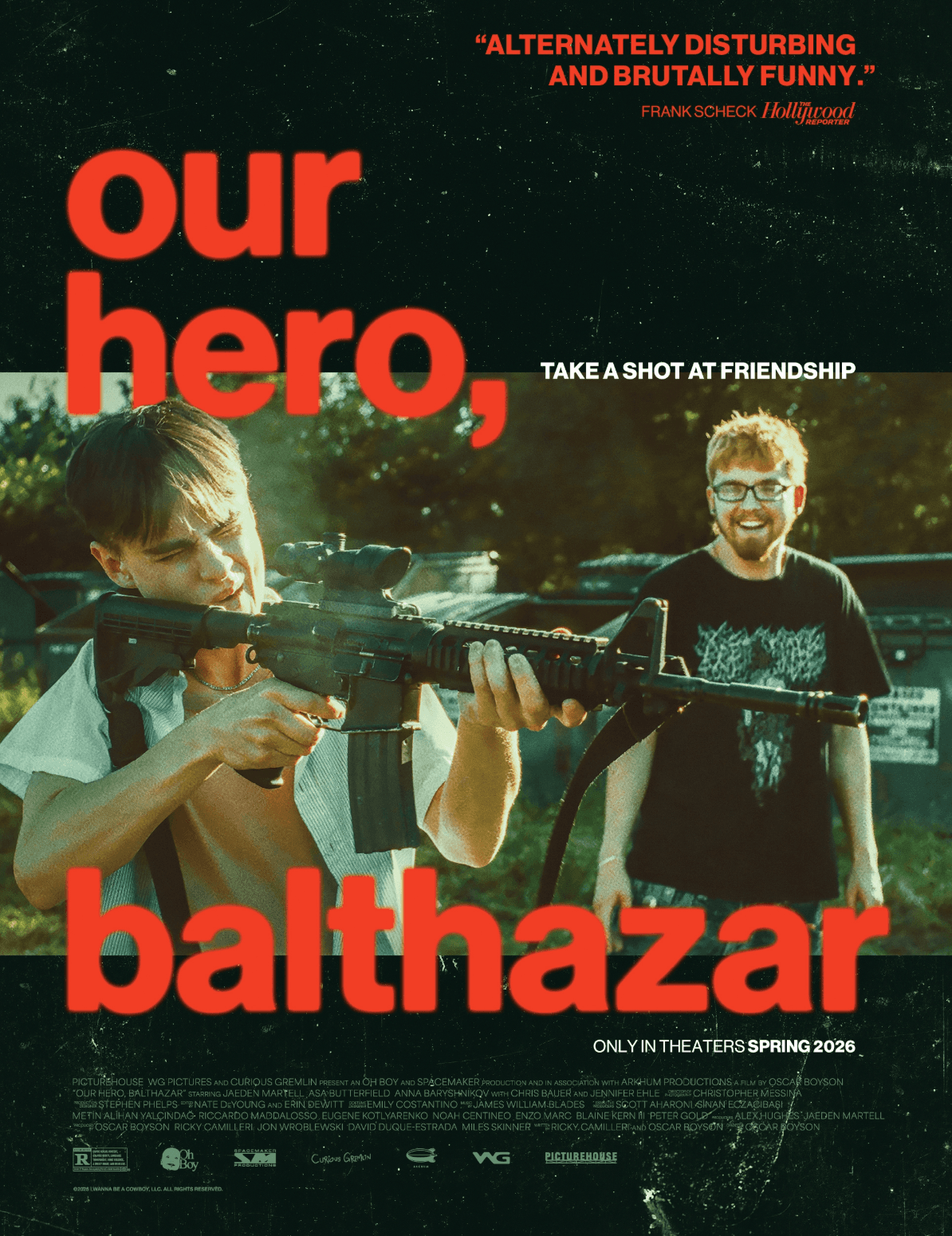
Within the tragedy of a school shooting in a far-away state, absent fathers selling testosterone pills, timelines of live-streamed tears, performative politics, Edgelord memes, and the promise of stopping another mass shooter as a birthday weekend adventure, director Oscar Boyson’s debut feature Our Hero, Balthazar delivers an engrossing and satirical tale on the realities of American boyhood in its most unfiltered form.
Starring Jaeden Martell and Asa Butterfield, the film follows Balthazar, a New York private school kid whose performative Instagram content catches the attention of a Texas “incel” named Solomon. What follows is a narrative that sacrifices the safety of moral benchmarks for a raw, clear-cut exposure of dark adolescent troubles.
The ever-increasing political polarization of the country, and the film industry’s mounting anxieties about a film being marked “politically incorrect” has quietly pushed recent films capturing modern times to tone down the very elements essential to capturing the world inside teenage America. The repressed grief around missing parent figures and rage that only finds space for itself online. The sensitive, isolated boy pulled through dark-humor pipelines toward ideations of violence. The psychopathic boy finding release in an internet-hero-activist-empath persona. Our Hero, Balthazar flips the script and puts back the pressure points that define this generation into dynamic storytelling.
The film manages to do this all while remaining genuine, and consistently funny. In a culture where America famously processes devastating headlines through irony and detachment, Boyson manages to break through by leaning into that reflex, meeting the audience in their comedic remove to make space for a deeply introspective commentary about masculinity, coming of age, and televised tragedy all while keeping the audience on their toes between laughs.
This is why many have applauded the film for its “daring” approach; a label Boyson himself is reluctant to embrace. In his own words, the film never felt like a provocation. To him and co-writer Ricky Camilleri, it simply felt like the story that needed to be told: “Financier types will gaslight you into believing your own script is more controversial than it is just because they see ‘school shooting’ in the logline. But we knew our hearts were in the right place and trusted that if we presented the ideas, stories, and characters in a funny and accessible enough way, the audience would enjoy it too.”
After watching the movie through a screening hosted by 3rd Space — a New York City collective and event series for artists and founders — I found myself talking through the film with the boy sitting next to me. He leaned in and said: "I just kept thinking something crazy was about to happen. Like he was about to shoot everybody or something. And then it wouldn't, and I just kept waiting for it."
To which I thought “so did Balthy?!”
There we were, a room full of young New York creatives, watching a privileged New York kid ride around Texas with a boy he believed was a school shooter, all of us collectively bracing for an atrocity. Waiting for the violence to arrive so the story could mean something; for Balthazar to get his moment of heroic resolution. Balthazar was waiting for violence to give him a chance to sweep in while we were waiting for it to be entertained. It hit me then how precise this was on the filmmakers to engineer an anticipation that mirrored our very own appetite as viewers, making the audience complicit in the very hunger the film is interrogating. Why were we waiting for the scandal to erupt to make it feel real? Why are we pushing Solomon toward something he clearly doesn’t truly want to do? And how do we approach these often hostile calls for help from the dark undercurrents of the internet before an atrocity happens?
The caricature of the incel is used to show how a young boy like Solomon is constantly pushed into this stereotype by the people who know him, as he seems to fit the criteria, and plays into it himself. This is where the film takes its most devastating turn as we watch him struggle to find solace from his familial and economic struggles, and ultimately finding no option to escape the narrative casted onto him even when he chooses against it.
It is here that Boyson and Camilleri implicate us in how we watch young men, on and off screen. Through their refusal to sanitize male adolescence, they expose how the nation, the film industry, and the audience are all complicit in writing off and misunderstand all-American digital boyhood, all while taking us through the manosphere, poking fun at the homoeroticism latent within it, highlighting the weight of our constant proximity to gun violence, and finding comedy in the perversions that grow from misplaced human emotion.
I spoke with writer-director Oscar Boyson about the choices that made it possible.
The film has been called a satire, but you've said it can only function as one up to a certain point, when the story so clearly describes what's actually happening IRL . In a country that increasingly feels like a parody of itself, how did you land on humor and absurdity as the way in?
OB: Ricky and I have a very similar sense of humor, which has been developing, or maybe stopped developing when we met at age 17, and a lot of our writing process is just about trying to crack each other up. Knowing that, at the very least, the two of us find so much of American life today equal parts tragic and hilarious gave us the confidence that others would too. We had already written a draft of the movie when the mass shooting in my home state of Maine happened in 2023, and I remember Stephen King (fellow Mainer) wrote into the New York Times an op-ed saying “we’re out of things to say” about guns in America. I remember thinking that may be true, but what about how we talk about it, and thinking that approaching it with humour would at least allow a different way into it.
The whole film feels very now, from character Instagram accounts that have gone viral outside the film; street interviews in character as promo, and joking about the uses of AI. Getting modern culture right in real time feels like a much riskier target than nostalgia. You welcomed it, and turned the themes of society-as-spectacle back on themselves. How did you stay connected to a moving culture throughout production without losing perspective or disappearing into an echo chamber?
OB: I think, especially as it relates to things like AI, if I had worried myself too much about it being “dated” by the time it came out, I might have talked myself out of doing it. But with school shootings, at least, they’ve been happening consistently for 30 years. Loneliness is always going to be relatable. When you live with material for a while it gets easier to separate elements that are chasing a trend from more human stuff that is true to character. And once you’re in a really good place with it, trying to glob some idea that went viral onto it that day just feels annoying. We made a point, early on, of not being a “screen movie” and shooting everything through the cinema lens, making the film more about the human looking at the screen versus the screen itself. That set the right tone for how we approached technology and contemporary culture in general.
At the 3rd Space panel, Jaeden spoke about constantly adapting to rewrites during the filming process. What were the scenes or problems you kept returning to, and how did you know when you'd finally gotten them right?
OB: I try to create an environment where, if anyone has an issue or a question or a better idea they can voice it. I always want to be open to new ideas that come to you and happy accidents that occur as we go deeper with the characters and get closer to the shoot. This can be annoying when it feels like the lines are changing every day, but the developments and improvements are always worth it. Both Balthazar and Solomon want the other boy to be something that they’re not, and figuring out how far Solomon would go with his act before fessing up to Balthazar was tricky, also how much of that moment is about Solomon fessing up versus Balthazar knowing that Solomon is performing. In moments that are as layered as that, a single word or an expression that we discover in rehearsal can change everything and make you want to throw out what you’re working with and try something new. But I don’t know that I’ve gotten it right until we’re editing, which is its own form of rewriting.
There's an argument to be made that this film is setting a precedent for how we tell stories about this cultural climate, and how we'll eventually look back and understand this particular moment in history through film. Did that feel like a responsibility while you were making it?
OB: I definitely feel a responsibility to make films that feel contemporary and don’t shy away from the issues that we’re all dealing with. But they need to entertain, first and foremost. And in our case, humor is one of the ways that we do that. I think of Trainspotting as a great example of a movie that holds a mirror up to society and is also just wildly entertaining.
Looking forward, What are you hoping to see when other filmmakers take on stories like this? Are there things you're taking with you from this process into whatever comes next? Are there any particular takeaways from making this movie that you are excited to take with you on your future endeavors?
OB: If by “stories like this” you mean stories that feel very now, I hope that along with representing and commenting on the moment that their audience is living in, filmmakers are working harder to earn that audience’s money. These movies need to make people laugh, or cry, or turn them on, or scare them, or ideally do all of those things to create an emotional experience that's worth the price of admission. Nobody goes to the movies to be lectured.
Things I’m taking with me: the time we set aside for rehearsal on Balthazar changed my entire process, compared to short films I’d done in the past. I’d be very disappointed if I wasn’t able to take that with me and improve upon it more with the next project.
Takeaways: This movie started to become a reality as soon as we started looking for and finding support outside of the industry. And now it has all kinds of fans who are seeing it in the theater multiple times, bringing their friends, making fan art, and begging us to bring the movie to their hometowns. It’s a reminder I will take with me that the industry gatekeepers and the fans that actually buy the tickets and show up for your film have almost nothing to do with each other.
I went back the day after to watch the movie again the day after in preparation for his piece, A 9:50pm showing at Regal, to find a full audience, predominantly composed of groups of young men. As the movie played they laughed, they made inside jokes, they understood. In a culture shaky and polarized, Our Hero Balthazar knew exactly where it was going the whole time.