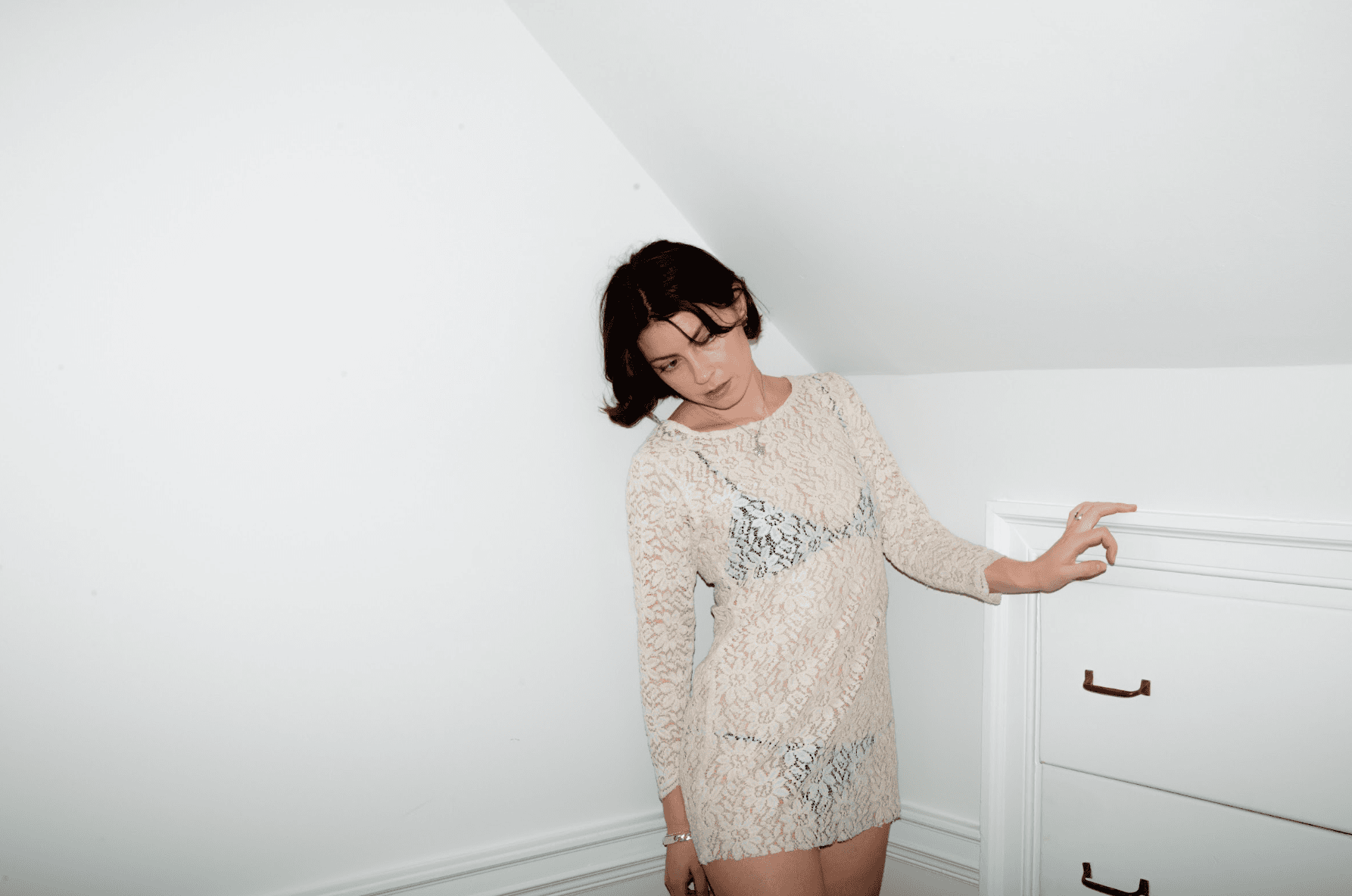
Perusing the Menu of American Culture with Biz Sherbert
Byline sits down with the writer, podcaster, and fashion critical theorist to discuss her new Substack American Style, the contemporary culture complex, and a mutual reverence for style.
By Maya Kotomori
Photos by Timothy O'Connell

Published
We ordered a fuck ton of food at the diner; that’s the first thing you should know. My club sandwich came with a side of coleslaw and fries, and writer, podcaster, and fashion critical theorist Biz Sherbert’s pancakes arrived fluffy and flanked by their own pile of fries, carb twins separated by philosophy. Both of us drinking Coke, not Diet. None of that performative aspartame-loving irony. Just real Coke, crisp and honest. Maybe that’s the thesis of the afternoon: real sugar. No imitation sugar. No half-writing or half-saying what we mean.
Sherbert, who most people first met through the Nymphet Alumni podcast has always been allergic to the half-version of things. Her voice is sharply accurate and considered in equal measure. Through her Substack American Style, she’s serving up full-sugar content style: a sartorial, anthropological digest that reads like an archival collage, where fashion theory sits next to street interviews, moodboarding the style-cultural moments of today. It’s writing that resists the SEO impulse to simplify, to tag and file experience into something Google-shaped. Her observations don’t serve any media formula or exist in a box, which makes sense, because neither does actual style. KRS-One understands the conundrum well in his own field: “rap is something you do, hip-hop is what you live.” Fashion is something you do you do, style is what you live.
Across the table, she cuts into a pancake and says something about freedom, how American Style is a space to be a “sentence freak,” to feel rhythm in language again. I think about that as the Coke fizzes, how unfortunately rare it is to enjoy sans apology and go for the full sugar version of thought. In a culture obsessed with keyword identities and bite-sized aesthetics, Sherbert is after something messier, something whole.
This is our conversation: consumption theory, but lunch-turned-brunch.

Maya Kotomori: So, Substack. I’ve noticed more writers flocking there after that first boom in 2020 because it’s a space for monetized personal voice. What inspired you to launch your blog American Style there?
Biz Sherbert: Freedom. I wasn’t seeing my kind of writing published anywhere else, and I couldn’t imagine adapting it to fit another outlet’s tone. With American Style, I get to experiment with language and visuals, like scans, photographs, and moodboards, without worrying about an editor saying, “Can you make this more Google-friendly?” There’s of course a place for writing like that on those platforms, but American Style is mine. I call myself a “sentence freak” because I care about rhythm, about how words move. Substack lets me indulge that without compromise.
MK: That’s rare. But it also makes me think about how much identity gets shaped by SEO. Whole aesthetics exist as keywords now.
BS: Exactly. In the early years of my podcast [Nymphet Alumni with Alexi Alario and Sam Cummins], we talked about how trends were essentially keyword clusters. “Indie sleaze” is the clearest example. Nobody called it that in real time, but later the phrase made it searchable, packageable. There’s something addictive about a catchy word, even when it flattens nuance. I actually tried calling that era “millennial core,” which is kind of an embarrassing term to use now, but honestly, it fits better. “Indie sleaze” sounds like a scented candle.
MK: Or an OPI nail polish.
BS: It’s too juicy, too slick. But this is what we live in: a culture of compressed meaning. We see bleached brows or a trench coat and immediately assign an identity package. It’s reductive, but it’s how the internet trained us.
MK: You were writing about this early on, naming cores, parsing why people got hysterical over aesthetics. How has your approach shifted?
BS: At first, I wanted to explain and predict, like “Here’s why this is happening, here’s what’s next.” Now I’m more interested in listening. Trend essays too often reduce everything culturally to “oh, it’s the internet” or “oh, it’s late capitalism.” That’s boring. You learn more by asking people directly what they’re wearing and why. Sometimes someone in a full Shein outfit has a more moving story than any essay I could write.
MK: And you’ve done that across continents with American Style. Living in London must have shaped your view of American style.
BS: Definitely. I realized the U.S. is obsessed with extremes, extreme diets, extreme outfits, extreme identities. In London, style blends with its environment. A trench coat looks at home. In America, you see someone and think, “that’s a deeply online Gen Z-er” or “that’s a Charli xcx fan.” Our outfits announce us; it’s very American to stand out.
MK: That reminds me of this idea I’ve been cooking on for years now, defining the difference between fashion and style. To me, style exists as necessity, and fashion exists as industry, and before industry, a history of elitism through dress. But, I went to the preview of Dr. Valerie Steele’s latest exhibition at FIT, [Dress, Dreams, and Desire: Fashion and Psychoanalysis], and when I asked her how-and-if she defined the difference between fashion and style, and she said she didn’t separate the two, and that the distinction is only there because people need it to differentiate themselves. I’m curious what you think, as a fellow fashion critical theorist.
BS: [laughs] Girl, you can’t ask me that right after quoting Valerie Steele! I agree with her: the distinction exists because people need it. If someone feels they understand what they’re saying by separating fashion from style, that matters—like, the history you’re talking about matters. But I do think we’re in a weird moment of over-emphasizing style, almost fetishizing individuality. It can get a little eerie.
Dr. Steele is a model of rigor for me. Her ability to treat fashion with the seriousness of art history or philosophy, while still speaking to a public audience, is rare. I admire her consistency. She reminds me that you can write deeply about fashion without chasing pop culture’s noise.
MK: Let’s talk about your path. You studied at FIT—did you find yourself building your fashion theory knowledge from scratch, or were there direct channels in school you could find your way into?
BS: I majored in art history but became obsessed with textiles. Textile history taught me how much culture you can read from material details—motifs, trade routes, even dating a tapestry by the shoes depicted in it. That attention to material culture shaped my eye. It made me detail obsessive, which definitely carries into American Style.
MK: One thing I love about American Style is that it resists categorization, and instead hits this man-on-the-street perspective. You’re not rushing to call something a slay or a flop, you want to ask the kids.
BS: That binary is exhausting. Culture is not just slay/flop. On my podcast, we talk about resisting the extremes and living in the middle. I think Alexi first brought up the slay/flop binary there. People think they need an opinion on every swing of the cultural pendulum, but culture shifts constantly, from day to day to decade. Not everyone needs to declare what’s next. Sometimes you just let it be.

MK: Fun question: Fuck, marry, kill: Tumblr, Are.na, Substack.
BS: [laughs] Okay, right now? I’m fucking Substack because it’s new and exciting for me. I’m marrying Are.na because I love the intimacy of how it lets you curate and share moodboards. And I’m killing Tumblr. People mythologize it too much. You can’t recreate the conditions of the past. Tumblr was formative, yes, but it’s “the one that got away.” Sometimes you just say, thanks for the memories, and move on.
MK: Speaking of platforms, your Are.na boards for American Style. Who or what made it onto them?
BS: Lola [Dement Myers] was huge. Her tweets about identity mismatches, like “your fit pic doesn’t match your subculture,” really nailed the absurd expectations we place on coherence. I was also inspired by Joel Meyerowitz’s photos of ’70s New York, by Bruce Springsteen’s Nebraska, and even by images of runaway models in American diners. They all capture the mix of beauty, grit, and human psyche I want American Style to hold.
MK: That’s poetic. Before we close, what’s next for you?
BS: Going deeper. Longer conversations, more embedded stories, more visuals. American Style has already taken on a life of its own, and I want to follow where it leads. Writing, to me, is being okay with both clarity and confusion. If I can keep documenting this moment through people’s own words, that’s success.