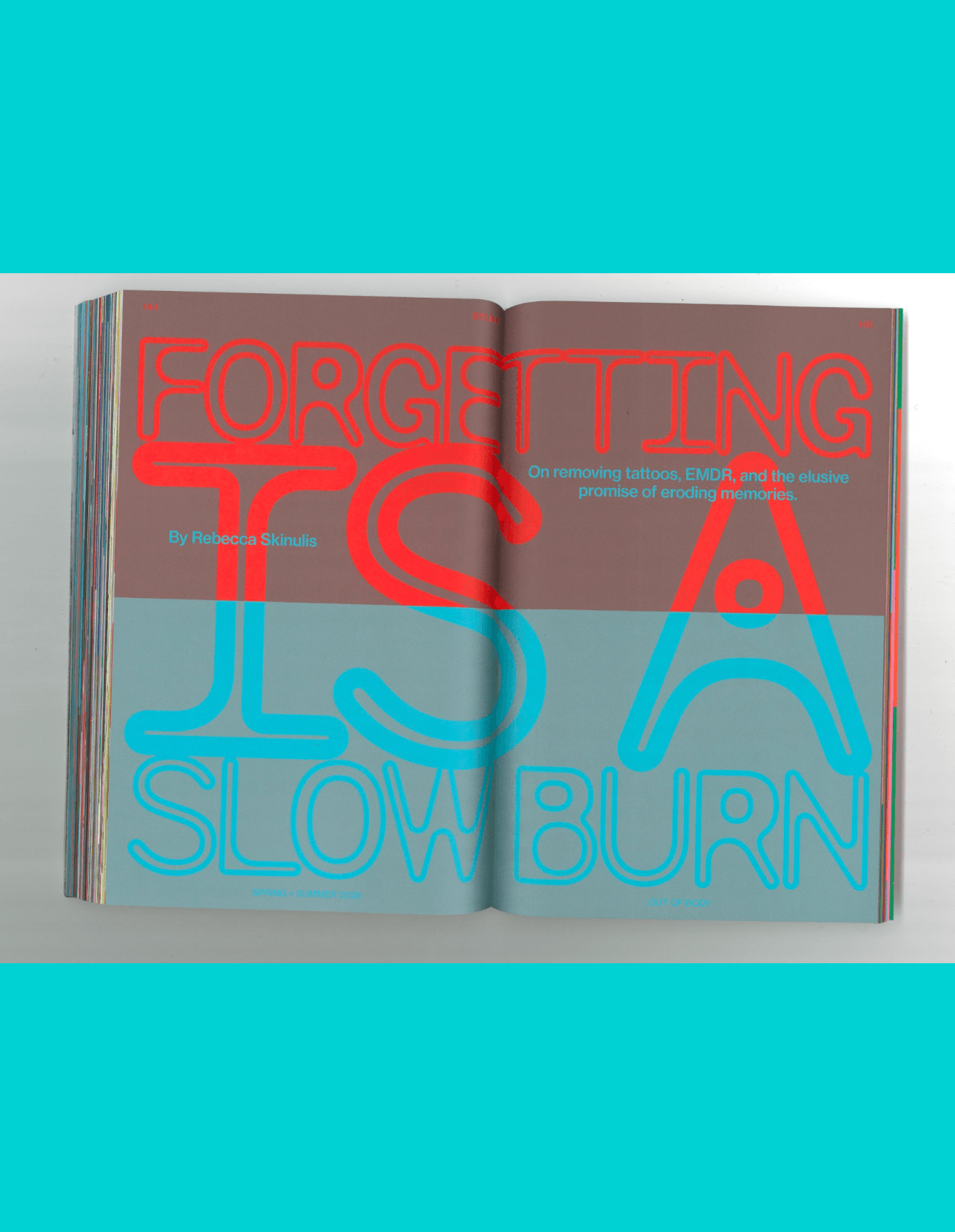
Published
Like most people my age, I have some light mental illness and a handful of shitty tattoos. I’m working on both. The first with EMDR therapy (Eye Movement Desensitization and Reprocessing), the latter with lasers.
There are several tattoos I’m removing, but the main culprit is my first—and largest—poor decision. Six lines of script on my ribcage bordering on illegible from fifteen years of fading. (I will not share what it says, as immortalizing it on my body was bad enough—and the internet is forever—but just know it’s prose that only a lost, impulsive nineteen-year-old girl would permanently etch into her skin.)
I walked into my first session positively giddy. My body tingled with excitement to finally erase something that has caused me, for over fifteen years, to wince at my reflection. I was curious how this laser would compare to that of a tattoo gun, a dull pain that never bothered me much. Then I got an initial test zap, a sensation nearly identical to hot cooking oil sputtering from a pan onto your skin.
After that little preview, it dawned on me I may have made another poor decision. I had just dropped an exorbitant amount of money on an unlimited package of these torture sessions, completely voluntarily—just because I didn’t like the way I looked. How silly and vain, I thought.
Amidst the white-hot pain terrorizing my nerve endings, curiously, a tinge of metal seemed to enter my mouth. “That’s why we hand out lollipops,” my technician said, nodding to a fishbowl swimming with them. “Sugar masks the taste.” Apparently, tattoo ink often contains unknown metals (cute!), and when the laser hits, it shatters, scattering that ink into a million micro-metallics making their way through your bloodstream.
So that’s how my sessions go now: I get a ladle of hot grease poured over my ribcage, swallow a handful of pennies, and leave with a lollipop. Like a kid at a deranged dentist.
Around the time I started removing my tattoos, I felt a similar urge to cut my hair off, stop dyeing it, and remove any piercings lingering from my teenage years. A clean slate. But this superficial cleansing wasn’t hitting quite hard enough. My cluttered mind was next.
“Have you ever heard of EMDR?” my new therapist asked in our second session together. In fact, I had. I’ve been in therapy on and off for years, battling an innate talent for ruminating as a result of living almost exclusively in my head. Therapy has helped beyond measure, and yet, my mind is often still a precarious place to be.
One day, I googled “what happens when you hit a wall with therapy” and discovered the wonderful, borderline woo-woo world of somatic healing. I only stopped short of looking into it seriously when I read it was mainly to treat those with PTSD and other capital “T” Traumas. I abandoned the idea and resumed my usual talk therapy, untangling my neurosis the old-fashioned way.
But my therapist knew that my anxiety has a certain je ne sais quoi I can’t always talk my way out of. So I agreed to try it. Sometimes you have to really sit with the discomfort in order to move past it. In EMDR, you’re supposed to take whatever it is you’re working through—trauma, a phobia, or in my case, excessive rumination—and try to go back to its inception. Then you sit there. You sit there until sitting there becomes so boring that you couldn’t possibly want to sit there again. EMDR doesn’t violently erase memories like tattoo removal. It wrings them out.
I had my first EMDR session virtually, sitting in my home office. It was confronting, and awkward, and painful, and cringeworthy. I was paying money to stare at a blue ball ping-pong across my laptop screen while a beeping sound, alternating between my ears, came through my headphones—all while I mentally replayed a disturbing memory from so long ago, I wasn’t sure I even remembered it accurately. After a 30-second sprint of this, my therapist would ask, “Now what do you notice?” to which initially I wanted to reply, “I notice how dumb and desperate this is.”
But as the session progressed, my body seemed to react before my mind caught up: tense back, tight chest, lump in throat. After a while, I started to get bored—almost numb—to this sad, looping scene. I left the session in a daze, unsure how I felt until I said goodbye to my therapist and shut my laptop. I immediately started to bawl.
In the following days, the usual thoughts still showed up. But instead of hooking into me, they seemed to simply pass by. One session wasn’t going to solve a lifetime of overthinking, but seeing those sticky, deep-rooted patterns from a different angle shifted something. I saw with fresh eyes the effect of letting thought loops run amok, how they can splinter off into strange new stories.
There’s something to be said about learning to live with your mistakes—that taking a magic eraser to them is missing the point. We’re sentimental beings made up of every past experience and thought that got us to where we are, horrible tattoos and all. But the act of ruthlessly editing your life, parsing what deserves space, has its own merit.
I feel for that nineteen-year-old girl who was just looking to make a mark, however literal. I feel for all the selves I’ve cycled through. But sentimentality has its limits. As my tattoos fade, however painfully slow, the well-worn tapes I’ve played in my mind do, too. Revision comes with all kinds of novel discomfort, like metal on the tip of your tongue.