Broadway’s ‘Liberation’ Is A Salve For Female Rage
Playwright Bess Wohl tells the story of who her mother was before her time.
Published
On a particularly wet evening in November, I saw the play Liberation, which affirmed everything I had been thinking about that fall.
I left the office only slightly early to meet my aunt for a pre-show beverage. We were set to see the show at the exquisite James Earle Theater at 7PM. It was a timely one. My brain had been stuck on the old “I can’t believe what women deal with” track, and this play lands squarely in that genre. A New York Times Critic’s Pick, Liberation was lauded by theater heads all over the city (including Mur, my personal benchmark for all things theater). The playwright Bess Wohl spent 15 years writing, workshopping, pitching, and producing a story about her mother’s 1970s conscious-raising group. Now, it was making its Broadway debut.
The show opened with Susannah Flood, who plays Lizzy, the protagonist, thinking aloud about her mother. It’s a non-traditional opener. At first, I couldn't tell if she was sharing pre-show remarks or if this was part of the script. This was the first of Lizzy’s several short monologues, in which she invites the audience into her thought process as she recounts her mother’s life before she was born, and specifically, the role her mother played in the women’s rights movement as a leader of a small group that met weekly in a gym basement in Ohio.
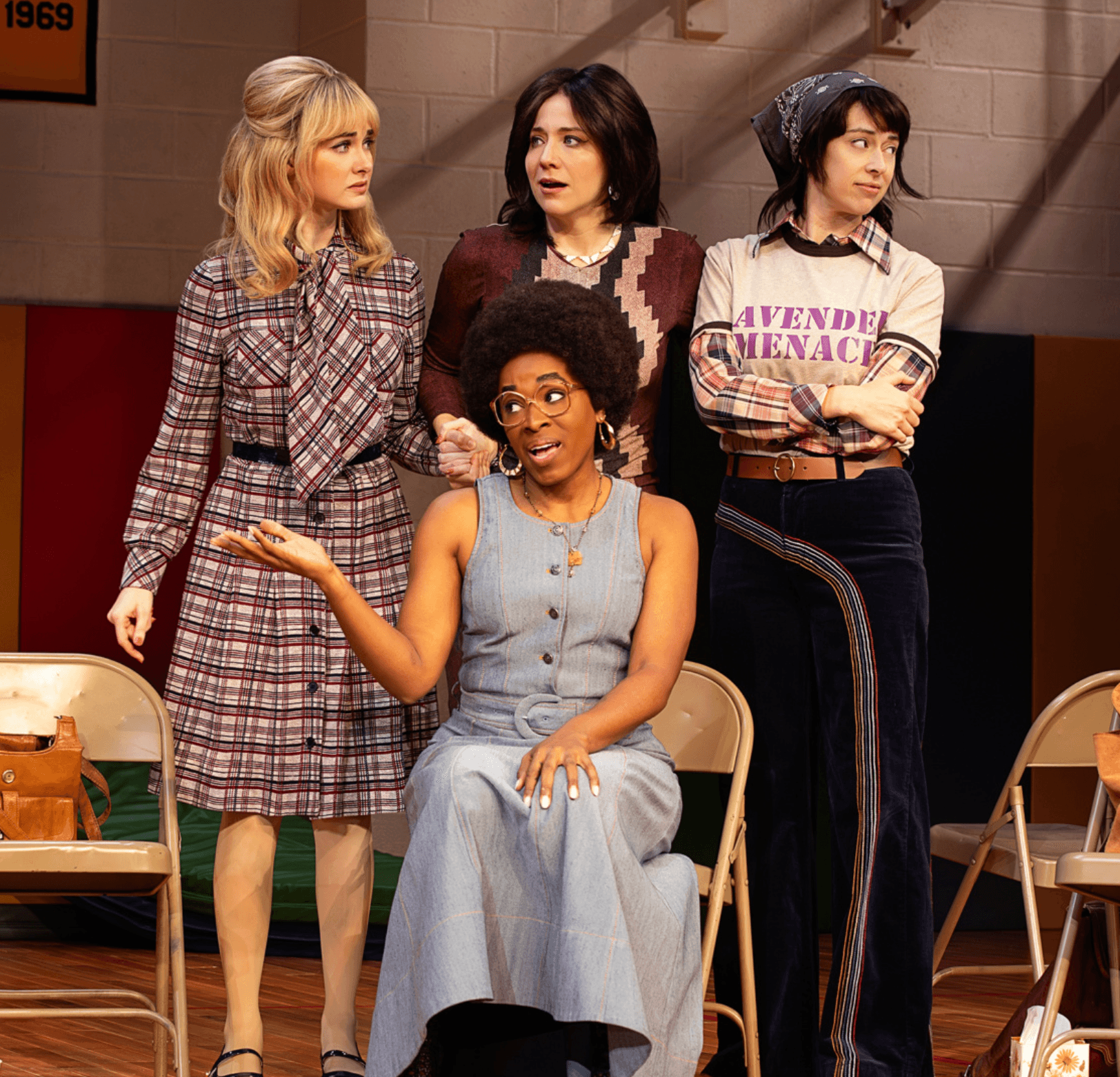
In between Lizzy’s monologues, we meet her mother and the other group members. It’s an unlikely mix of women from their early 20s to 60s who are each experiencing various flavors of sexism. Dora, the youngest, is engaged to be married and working at a job where she is underpaid and undervalued (here she is having a conscious breakthrough around the double standards of the workplace). She eventually breaks off her engagement, and of the group, she says: “They saved my life.” Susie, another young member of the group, is generally over men, is a radical, and lives out of her car. Then there’s Celeste, who moved to Ohio from New York to take care of her mother. She and Susie temporarily find themselves in a relationship. There’s Isidora, an Italian immigrant who is hellbent determined to make a change. There’s Joanne, a mother of four boys who doesn’t have much time for the antics of the group. And there’s Margie—my favorite character, the eldest and perhaps wisest.
Margie had been married for most of her life to a man who was categorically unhelpful and unappreciative. She had settled into a role of carrying all of the emotional labor in her relationship, doing all of the housework, and so on. She raised her children, cooked, cleaned, did the laundry, maintained the house, all without much thanks. She joined this group with an inkling of irritation regarding the blatant imbalance, and by act two, she finds herself in a full state rage. She reaches her breaking point. She ends up making a list (this is the scene that lit me up the most) of every single thing she does in the house and leaves it on the counter for her husband to notice. He barely does. One of her most powerful lines: "You want a revolution, but you want it on your own terms, and you don't want to have to give anything up to get it."
I relate deeply to each of Wohl’s characters in some way, and I think most women will. I specifically sypathized with Dora, a young woman who was doing exactly what she thought she was supposed to be doing. She’s working (at a job that she hates) and is engaged (to a man that holds her back). It takes a group of women to make her realize that there’s this great, big world out there, that she deserves more. They give her the courage to step away from what is not serving her. I asked the actor Audrey Corsa, who plays Dora, what drew her to the character. “Reading this script for the first time was wringing out a wet towel emotionally—so much laughter and fury and grief,” she tells me. “Dora has been raised to be very polite, told that being pretty and compliant are her greatest assets. Inwardly she seethes with the desire to be seen for her sharp mind, ambition and innate business acumen.”
This statement alone encompasses so much of what Liberation addresses. That to be liberated, something foundational has to break. “Dora's self-esteem, and my own, are only capable of being built by the communities we surround ourselves with, by taking risks, loving unconditionally and learning from our mistakes,” she continues. The play weaves in and out of different eras for each of these characters as Wohl connects the dots around what was happening. We hear from the characters later in their lives as she interviews the members who are still alive to find out more about what happened in this group. Because of that, we see how the lives of each character unfolded.
Kayla Davion, who plays Joanne, also found herself identifying with her character in a way that became a catalyst for her own emotions. “Truthfully, the most surprising feeling I have experienced is my rage,” she shares. “I think being a black woman in the conversation can sometimes feel numbing because of the generations of sorrow our community has felt, but the new rage I found for the rights that we all are fighting as women, and the boxes that I didn't even realize I felt accustomed to had me at a stand-still, shocked that I hadn't noticed these things before and either hadn’t had some of these conversations before or, quite frankly, hadn't had them enough.” As for how she prepared for the role, Kayla built upon her own experiences while also reaching for cultural references. “I watched a lot of documentaries and interviews with Black women,” she says. “The interview I love the most is called ‘The Black Woman (1970)’, which is from the Black Journal Program and features many women such as Niki Giovanni, Joan Harris, Amina Baraka, Marion Watson, Lena Horne, and Martha Davis.”
Whitney White, the director of the play, felt the characters moved her to direct Liberation. “The characters, the setting were so strongly communicated by the text and seemed to demand a taking up of space,” she says. “As a director, when a world is concretely drawn, yet has enough space for interpretation, that's when worldbuilding feels possible.” How was she able to so accurately depict a time and place through dialogue and character building on stage? “For Liberation, building a trove of research was a key part of the directing process,” she shares. “I treated this play almost like a documentary project. There is so much material from the time and it was important to educate myself and encourage the cast to educate themselves so that we could be grounded in a real world with enough references that were accurate.”
It was especially fitting to see this Broadway show with Amy—my mother’s sister—as the show is based on a story told between two generations of women. The story of the Second Wave feminist movement is told through two generations as well. There’s even a moment when Lizzy is talking to her mother’s reincarnated spirit, asking her for help to finish telling this story so that it is accurate and true and reflective of her mother’s inner world (this is where you will most definitely cry). The dialogue and experiences are conveyed through Bess, conversations with her mother, and the memories of other women and activists who were part of her group. What unfolds is a poignant account of a mother-daughter relationship and exploration of what it means to be a woman—today, yesterday, and tomorrow.
What does Whitney hope everyone gathers from the show? “Have the conversations you need to have. Don't wait, don't assume that someone else would have it and don't shy away from it just because it may be difficult to begin.”