Published
Arrive. Find stillness. Notice the quality of your breath. Recruit it to work for you, breathe deeper, longer. Inhale to fill up, feel your stomach expand with new air. Exhale slowly, release. Breathe audibly. If I walked by, I could hear you. Now scan your body. What does it feel like to sit, stand, lie as you are? Your body is operating for you, acknowledge it. Is there tension in your fingers, your toes? See if you can use your breath to relieve some of it. Relax your brow, jaw, tongue from the roof of your mouth. Regard your eyeballs within their sockets as they shift across the page, your breath still deep. These words, their shape, your eyes sending signals to your brain. Inhale, fill up, more, more, exhale, interpret. Coalesce the mind and the body. That’s yoga.
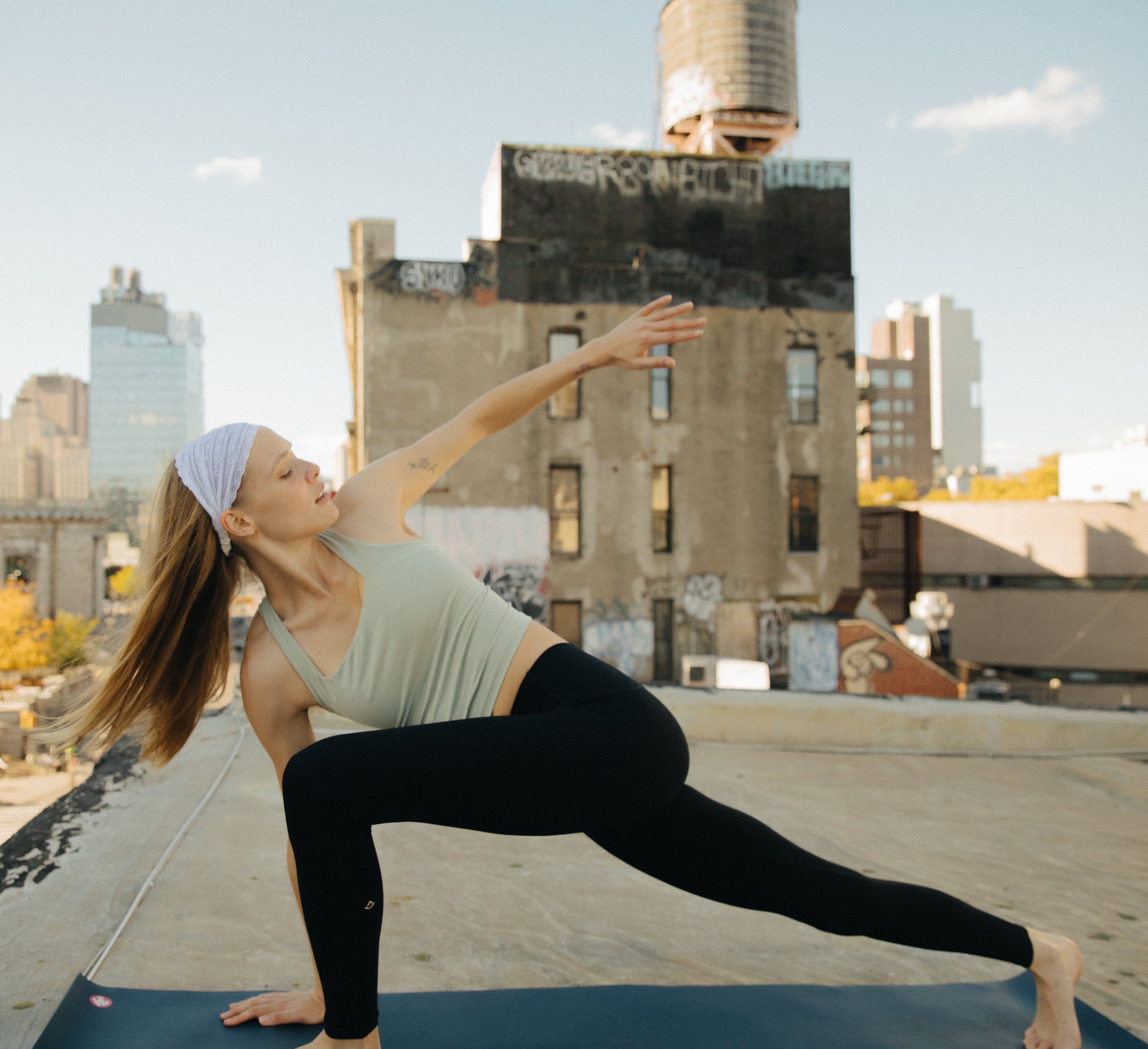
Yoga means “to join” in Sanskrit. It is the practice of using breath as a tool to unite the mind with the body and support an arrival into the present moment. It requires slowing down a lot to notice more, starting with breathing, something we seldom, if ever, do consciously. It’s incredibly simple, which is why it can be so difficult. Eager to get to the flow, the workout, these steps might seem unnecessary. Surely I can move and stretch without woo-woo hyper-awareness of the body, you might think. And you can, but if it’s so easy, why not try it? Inhale, you might get a little more specific in your movements, more honest about where you’re at. Exhale, maybe you find some ease in your practice, your concentration. Inhale, start to get to know yourself a little better. Exhale.
I’ve practiced yoga (as an exercise, not by definition) since I was a teenager, but sloppily, throwing my body around. I used to cheat, bounce into a forward fold. I’d force my legs straight, strain my muscles to prove I could touch my toes for a few seconds. I thought of breath cues as filler words. I started practicing at Hot8Yoga, where the rooms are 110 degrees Fahrenheit and the bodies are drenched. When the heat gets to your head, they advise that you stay in the room, take breaks and breathe to acclimate. I was hooked immediately, all that delicious sweat, but I loved to be careless and leisurely stroll out of class to cool down. I chose to disrupt students and disrespect teachers over even attempting to be still and breathe for a moment. Eventually, I started hearing them: Wait, reversing my warrior on an inhale does create space and lengthen my body… If I exhale, my fold deepens… Maybe I should try the whole flow with the breath cues. I’m moving and breathing—where are my thoughts? Savasana already? Namaste.
Yoga (the definition) has transcended class at Hot8. There is a method acting class I take in a Soho basement. The very first lesson of each session, the teacher, Tony Greco, asks students to first close our eyes and notice our breath. Find a breath, then, that teeters right on the line between too little and too much. This is surprisingly strenuous, and is especially difficult to accomplish when preparing to perform, but if we can manage it, we can really be where we are. Next, he guides students through a scan of our entire bodies, prompting us to ask about specific areas, take note of where we carry tension. The purpose is to be patient and curious. Our bodies hold onto a lot, and through this process we try to unearth what. If we can be that still and focused, answers (and more questions) do come, and they can be utilized to discover our version of whatever character we are trying to enliven. You can’t be specific about your instrument, your body, without the breath first and foremost, and you certainly can’t get to the character without meeting yourself where you are first. Excess tension will hinder a performance, prevent any sense of presence, take you out. I used to black out on the stage. I wasn’t able to remember a thing about my work before I started slowing down.
What can be discovered if we take our time—even if it means taking a step or two back, lying still on the yoga mat and just breathing, or not getting to the lines of the play until you can use your breath to stop hands from shaking—is boundless. If the union of breath to body has proven to be a step not to skip over in yoga and acting, I’d go so far as to say that it can be applied to any creative process, or any process at all for that matter. All this to say, there is no result to strive toward. Strive for a result and it will elude you. Lee Strasberg said that, and so do the Yoga Sutras. Ungracefully hurling my body in half is not the flexibility I sought after. The only reward for this practice is the practice itself. Breath. Presence.