Hayley Briasco on Building the Sonic Worlds of Clairo, Audrey Hobert, and Grace Ives
Musical director Hayley Briasco takes a non-traditional approach to her career.
By Ali Royals
Photos by Daniel Dukane
Published
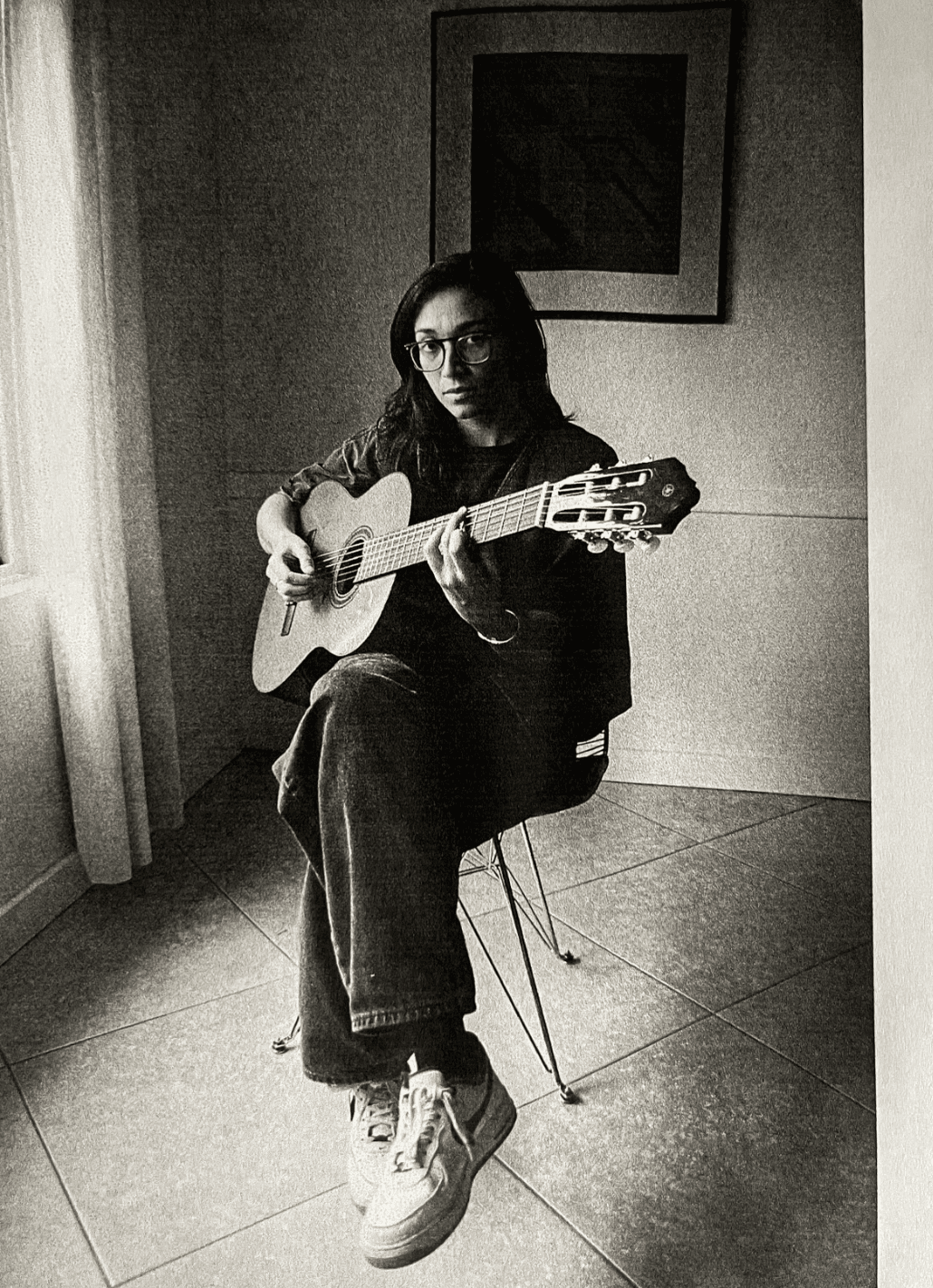
I don’t know when Hayley Briasco sleeps, but I do know she has more to do during her waking hours than most. Hayley’s had a busy year: she was the Music Director for Clairo's Charm tour, Audrey Hobert’s The Staircase to Stardom tour, and Grace Ives’s Girlfriend tour. She was the assistant Music Director for Sabrina Carpenter’s Coachella performance with Madonna. She toured the world playing guitar in Clairo’s band, played guitar and Banjo for Audrey Hobert’s Tiny Desk performance. She sourced vintage instruments, choreographed lighting cues, produced music of her own under the alias Kim Tee.
What started as a career playing guitar and composing music for ad agencies has fashioned Hayley into quite the musical multihyphenate. Whether she’s producing or performing life, directing or deciding where to carve out silence on a track, one gets the sense that Hayley Briasco can do anything. We sat down with her to learn just how she pulls it off.
Photo by Nicole Busch
Ali Royals: You’re a composer, producer, musician, and music director. What came first? What excites you most about each? What different parts of your brain do you have to tap into for each role?
Hayley Briasco: I’d say I’m a guitarist first. I spent years performing in bands in middle school and high school—at block parties, school events, county fairs, garages, you name it. In my first year of college, I discovered music production, and it changed the way I look at music.
That producer mentality has been incredibly helpful in my work as a music director. The songs are already made, the album is done, and now you have to take the existing music and turn it into something new, but recognizable. In a sense, it’s the second stage of producing an album.
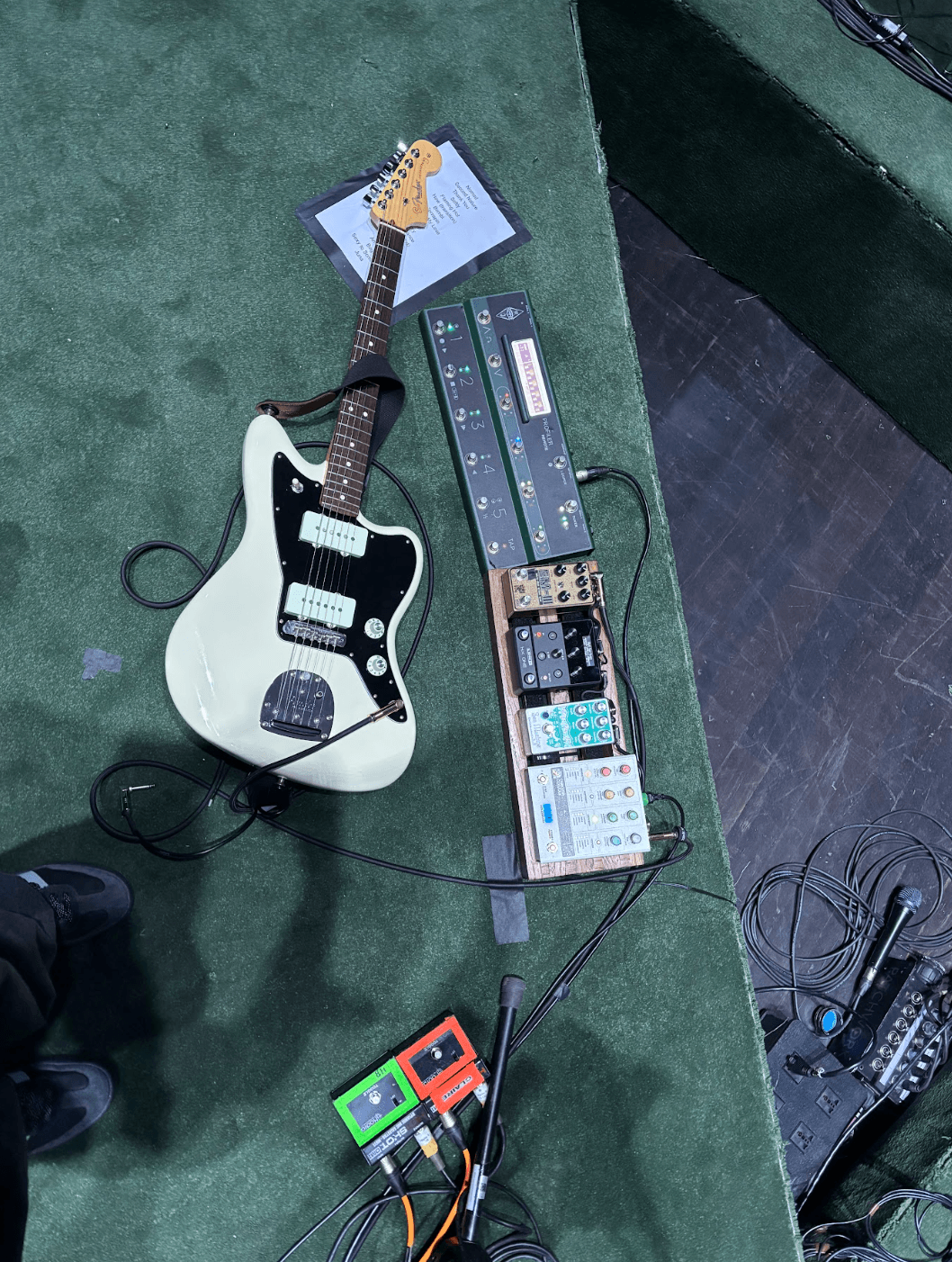
One of my favorite parts of being a Musical Director is the sound design: making sure all of the parts played live (on guitar, keys, drums, bass, etc.) match the sounds on the record. Being a producer means you are always finding exciting ways to achieve the tone you’re looking for, so working with specific gear and budget limitations almost feels like second nature.
My first job out of college was as a composer at an advertising music house, an experience that fundamentally shaped the way I approach arranging. Before that job, I don’t think I truly understood how to arrange music. Each role I’ve taken on in the music industry has informed the others.
AR: You help artists take their sonic vision and translate it into the aesthetics of their live show. Walk me through that process—what are the initial conversations you’re having? What’s possible in this realm?
HB: This is always a really fun part of the job, because you get to talk through the ethos of the show—the bones of the production and big-picture ideas. It’s the wide-eyed feeling of “we can do anything.” These conversations go over the musical tone and overall flow, the instruments band members are playing (for visual and musical appeal), how to get from song A to song B, storytelling, a cover that might make sense to weave into the set, and so on. I’ve been fortunate enough to work with artists who all have a really particular and inspired vision for their show. I’ve worked in sound effects, narrations, transitions to give time for a costume or prop change, etc. Those moments really bring a show to life. I love that level of collaboration, because I get to work alongside the artist to bring their vision to life.
AR: How did you go about building out the sonic world for Clairo’s Charm tour?
HB: Claire’s inspiration for the Charm Tour leaned into the smoky living room and conversation pit aesthetics, mixed with the elite musicianship of the ’60s and ’70s, while still feeling modern. It was such a treat to have that be the first tour I fully music-directed by myself, and especially because I got to do it with my best friend. Knowing how Claire functions as an artist—what she likes and dislikes—allowed me to skip a big step in the process. A huge part of that world was Claire’s idea of making the band feel like a group of friends playing together in someone’s living room. Working with Imogene Strauss and Jonny Kingsbury, we arranged the stage so that the musicians were spread throughout the space, sometimes having to physically move to different parts of the stage for different songs, which made the show feel conversational and spontaneous.
Sourcing vintage gear for the tour was one of my favorite parts of the job. I got the go ahead to grab whatever I felt necessary for the show, and as a person who already spends hours every week looking at gear online, I felt like a kid in a candy shop. One of my favorite discoveries was a 1980s Japanese synth called the Suzuki Marching Echo. At the time, there were only two in the United States. We bought them both. It’s an FM-style synth (entirely in Japanese) designed to be worn with shoulder straps like a marching band drum. Paired with Hologram Electronics’ Chroma Console, it became a standout moment of the show. Details like this are what made the Charm Tour feel so fully realized, both visually and musically.
AR: Any standout memories from working with Madonna on Sabrina’s Coachella set?
HB: Honestly just watching Madonna collaborate with Sabrina as she was putting together the biggest show of her life to date. I’m honored to have played a small part in that process. Crazy!!
AR: You (semi) famously don’t read—or even use—sheet music. How do you go about composing, and working with artists who use traditional training methods?
HB: I used to be in band and orchestra as a kid, so I’m familiar with sheet music in the sense that it doesn’t feel like hieroglyphics. That said, it’s definitely a muscle that you need to exercise. Chord charts are something that I’m definitely more attuned to, which I tend to write for myself in a sort of bastardized way (not sure jazz schoolers would love them). But I do believe music is a language that can be translated in many different ways, and that it’s possible to get your point across without relying on precise or classical notation. As a self-taught guitarist, the cornerstone of my music exploration was learning by ear. This allowed me to become fluent in communicating my point without necessarily needing years of classical training. I have yet to come across players who are unable to take stems or my written parts and notate them in whatever way resonates with them. When I do eventually come to that point, I’m sure it will be a fun exercise to revisit the good ol’ days (with the help of Logic’s Score Editor, of course).
AR: How did you start working with Audrey Hobert?
HB: My relationship with Audrey Hobert started in the way that most prospective working relationships in L.A. do: we got coffee in Silverlake. But this wasn’t your typical coffee date—the skies opened, the angels clocked in. It was electric. We immediately became friends and decided to work together. Audrey’s genius is one of one. She sent me a manifesto of the entire show, where she had already designed the blocking, the stage setups, costuming, every lighting cue, and ideas for specific musical moments. Putting the show together was such a joy. It never felt like work.
AR: What went into realizing Audrey’s vision for her Staircase to Stardom tour?
HB: I spent time in my studio crafting all of her delightfully silly audio cues: a dream sequence with her voice complaining that she’s too tall to be a pop star; the foley and sound design for a scene of someone getting into their car and driving away, only to crash it; hiring a voice actor by the name of Wolf Williams to act as the voice of God; making a “Super Bowl” intro for her “least popular song”; and grabbing countless sound effects that are strewn about the show at the perfect moment. Aside from the typical musical director duties of getting the band sorted with their parts, arranging every song, and making sure it all sounds good, rehearsals with Audrey in the room were focused on getting the timing for all of these magical moments down. All the photos and moments you’ve seen from Audrey’s shows truly are as amazing as they look. GO SEE IT.
AR: What went into the musical direction behind Audrey’s Tiny Desk concert?
HB: A typical Audrey show has big theatrics and iconic moments, monologues and trampolines. Preparing for the Tiny Desk performance was different: it was purely focused on the music. I wanted the performance to feel alive and interactive, so I built around a variety of instruments rather than relying on patches on a MIDI keyboard. We used instruments like the little Casio VL-Tone, Mellotron, saxophone, banjo guitar, and upright piano, so everything had its own organic sound and tactile nature. Everyone playing touches at least two instruments, with some playing as many as five (shoutout Steve).
I’m honored that Audrey wanted me to step in and play on some songs. That came about when rehearsing my arrangement of her song “Shooting Star,” which I had arranged months earlier for a stripped-down set the band played at Jingle Ball. We were jamming on it in rehearsals, and I thought that the guitar arpeggios needed some more love, so I hopped in on the 12-string acoustic. Given Audrey’s family-like mentality, it was only right that I, and her producer Ricky, joined the band for the day. The rest is history. It felt like Christmas morning the day it was released. I made pancakes and watched it three times in a row.
AR: What are some of the most unexpected challenges you face?
HB: This is going to sound trivial. But as a producer and Virgo, I run a tight ship when it comes to file organization. The sheer amount of stems you receive as a music director is uncountable. I now have multiple hard drives for specific ventures. They say you’re supposed to have things backed up in three separate places…so I try to do that. In case of emergencies, of course. In this digital age, we’re all on our own journey of file management.
AR: Do you have any creative rituals?
HB: I have two sets of creative rituals. To ground myself when I want to pull my hair out because I’m stuck in my studio doing file management, or need inspiration for parts that I’m writing, I go on a walk and get a fun drink. This always clears my head. Nothing a fun drink can’t fix.
Before I’m about to go on stage, I make sure my hands and arms get a good stretch, text my fiancé that I’m about to play so she can text me back saying, “go shred!”, and either having way too much caffeine or taking a very large sip of whatever alcohol is closest to me.
AR: How does your experience performing inform all your other creative endeavors?
HB: Performing live has always been a part of my music journey. Since I picked up a guitar in 2006, I’ve been playing it in front of people. At the very beginning, the stakes were incredibly low. But now I’m out there playing on massive stages, and it can sometimes feel very trippy. Every single time I’ve played Coachella, I have blacked out. I have no idea what happened during the 2023 Dominic Fike performance, other than that I know we crushed it.
Being somewhat of a seasoned live player gives me a helpful perspective on the way that I approach arranging as a music director. One of the cornerstone philosophies I bring to producing and live arranging is that silence is the most important sound in music. If sound doesn’t need to be there, then we should explore taking it away. All that to say, if it doesn’t serve the song and the concert experience to have the guitarist playing during the second verse, I’ll have them not play. Exercising restraint in music is what creates the sweet relief. I know what it feels like to be on stage feeling a little awkward that I’m not playing anything for a section, but I also understand that the bigger picture is most important. Sometimes the best thing you can play is nothing at all!
AR: Who could you not have done this without?
One of the truest, corniest, most exhilarating parts of life is getting to say in an interview about yourself that your fiancé is the person you could not have done any of your work without. As a badass independent woman, I will say I could have done this without her. But would I have felt as grounded, supported, heard, inspired, proud, and generally high on life without her? NO. And that’s the dang truth. Hi, Maria :)