Memory and Its Discontents
How digital memory reshapes human memory, blurring the line between what we store, what we forget, and what remembers us back.
By Kate Grant
Illustration by Víctor Arce
Published
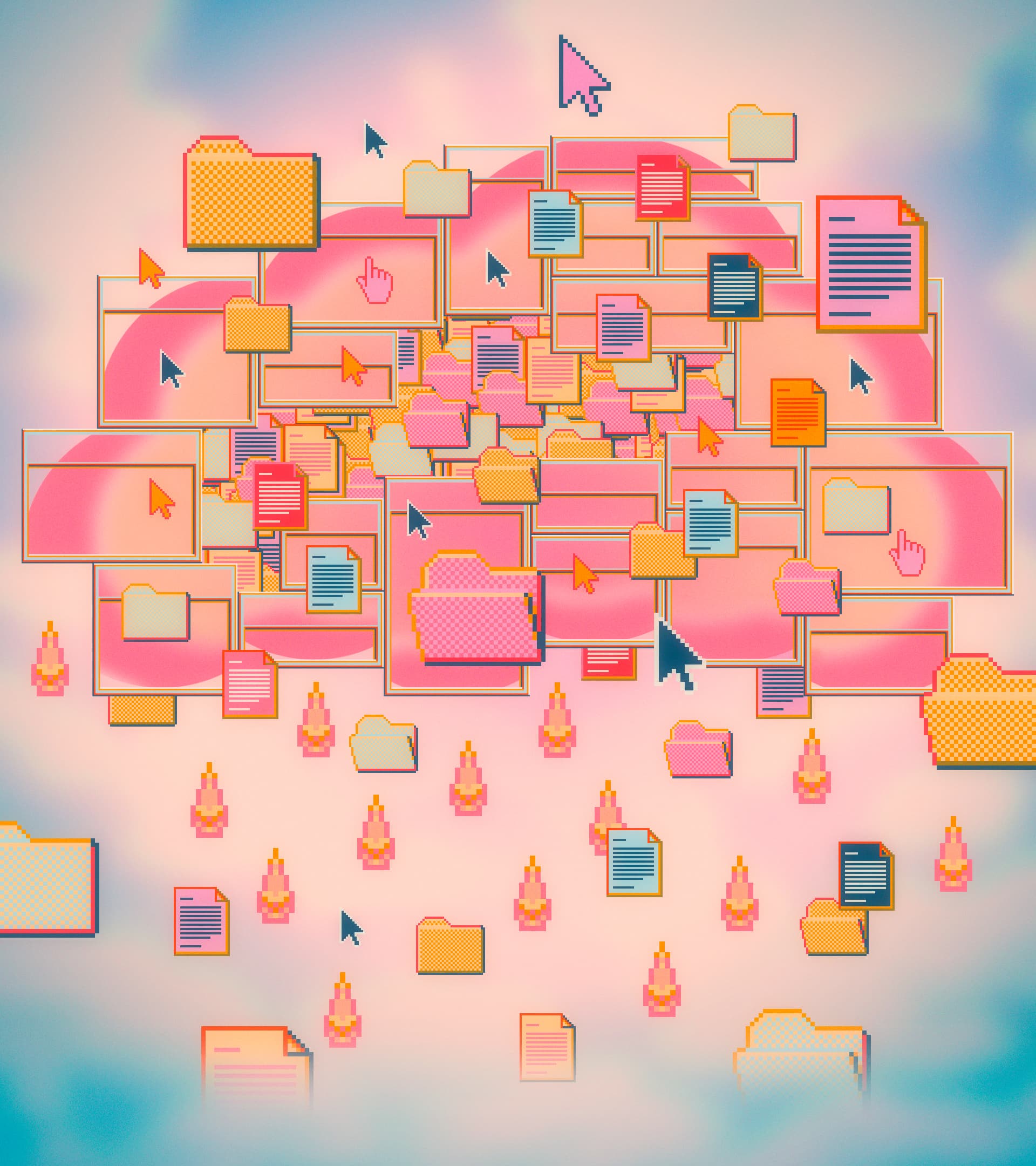
The cloud is a Cubist engine. The folders multiply and divide like cells. I no longer remember what’s inside most of them. The context has rotted but the files are pristine. They store everything from every angle, forever. Versioned. Forked. I find a poem last touched in 2018. I can’t recall writing it, but the voice is unmistakably mine, perhaps even more authentically than in my most recent work. I don’t delete it. I make a new copy: edit_v2_FINALPoemMaybe.docx.
Each version of the poem is a decoy. A scaffold. A deferred embodiment. I label my documents not just to recall, but to prefigure, to script a self I might someday be fluent enough to inhabit. My writing doesn’t emerge from the present, but moves toward it, always just out of reach. Revision becomes a rehearsal, a way to ward off the fear that nothing will cohere unless I orchestrate the emergence in advance. It’s a mythology built around documentation: that with enough data, I will be able to reconstruct the truth of who I am.
This is not nostalgia. It’s something stranger, a temporal dislocation spawned from the cloud’s quiet utility. What begins as a feature—that files are rarely lost—becomes a bug in my creative process. Each time I hit “save” feels like an act of devotion, motion toward a future, a new facet, but also deference to a version I haven’t become yet. The present evaporates. I’m haunted by essays that resurrect a former self, and in incomplete notes where skipped lines suggest a kind of hollow clarity, a meaning implied only by proximity. We used to think of haunting as something from the past that persists. But in the cloud, the hauntings are ambient. They drift in all directions.
I tell myself cloud storage is archiving, but it isn’t. It’s hoarding in pixels. A compulsive gesture toward the infinite, an attempt to leave a trail through the fog. As if saving were the same as remembering. As if iteration were a form of survival. Or if not survival, then a bid for posterity.
James Bridle, in The New Dark Age, reminds us: “The Cloud doesn’t just have a shadow; it has a footprint.” He critiques how the tech industry has made the cloud appear immaterial, weightless, pure. In reality, it is energy-hungry, industrial, and terrestrial: cables, servers, cooling systems, resource extraction. Every upload is a transaction with real-world consequences, though they remain largely invisible, localized behind unmarked facades in industrial parks or just beyond town limits.
Increasingly, I sense my mind behaving less like a mind and more like a distributed network. I send my thoughts to servers at us-east-1, the technical name for the North Virginia AWS data center, more than I think them. My inner monologue is an inbox. Friends are external hard drives for the parts of my life I didn’t realize were worth keeping until I heard them told back to me. Somewhere, my open tabs end, and I begin.
I’m drawn to philosopher Yuk Hui’s writing on cosmotechnics and technodiversity. In his essay “Problems of Temporality in the Digital Epoch,” he describes multiple modes of externalized, technical memory. Two in particular feel urgent: tertiary retention, systems that hold memory on our behalf (smartphone calendars, social media, Notes app), and tertiary protention, systems of technological anticipation (10-day forecasts, predictive disease models, climate risk assessments), where data not only imagines the future, but when applied, attempts to govern it.
In the digital present, our own anticipatory instincts—those vague, intuitive orientations toward what’s to come—can be displaced by algorithmic foresight. The future is no longer a realm of possibility, but of prescription. Our desires are modeled and fed back to us as predictions, gradually shaping us to behave in alignment with the forecast. The empirical logic of data becomes an oracular loop, turning the unknown into inevitability.
We once gathered thoughts in journals, diaries, marginalia, notebook pages filled with scratch-outs and hesitation. Now our attention is split across two registers: urgent data about the present and predictive data about the future. In this split, it’s no surprise that ideas get lost to time. It’s no surprise that the cloud feeds the friction it is designed to reduce.
It’s not just externalization of retention that causes me to forget a poem I meant to finish; it’s the seduction of being able to save the latest, most “truthful” version of myself. My creative process, outpaced by data availability. As I consume my future, the proxies get left behind.
Some turn to rituals of dopamine detox, spiritual retreat, or analog resistance to avoid the cloud’s invisible techno-vapor; putting down phones, touching grass, trading endless notifications for the uncertainty of lived-in latency—not a pause, not a pursuit, just presence uncommodified. But for creatives, these media diets aren’t always enough. Even when we renounce productivity, creativity remains industrious. Even in analog forms, it remains generative. To truly reboot a creative practice overwhelmed by capitalist optimization, we may need to shut down altogether; to become offline, creatively idle, and digitally feral. To reorient the clock, we may need a new operating system. To rewire our making, we may need alternative technologies that welcome ambiguity, celebrate the unoptimized, and let us forget.
Until then, I revise. I rename. I save a new version.