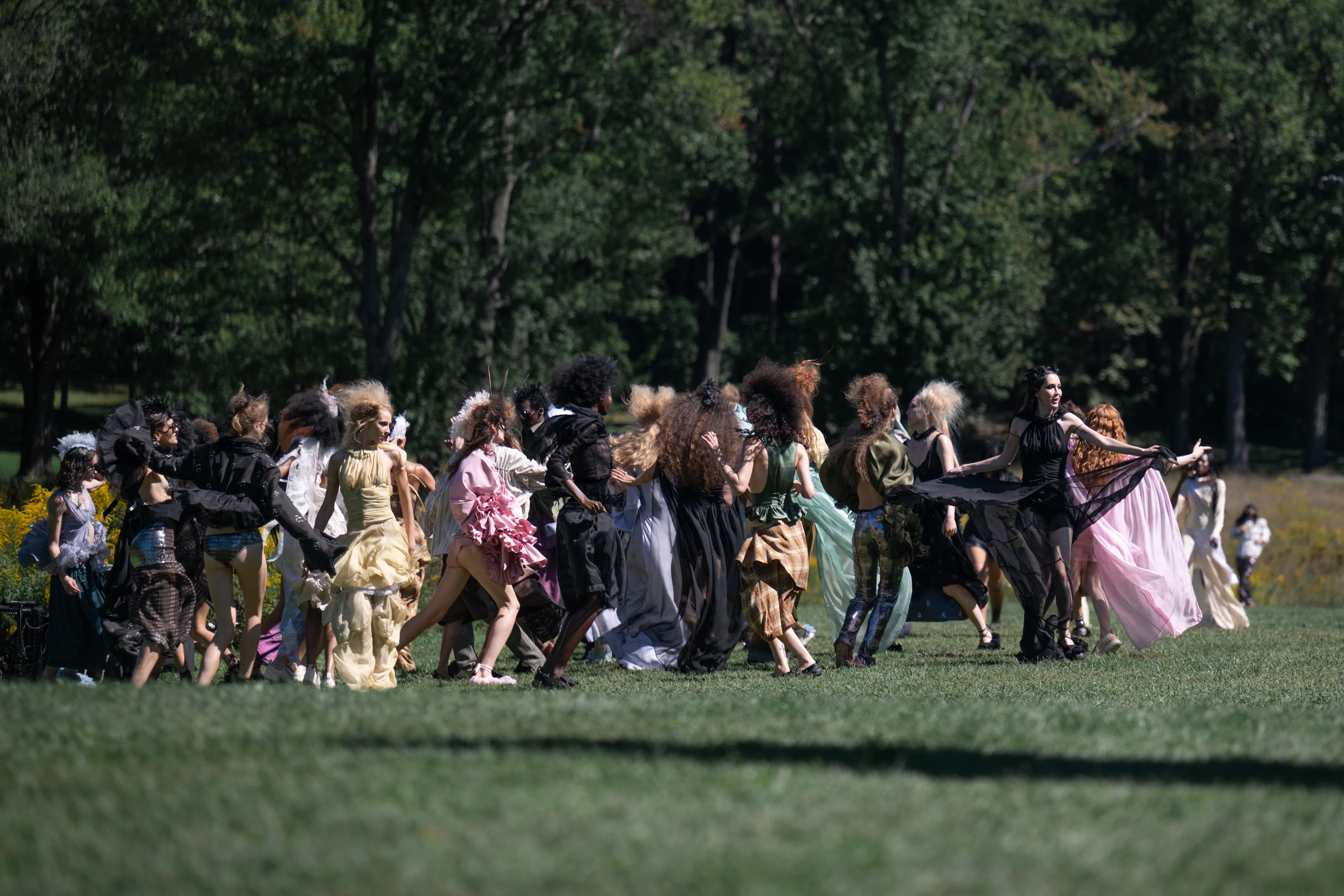
Fashion shows once represented the utmost center and most aspirational parts of the industry. I still hold onto the version I first loved.
Published
Underneath my desk, inside a wooden box collaged with magazine cutouts, is a slew of papers, seat assignments, invitations, polaroids—all paraphernalia pertaining to a dream realized. Or partially realized.
In 2022, on an overcast Monday in September, I waited in front of 150 1st Avenue with bated breath. I was twenty minutes early—two hours in fashion speak—for a spring runway show from a small New York brand. It wasn’t my first time loitering in the name of fashion. I had stalkerishly subtly waited by fashion-week venues just to see what people were wearing or catch a glimpse of the scene in previous seasons. But this was my first time being invited to a show. I felt giddy. As more attendees arrived, we morphed into a well-dressed huddle on the street, much like the ones I had seen from the outside.
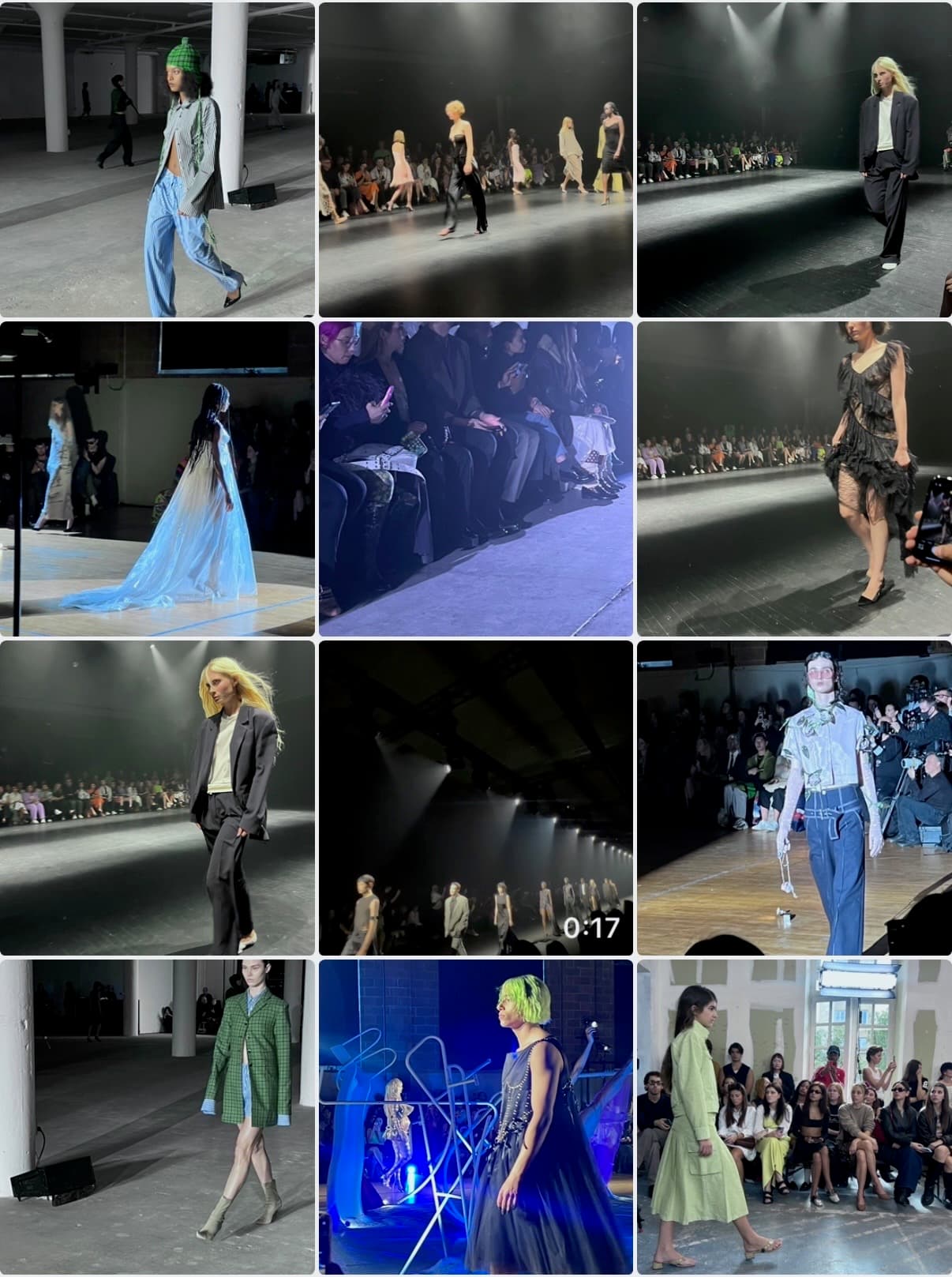
Inside, we filtered into rows of chairs lining the perimeter of a black box theater. My seatmates were two notable writers I had long admired. I was too shy to introduce myself. The lights went down. Models with long, straight, middle-parted hair walked within inches of our seats. I could feel the wind from their pace. Their gait was rhythmic and frenetic, perfectly synced to “Where Is My Mind?” by The Pixies. They wore crisp cotton shirts, billowing silk frocks, asymmetrical lace tops—all with frayed edges. I choked up as the designers took their bows at the end. I was just as high as my teenage self would be. It felt like a long-awaited arrival.
My first brush with Fashun (capital F, in full form) happened in 2014. I was a PR intern at Diane von Furstenberg. I was running errands and minding my own business when a slew of editors flooded out of a building and took over the sidewalk. I stopped in my tracks and watched as their heels clopped and their coats floated behind them. Their sunglasses were like tinted windows on a fleet of black cars with important people inside. There was Grace, Anna, Hamish. Eva, Tonne, Anna Dello Russo. These were my superheroes. I yearned to be part of that world (cue Ariel) since The Devil Wears Prada, since Mary Kate and Ashley’s Teen Vogue 2003 covers, since insisting upon making my own magazines with printer paper in the second grade. I froze in place as my icons marched into the distance. I could have sworn a massive gust of wind blew around me, or something dramatic added to the weight of that moment. It felt pivotal, formative even. I couldn’t unsee, or unfeel, what I had just witnessed.
That same week, I assisted the DVF spring 2015 runway at Spring Studios. My job was to usher select guests from the entrance to their assigned seats. As we finalized plans the night before, Diane descended the famous lucite staircase of her Meatpacking loft to check in with her team. It must have been 10 PM. She wore pajamas and carried a bowl of pasta—I was always impressed by how involved and personal she was, how her voice carried through the halls of her office. At the show the next morning, I remember Whoopi and André Leon Talley arriving together. I remember Chiara Ferragni of The Blonde Salad posing for photographers in a way that looked both manic and professional. I ushered Olivia Palermo to her seat. At the end of the show, I fainted.
It shouldn’t have been a surprise that my nervous system gave out at baby’s actual first show. I had placed enormous importance on that day. I didn’t know it at the time, but I was learning about panic attacks, which don’t pair well with fashion week. It was the perfect catalyst for the unchecked anxiety and characteristically unbalanced chemistry of a 19-year-old who was dying to do this.
I opened my eyes and was deeply embarrassed to find that Diane had noticed my display of amateurity—my literal downfall—but she was very kind. She was walking past the entryway and had stopped to see what was happening. I thought I might die of mortification, and yet, she stood over me and went as far as to comfort me, saying that sometimes, people faint at fashion shows.
I went back to school that fall with inhibitions about working in fashion. The thought of bringing my cortisol-coursed body back into a basement-level PR office in New York—despite how much I loved it and was desperate to be like Emily Weiss on The Hills—made me want to throw up. So I detoured. I moved to Dallas after graduating to become an assistant buyer at Neiman Marcus. Then, in true impulsive 22-year-old form, I moved to San Francisco. There are no fashion shows in San Francisco. Some might say there is no fashion in San Francisco. But I got a job at a small, buzzy retail company and wanted to try something new. Still, I still fangirled about New York and fashion from 3,000 miles away. I followed every writer and editor, watched the girl bosses come up in the mid-2010s, read every essay from Harling Ross and Hayley Nahman on ManRepeller. I wondered if I had psyched myself out. Why was I so far away from something I couldn’t quit?
When I finally moved to New York after five years of Pacific living and a quintessential 2020 reroute, I wasted no time and began writing. I wrote about cottage core, crush dressing, red socks, quiet luxury, and post-war accessories. I felt like the winds were finally blowing me toward something I had always wanted. That first fashion show at 150 1st Avenue—from the New York brand Interior, also their first runway show—epitomized what I always loved, and still love, about fashion week. The theater kid in me relishes being part of a cast or an audience witnessing a moment in history. I felt the same sense of arrival, or maybe it’s a semblance of belonging or feeling of acceptance, a Maslow’s need being met or a feeling of honor, as I trod deeper into fashion. Some of those shows almost confirmed a hunch I had about dream chasing: that if you’re drawn to a thing and keep coming back to it, appreciate it for the right reasons and repeatedly show up for it, you will eventually become part of it.
Yet, amidst that emotion, underneath the clichés and between the highlights of an idyllic story about arriving, there’s yet another cliché. There’s a layer of truth about idolizing something from afar and then wondering if it’s everything it’s cracked up to be. There’s a version of fashion week that makes me feel like I’ve returned to Spring Studios in September of 2014, where I’m flat on my back post panic attack.
I first felt this sneaky sense of repugnance while overhearing a conversation about seat assignments. As we sat and waited for the show to start, two attendees near me gossiped about who was sitting where, saying something about how people need to learn to respect the hierarchy. Another time, I felt it while watching an editor scold a person in PR for not holding the show for her arrival. Again, I felt it when asking myself what it would be like to go to all of these shows and not post it on Instagram or what it means to attend a fashion show in a time like this. And I felt it most acutely when seeing Mark Zuckerberg sit front row at Prada. This is what I dreamt of being part of? This is not an aspirational image to me. In fact, it evokes a specfic type of sadness. It’s a feeling of angst with a depressive undertone. It’s a bummer that parts of fashion week feel less alluring or cool than ever before. It lives alongside the appreciation, the hopefulness, and the optimism I still have around fashion. It’s a nuanced, difficult feeling to describe. In layman’s terms, it’s the fashion week ick, and I fear I have it.
This past New York Fashion Week, I was surprised to find myself content on the sidelines. I didn’t feel the same urge to create a spreadsheet and fill it with a calendar of shows I planned to attend, hoped to attend, and was still waiting to find out if I would attend (it should be noted that this is the unique experience of the freelance writer, and that I respect the grind of the full-time fashion girls). I found myself focused on other projects, which is astonishing when we consider the 19-year-old a few paragraphs up. From where I stood on the sidewalk years ago, watching the mesmerizing march of fashion week, attending appeared to be all that mattered. I’m not sure if that’s true anymore. Attending is an honor. But it’s not required to appreciate the art. I don’t feel the same need to chase it down. Sometimes I relish returning to following it from afar. Sometimes I pine to be there. Both are true.
Fashion week stands for something sentimental and personal—at least in part—for so many attendees and observers. That might be one of the most beautiful things about it. I once wrote a piece for Vogue about the fashion fanatics at Paris Fashion Week. I pushed through hoards of people outside of the Dior, Louis Vuitton, and Chanel shows to interview fans all over the world who also just wanted to be part of the rush. There was a consensus that the internet made it easier to attend and find a place in it all. Some would say the democratization of fashion week has made it better, some would say worse. Either way, for many, fashion is close to the heart, so people want to get close to it.
I love that it took me years to get close to fashion week. I love that I still don’t exist at the center of the beast. I love that I get to experience shows as someone who still feels like the dream hasn’t been fully realized, and like maybe it doesn’t need to be. For now, the box underneath my desk serves as a reminder that any dream is worth having, even if its final form isn’t what it seems.