Working with intuition and an eye for unexpected materials, Brett forages found items to create collections of treasures.
By Billie Muraben
Photos by Sahra Jajarmikhayat
Published
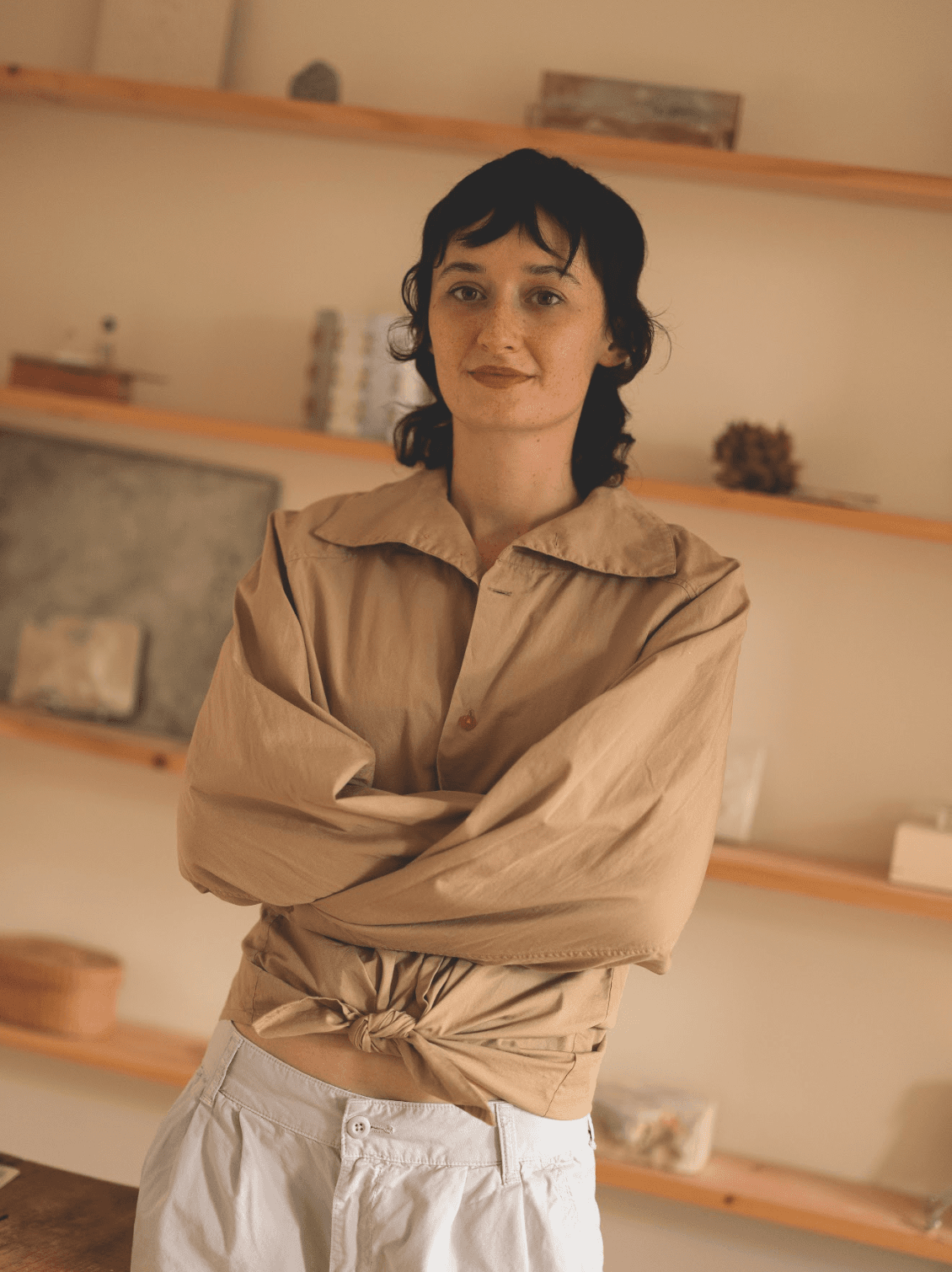
Katy Brett has always gathered material references from her surroundings. Whether in rural England, where she grew up, or in Brooklyn where she now lives, Katy’s interest in pre-industrial craft—when you could only make things with what was locally available—has lead her to foraging in some unexpected places.
“I was doing it in Greenpoint, going out and foraging for a lot of gross stuff and trying to make something functional with it for domestic space,” she tells me. “One of my favourite pieces I made was the quickest and easiest thing, which is often the case. I found three lamb bones—leftovers from food, which were hollow in the middle—and stuffed the handles of a plastic fork, knife and spoon in them. I loved the relationship between the materials, and it felt good in my hand. I ended up casting them in pewter, too, translating the plastic and bone into metal.”
The pewter cutlery, Crofted Cutlery, is one example of how Katy’s material library becomes part of her work, but the process of translation from one material to another often happens in ways that don’t necessarily allow for the elements involved to be applied directly. Whether it’s because of scale, something actually being part of a landscape, or a desire to repeat a reference over and over again, Katy’s approach to souring references is equal parts rigorous and light-footed. Rock pools in rural Scotland—where Katy’s mother is from—become a typeface, a pheasant bone found during a residency becomes a hook, a scrap piece of metal found by a Greenpoint construction site becomes an element of a teaspoon. “I need to put it to bed now,” Katy says of the scrap metal, “but I love that tiny scroll.”
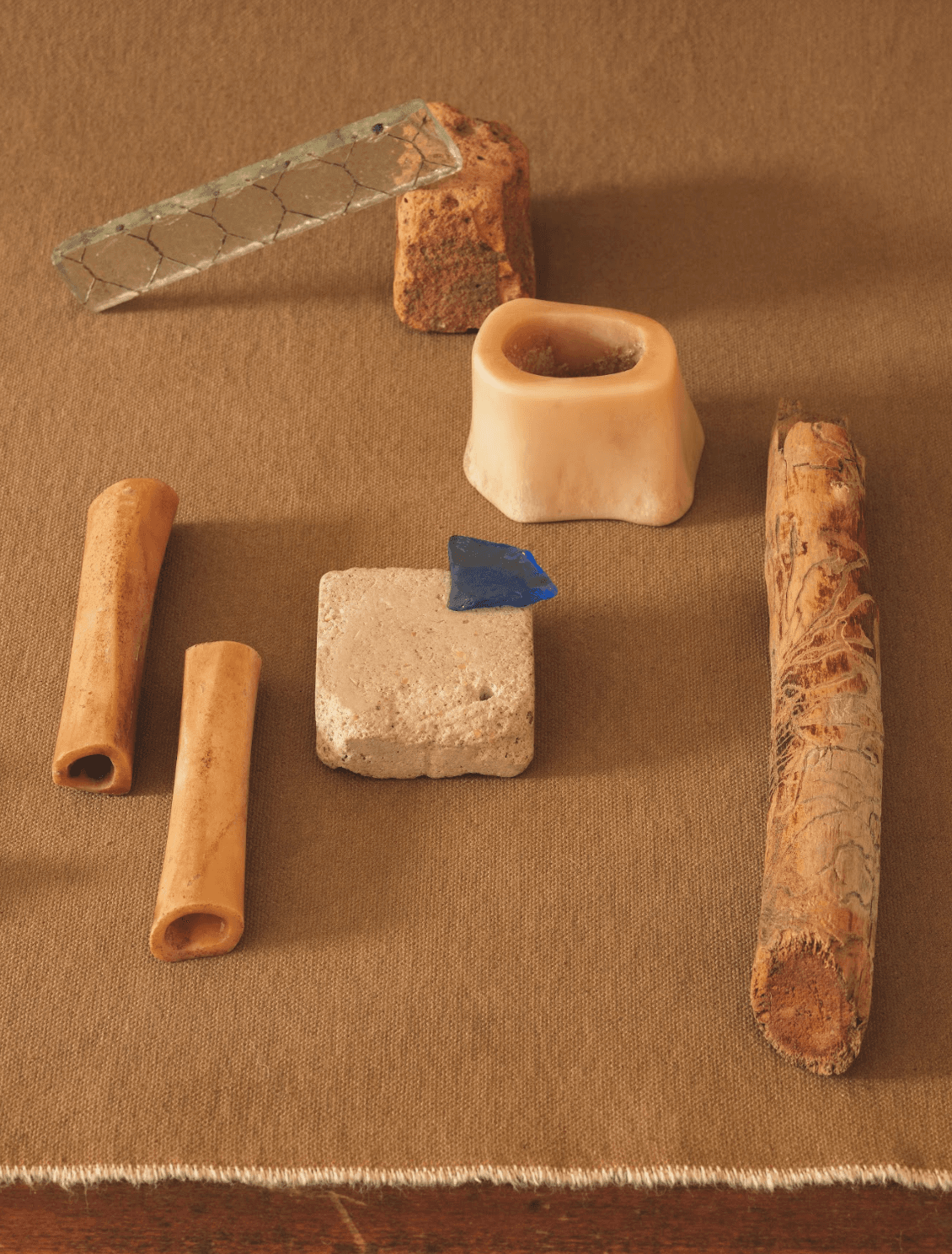
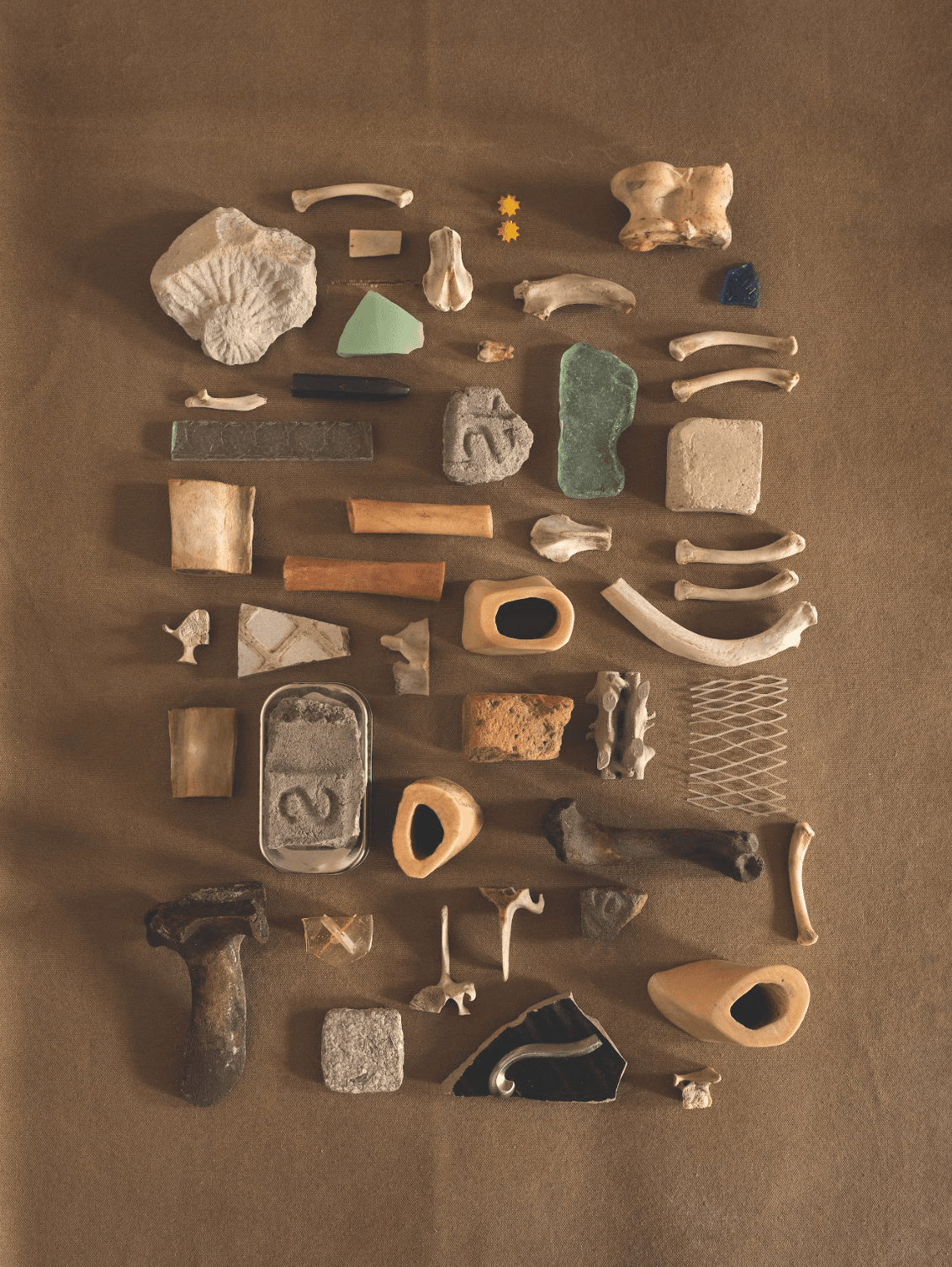
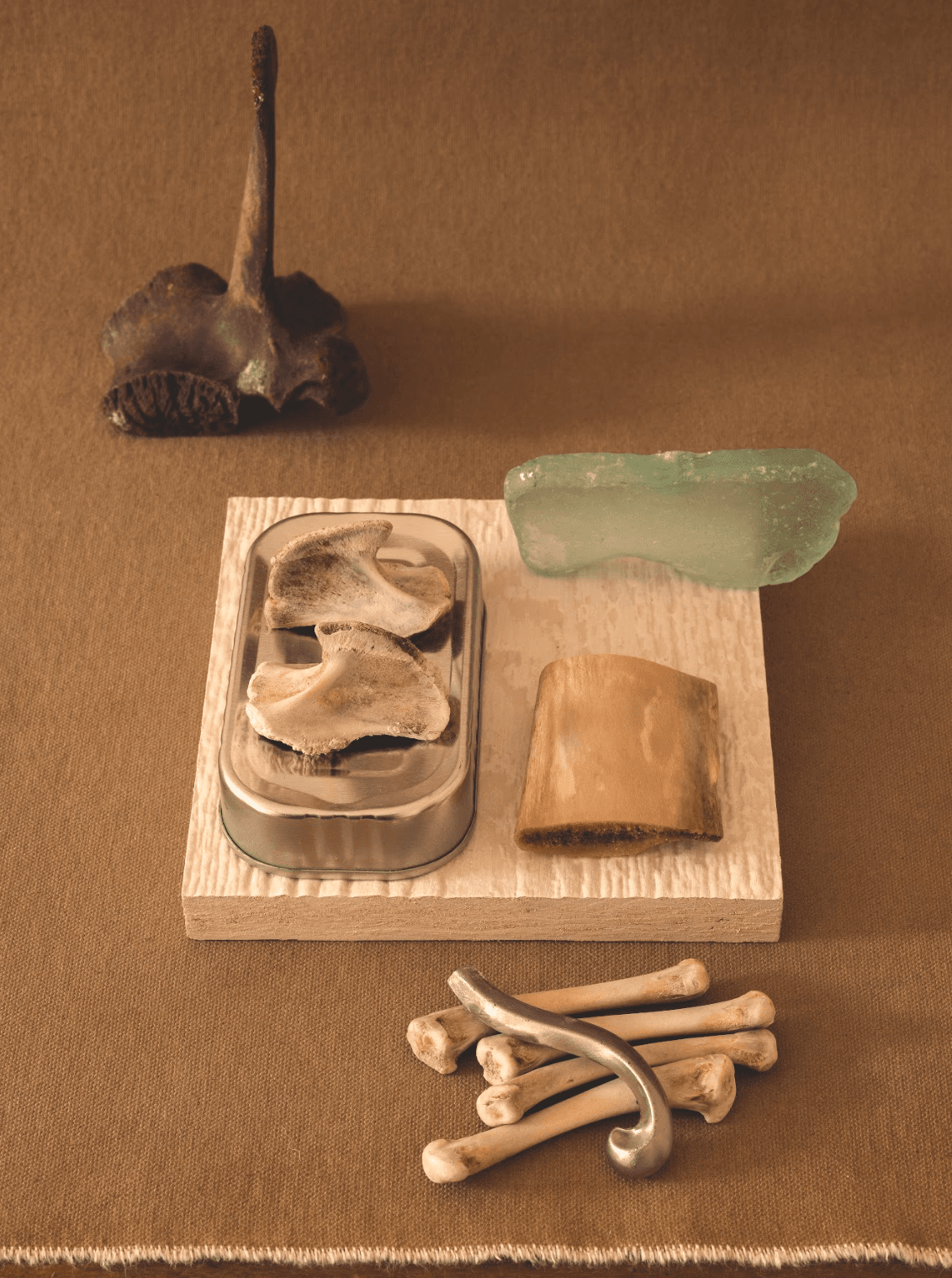
The scroll is one of the pieces that make up Katy’s material archive, which holds many of the elements that have informed her work over the last five years. The pictures in this story are still lives of those things; “the materials that inform my work, rather than the work itself,” Katy says.
Although they are a series of elements, the way the archive is brought together as compositions makes it feel like more than the sum of its parts, and begins to bring the viewer into the realm of how Katy perceives her raw material. “They are tools, influences, everything. I carry them around in a fishing tackle box, and they all have their little sections.”
While there is a whole range of materials in her archive, Katy is increasingly drawn to working with bone. “I think I was waiting for a material to find me, and I’m feeling excited about starting to define my practice through bone,” she says. She’s polished bones and used them as parts of lamps, cast them, and ground them down into terrazzo. “I assisted a stonemason on the Isle of Skye, who makes oyster shell terrazzo” Katy tells me. “I was so in awe of making something out of oyster shells that's so functional. I just rocked up to his studio one day, and asked if I could help out.”
When she got home to Brooklyn, Katy started “messing around with different crushed hard substances”, and found that chicken bones make for great material: “I would go to Buffalo Wild Wings, have a bunch of chicken wings with friends, and then bring all the bones home and crush them up to make this cast tile.” As well as using her own dinners as source material, Katy has asked people in bars if she can take their bone marrow home, and is thinking of asking restaurants if they would work with her as sort-of material suppliers, when they are throwing out bone waste. “Luckily, I can pull up pictures of my work. I can be like, ‘here is what I make’, which makes it less awkward,” she says.
The chicken bone tiles, which are mixed with crushed eggshells, have become a series of wall-mounted, figurative pieces, Pail, Shears, and Argo. “One is a cow, one is a ram and one is a stag. They've got different amounts of bone in them. I was referring to them as a tablet, but people call them tiles. It was so nice to make something less functional. It felt so freeing.” Although they aren’t functional objects, the use of bone as a medium challenges the idea of the work being purely decorative: “I love the process of having this leftover material and then making something formal with it. The frame is made from cast impressions of a plastic cocktail stirrer, too.”
Katy started doing graphite rubbings in a sketchbook during a road trip in Montana, when she came across a drain hole cover with “Rain Bird” engraved into it, with an outline of a bird. She wanted to have a one-to-one record of: “I couldn’t take it with me, but I liked the scale.” “Nine times out of ten I will do a rubbing of something mass-produced. In Montana it was the drain hole cover, and some moulded plastic gun cases that were just so beautiful.” The rubbings often feature printed type, a format that doesn’t really appear in her work, but as an integral part of her training in graphic design, Katy remains drawn to it: “It feels like such an influence in my work, it makes me think about the materials and forms that shape our world.”
Working intuitively with foraged elements, seeing the things she comes across as a signal of what she is supposed to make, guides her process. “I don’t know if it’s just my mentality in life” she says. “When I come across something interesting, I feel like I have to try to figure out how to make it work.” In contrast to the equal part limitless and stifling possibilities of working digitally, Katy finds the limitation of using found materials productive: “It feels so nice to reduce, reduce, and reduce.”