A Perfect Age
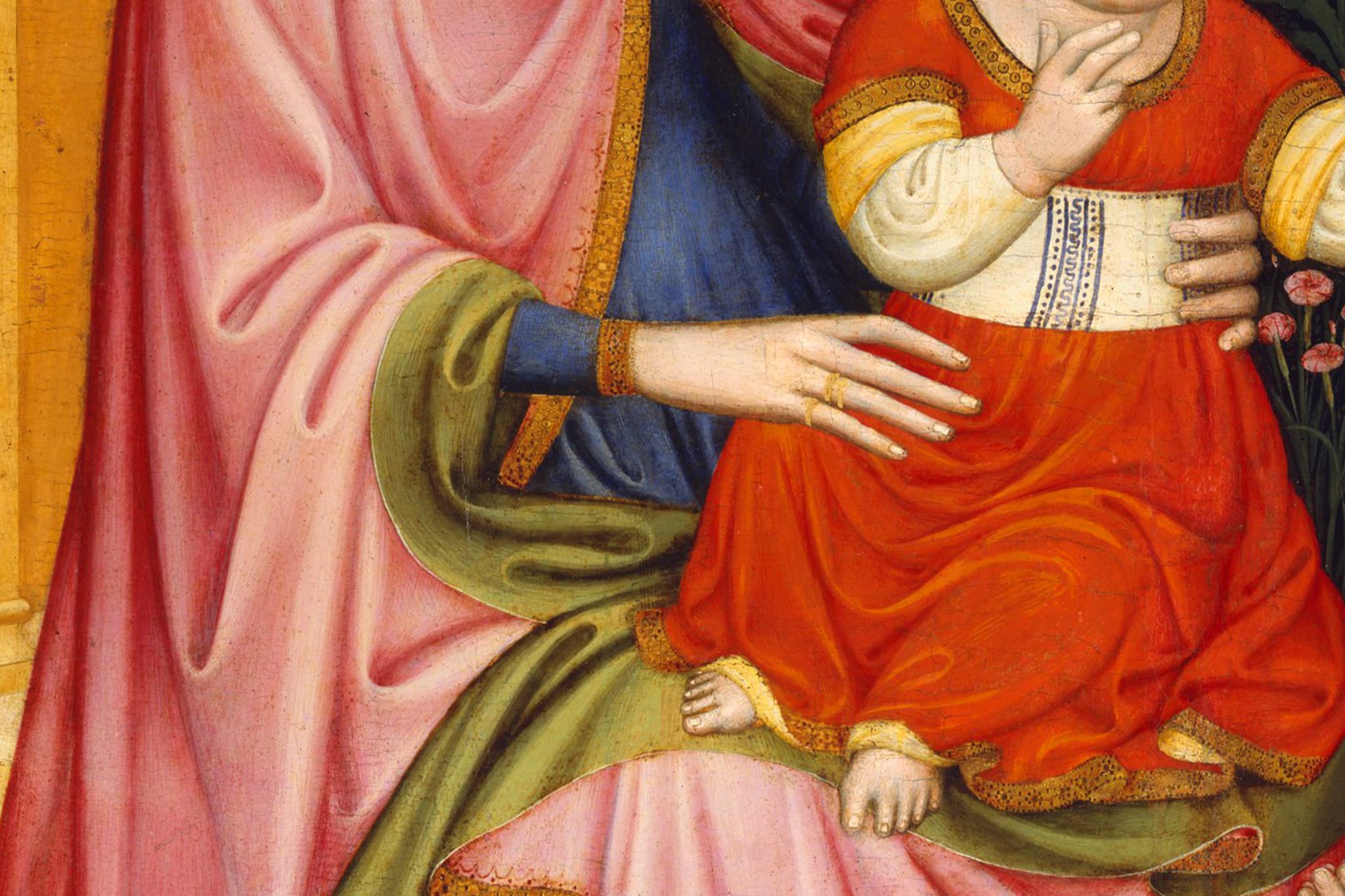 Madonna and Child with the Donor, Pietro de' Lardi, Presented by Saint Nicholas
Lori Anne felt her dad’s love only once in her whole childhood, after an aunt of his died and left him $10,000. He took her on a trip to Paris with the inheritance, when she was “the perfect age”: ten, independent enough not to be a burden, dependent enough to act like his darling.
It was a lovely holiday, their one shared happiness—sorbet at the Place des Vosges, books from a stall by the Seine, and long sessions in the sauna in their hotel’s basement, where they held each other’s hands on the hot wood benches until their pruned palms squeaked. They wiped the sweat off their foreheads and patched it on each other’s sweaty arms and chests, a rotating cast of Korean businessmen on lower benches never looking at them, never flashing a glance when they giggled, the two of them emerging from the sauna and running to the side of the pool and kneeling and ducking their whole heads in it for instant cooling, then coming up for air, dripping and gasping, looking at each other and laughing.
Back home, her dad forgot about caring for her, as if it were a vacation activity best left behind, like midday naps. When she was fourteen, he disappeared for two months and then came back but not all the way, stopping a few miles away from her mom’s house, at a trailer park that had washed up against a set of abandoned railroad tracks. He fought with her mom to see Lori Anne more, more to fight with her mom than to see Lori Anne more. At least in Lori Anne’s mind. Once, on a Saturday they were supposed to spend together, he never showed. Lori Anne went for a walk and saw her dad on East Main Street doing a wheelie on a bicycle that had no front wheel, giving him no choice, he had to keep the front of the bike aloft to keep it moving. He was pedaling in the opposite direction from her mom’s place.
Lori Anne started writing sonnets and stories to exalt her sadness. She sent her uncle five poems that her dad, in a rare moment of availability, had called “confused drivel.” Her uncle used the word ineffable, as in: Lori Anne had captured the ineffable. It was like an act of forgiveness. Lori Anne loved her uncle forever for the words he taught her by way of praise.
When Lori Anne was in high school, her dad emailed her a David Brooks op-ed, and she replied by citing a paragraph about becoming a “Yes-sayer,” affirming everything in life, even its ugliness, which she’d seen block-quoted on the Wikipedia page for amor fati. Her dad responded quickly, “A splendid manifesto, beautifully expressed,” believing she’d written it. Now she had to disabuse him of his admiration for her: she told him over the phone that Nietzsche had authored the passage and he said, “Oh. Of course.” As in: of course you couldn’t have written something I liked.
Now she was thirty, a new mom to a boy she struggled to love. She was too ashamed to admit it to her mom, to her girlfriends, to her husband, so she went to her dad for advice: I feel nothing when I hold my son.
Her dad sat at a desk in a dim basement office. Almost bald, he had only a few scattered wisps of greasy hair that he never bothered to shampoo, a face made gray by stubble and sleeplessness. Except for a narrow path that led to a silver metal folding chair, spotted with orange splotches where its paint had peeled, the room was packed with black binders. The binders were stacked in shoulder-height piles on the ground and spilling out of the accordion closet doors. A parapet of binders lined the desk’s circumference.
Her dad cleared his throat and leaned forward, elbows on the desk. Give it time, he said. The day will come when you are ready to love. It will come like afternoon rainfall in a mountain village.
A mountain village? Lori Anne wanted to laugh, but she couldn’t remember how.
When it happens, cling to your boy, her dad said. Hold him tight, and do not let him out of your sight. You can never love the same person twice.