The Plantman Gives Life to New York’s Underground
Photos by Sam Wachs
The Plantman is running late on his way to Paradise, one of several nearly identical plant shops in midtown’s flower district, and part of the Plantman’s rotating circuit of workplaces. It smells straight up like the Rainforest Café as I mill about the storefront. The walls burst with orchids and inextricable tangles of greenery and I’m thinking about an Ezra Pound poem, “In a Station of the Metro”: “The apparition of these faces in the crowd: / Petals on a wet, black bough.”
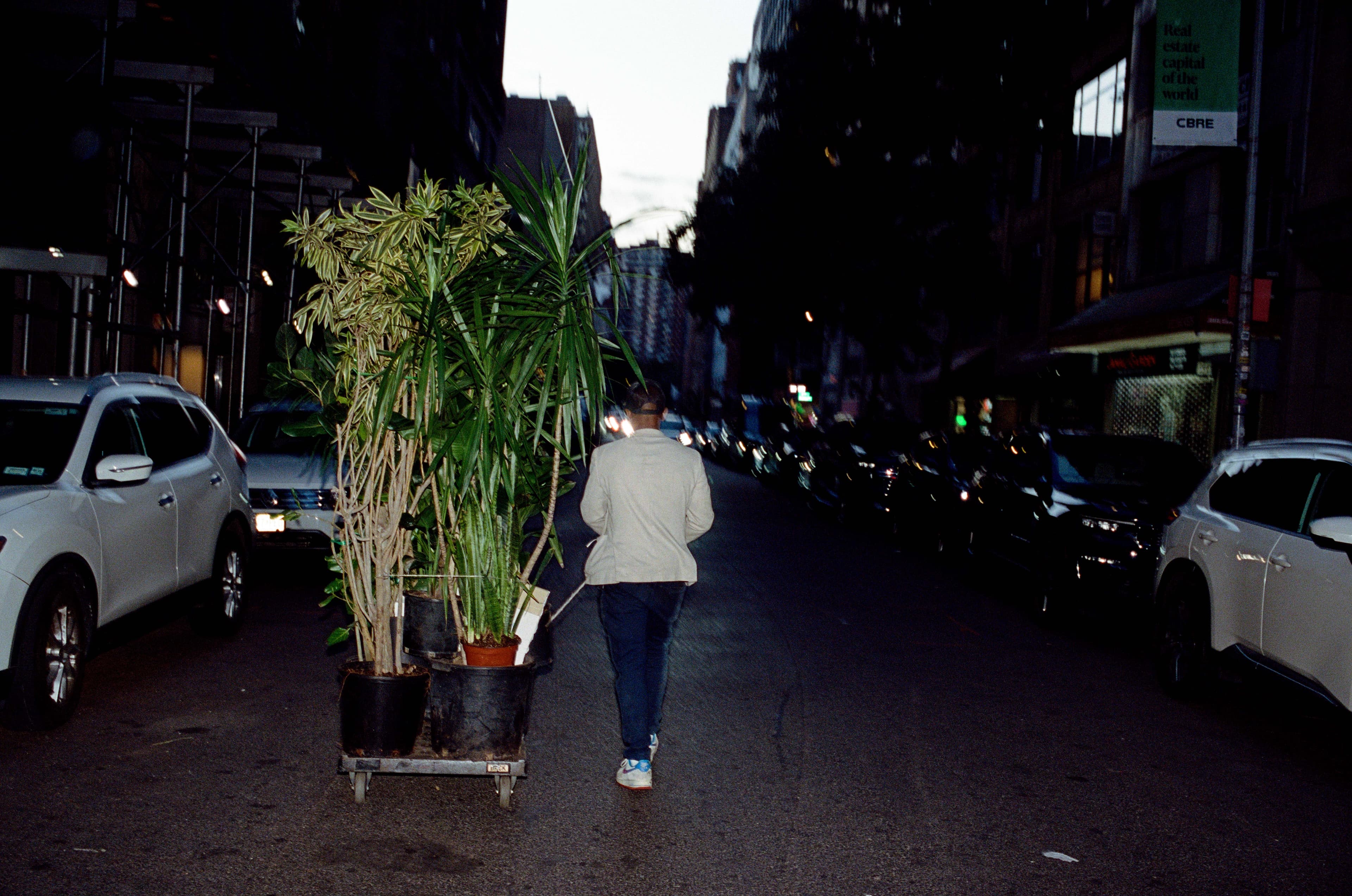
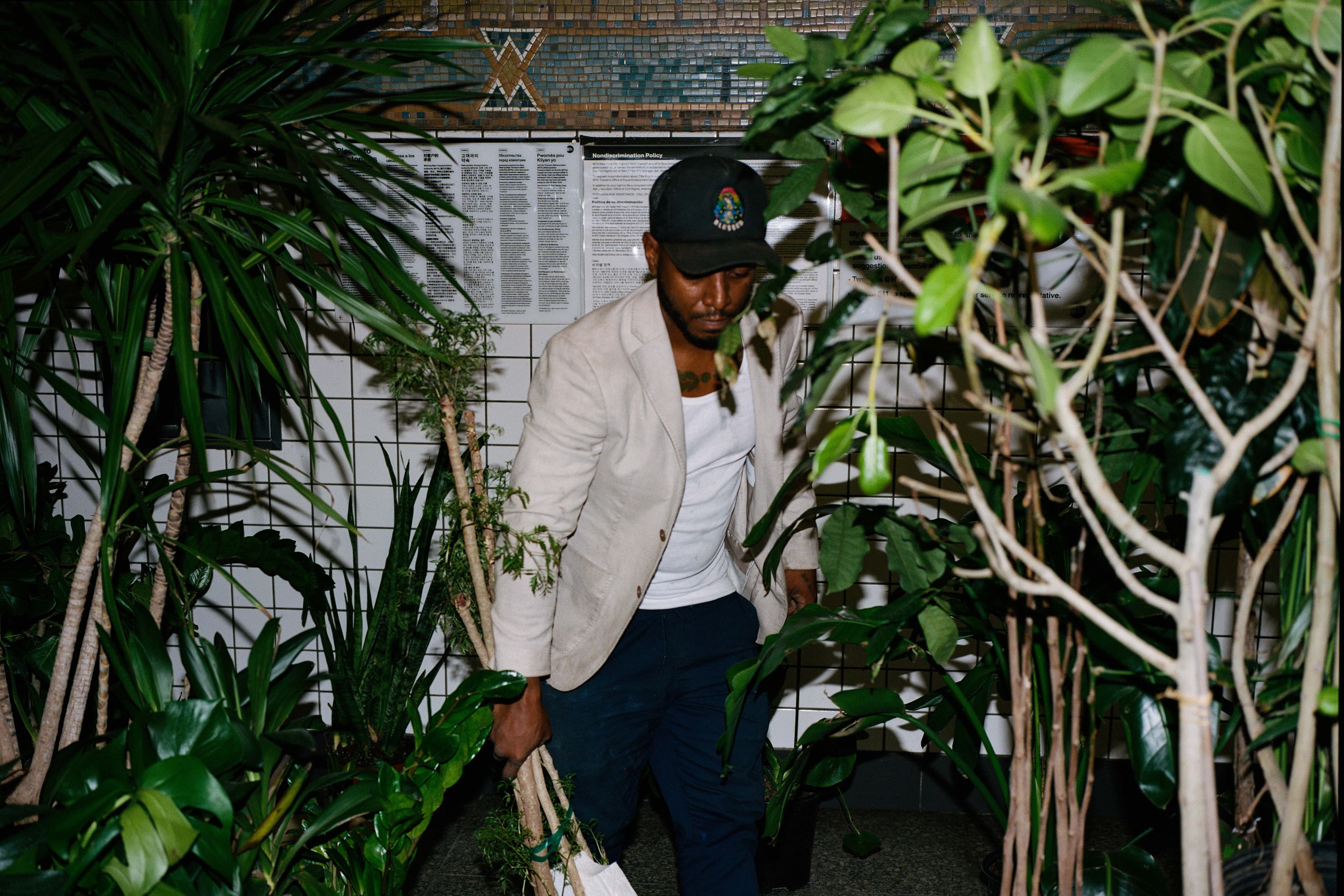
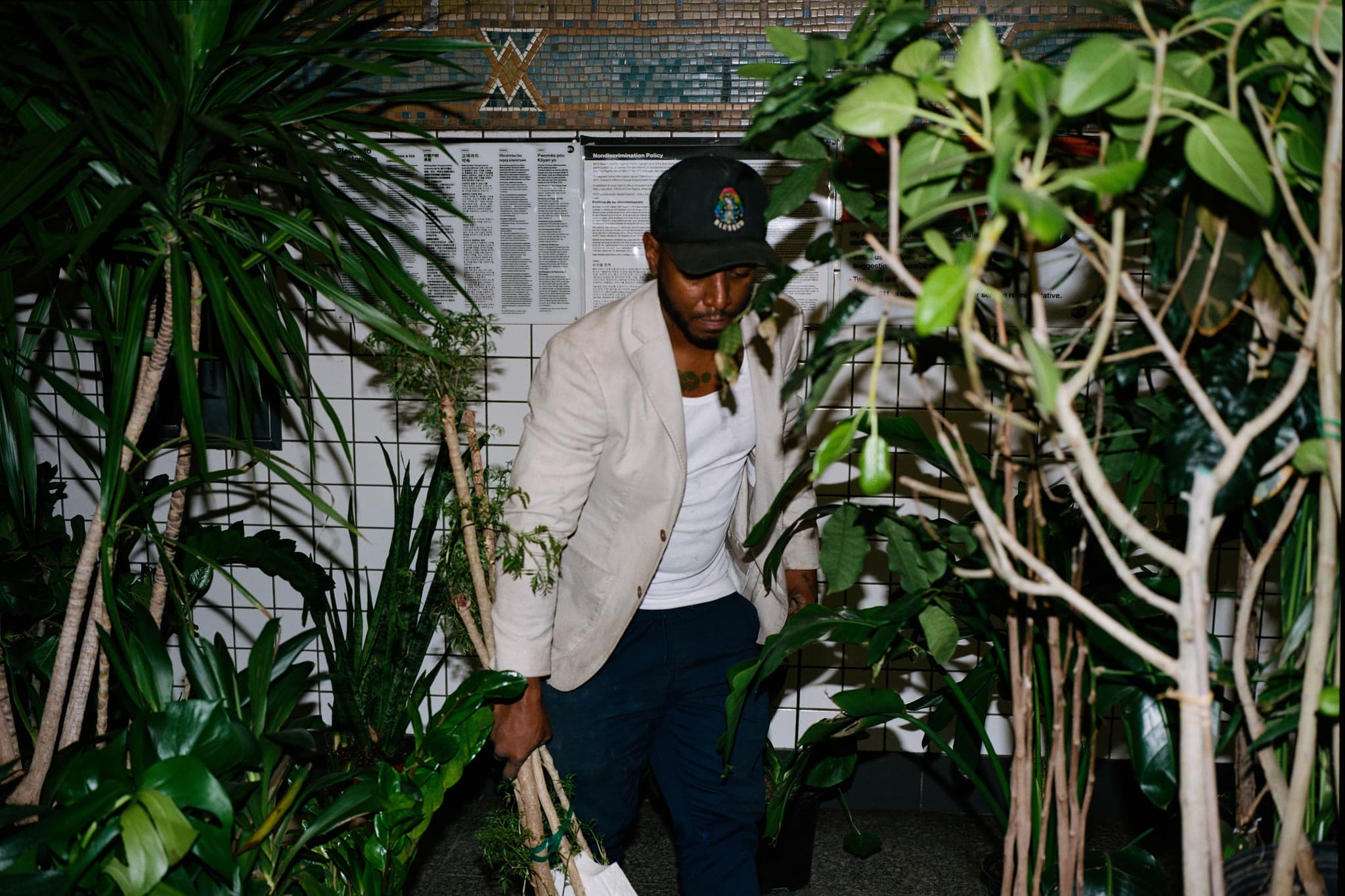
Mike “The Plantman” Andrade arrives in a swirl of foot traffic, surrounded by boys wearing all white even though it’s after Labor Day, a woman with vitiligo in a pair of rainbow clogs, a teenage girl in a baggy T-shirt that reads PLANT MAGIC. The Plantman says a shy hi and immediately gets to work closing up shop for the day. He gets paid in plants. One evening of labor yields a double-digit haul of snake plants and spider plants—their stringy fronds frizzed out like a tangle of hair after an afternoon nap—pothos and philodendron, their heartshaped leaves bleeding with yellow. After the Plantman closes up shop, he pulls them on a dolly to the subway, where he sells them at steeply discounted prices to MTA riders. It’s his only source of income.
The Plantman is quiet and charming. He shines in a shy way, softly self-assured, subdued joy simmering beneath the surface. A slight woman wearing head-to-toe purple teeters up to the edge of the sidewalk. She’s no stranger to the Plantman. “I know Mike personally,” she explains. “And if you need to know anything about him, know that he’s terrific and unique. And make sure people know he cleans up after himself.”
The Plantman was born for this. He grew up around greenery, his father supporting the family by working in florists and plant shops for most of Mike’s young life. For Andrade, it all started as therapy. One plant, one perfect slant of sun. He was battling a bout of depression—one catalyzed by his partner taking their three children and leaving New York—when he brought his first plant back to life. He nicknamed himself Plantlife. “People came to find me,” he says. “They said they’d heard I could bring plants back to life. They wanted my advice,” he explains. “So I’d help them. I’d ask how they’d nurture the plant, then let them know what they could be doing better. Repot, reposition. I always knew what was wrong.”
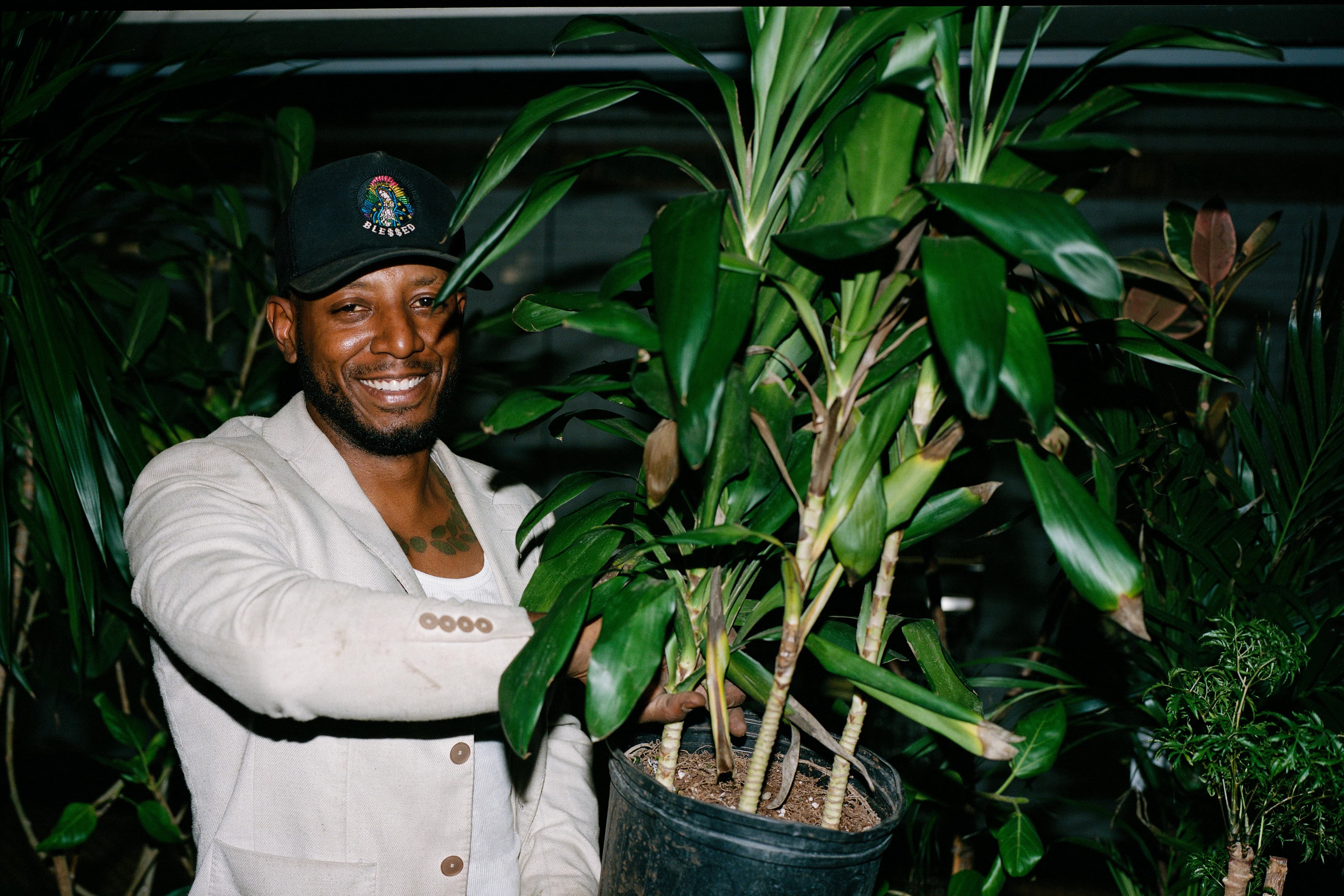
Without a car and unable to rely on truck drivers to pull through for his floral deliveries, Mike turned to the subway partly out of convenience, partly out of necessity. People would try to purchase his plants on the spot. The sheer demand crystallized the idea for a new business model: a mobile greenhouse. It’s an efficient process: trade labor for plants, transport the plants on the uptown 1 train to the 96 St station, sell until there’s nothing left. Plants every day, cut flowers Monday through Friday. On any given day, the Plantman walks away with $400 to $1,000. Most men buy flowers to get out of the doghouse. (The Plantman recommends orchids or red roses to get out of relationship troubles.)
It wasn’t until 2018 that he became the Plantman. People began to recognize him after an article published in The New York Post featured a photo of him pulling a palm tree out of a subway car. “Do you feel like the Plantman?” I ask. “No,” he says. “I know I’m the Plantman.”
We’re nearly finished closing up shop. The Plantman collects his payment, a small haul of greenery today, and begins repotting on the edge of the sidewalk. “God is my boss,” the Plantman explains, dragging six sets of hanging ferns to a homeless boy drinking a root beer under a digital obelisk advertising Pumpkin Spice Lattes. “I don’t have bad days, just slow-blessing days,” he says. I want to know what it’s like to have spreading joy as your central job description. “So many people I see—they don’t walk around happy, but they leave happy,” says the Plantman.
He shares a story with us about an angry man on the train. He was getting in people’s faces, screaming, agitated. The Plantman offered him a white orchid. The man’s anger amplified, yelling back: I don’t have any money and I don’t even know what kind of flower this is. When the Plantman explained it was free—just a gesture, an offering—the anger dissolved into tearful relief. “No one had ever given him a flower in his whole life,” Mike says. “He started crying right there, hugging me. Hugging the flower. It touched everybody on the train. God gives me extra flowers just for moments like that.”
The Plantman makes it look easy. He has the energy, the attitude, the patience. “You can’t be scared to get dirty,” he explains, scraping soil off the asphalt with a piece of cardboard, then with his bare hands. He pulls twine and ribbon from the trash to tie up loose leaves as we wheel our haul toward the uptown 1, the dolly unwieldy, nearly swinging into motorcyclists, into cop cars, inches away from brushing against the aluminum sides of stationary 18-wheelers stuck in traffic. The Plantman pours Almond M&M’s into his mouth as we assembly-line the plants down into the station. He tells us another story, this one about a witch. He could feel her energy seeping into the station. He asked her not to touch his row of orchids. “She didn’t like that,” Mike says. “She looked me dead in the eye, touched the petal of a purple orchid, and I watched the entire row of flowers wilt at once. They all died. She was a real witch. That was real magic.”
People shuffle through the train car doors, sullen until they see the trees. Plain faces light up with joy as they step into our jungle. The Plantman throws up a peace sign and announces, “The Plantman is here! Can’t beat the price, the plants’ lookin’ nice!” A shy smile spreads across his face. The volume slowly rises, lively sounds of Spanish swelling as the Plantman bargains with a Puerto Rican couple. In an instant, we’re the center of attention, not a mirage but a real oasis in the depths of the concrete jungle. People press their faces against the glass of passing trains to catch a glimpse. How unlikely, how impractical. Friendships start to form. A girl with felted flowers in her Reformation tote and a woman who could be Zoe Saldaña’s younger sister compare their new plants, freshly repotted Songs of Indias. A portly grandfather leans over to compliment a young mother’s new fiddle-leaf fig. Some people remain unfazed, heads bent down in books. Others look on in bemused disbelief, audibly laughing, pulling out their iPhones to take photos. Someone whistles a tune to nothing.
In the station of the Plantman, nobody is turned away for lack of funds. It feels rare to bear witness to benevolence for benevolence’s sake. A woman trots up with her pit bull in tow, wearing a felted fedora. She pulls out a translucent pink piggy bank stuffed with $7 and a smattering of loose change. The plant she’s eyeing goes for $60 in-store. The Plantman was planning to sell it for $20—but for her, tonight, he sells it for $7. “You better not eat my bird of paradise,” she whispers to the dog while thumbing through her slim stack of bills. “I’ve waited for so long to find one I can afford,” she explains to the dog, its snout uplifted toward her focused face. “God said to give it to you for seven dollars,” says the Plantman.
A DJ duo sidles up, speaking French, holding hands, a couple. The girl negotiates for a dragon tree, its spiky leaves brushing up against the Super Funk vinyl tucked beneath the man’s arm. They invite the Plantman to their next set on the rooftop of the Moxy Hotel.
The downtown 1 lingers in the station of the Plantman. Heads swivel as they pass his miniature oasis, these apparitions of faces in the crowd, these petals on this wet, black bough.