The Cake Zine co-founder on her new cookbook Will This Make You Happy and and a life that resists neat answers.
By Rafaela Bassili
Photo by Sophie Davidson
Published
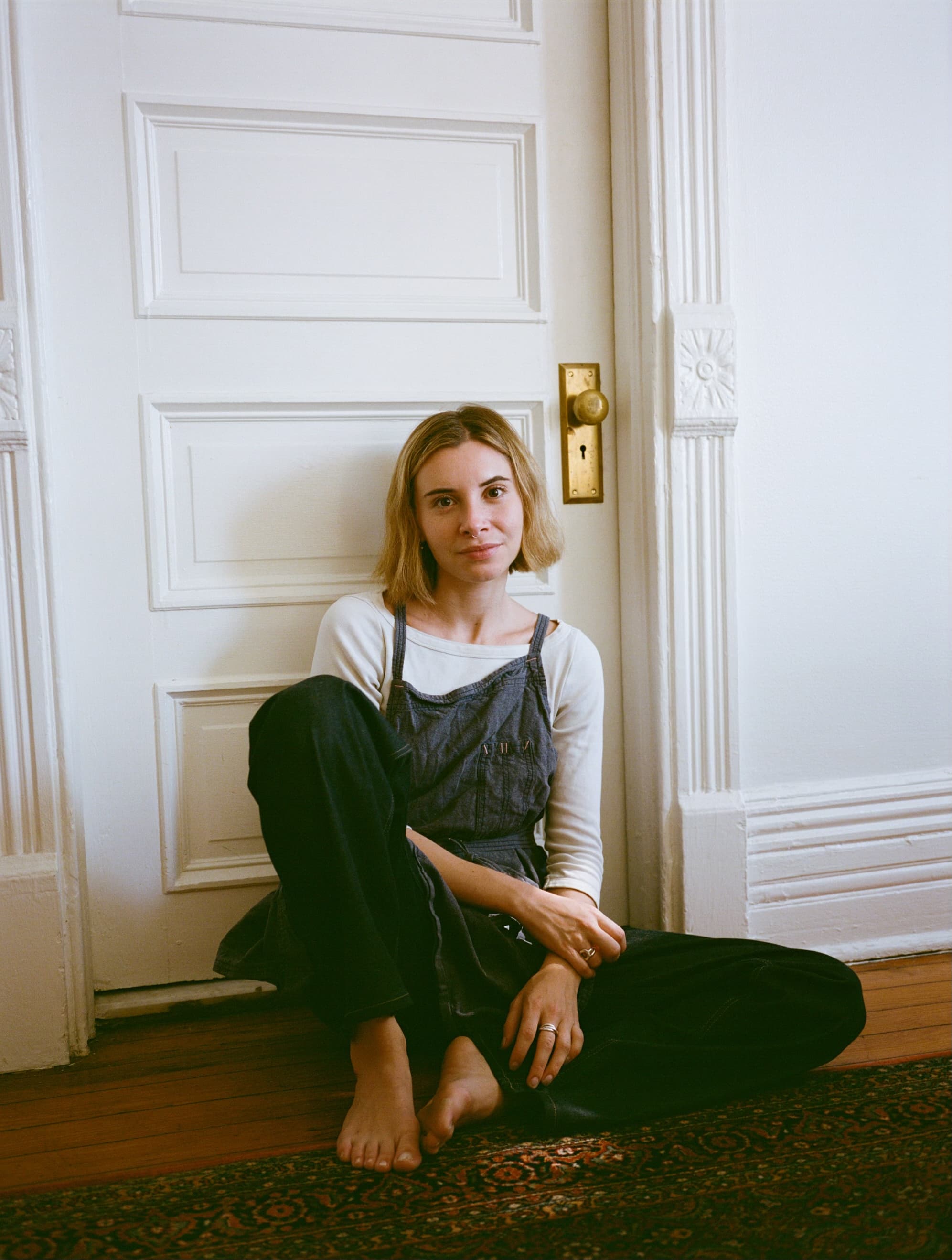
It’s a misty, cold morning when I meet Tanya Bush at Little Egg, the restaurant in Prospect Heights where she is the pastry chef. The dining room is cozy and inviting, the kind of neighborhood spot with crayons on paper-covered tables and coffee refills. Tanya’s daily pastry selection sits on a counter tray like an offering. I follow her down narrow steps to the basement, where she pipes her famous crullers on nonchalant muscle memory and chats with energetic warmth. We talk about Cake Zine, the cult-favorite food magazine she founded with Aliza Abarbanel, and the rollout for her narrative cookbook, Will This Make You Happy, which chronicles a year in the life of a young woman trying to answer the titular question.
A memoir-cookbook hybrid, Will This Make You Happy bookends each season with a block of recipes that get increasingly harder as the narrator advances her baking skills. In between, she tells the story of that growth, which resists the typical memoir arc. In her journey from unemployed, depressed listlessness to professional baker, the narrator nearly loses grasp of her relationship with a character she calls The Boyfriend, white-knuckles through painful disillusionment during an internship in Tuscany, and gets her first job as a baker. By the time a year has gone by, her life has changed, but whether it makes her happy, she can’t say for sure.
Often lyrical, by turns archly self-deprecating, irreverent, and melancholy, the prose takes a similar tone to Tanya’s Instagram account, @will.this.make.me.happy, which won over 20,000 followers with its playful concept. Using the handle as a prompt, she captions pictures of delectable-looking pastries with deadpans: “No,” she writes, under a picture of three perfectly domed profiteroles lathered in chocolate sauce. “Profiteroles filled with malted vanilla custard and blanketed in luscious chocolate, and still, the guilt of delighting in an unseasonably warm February afternoon as the climate apocalypse looms.”
Despite her success as a pastry chef and writer, Tanya is adamant that we’re all shooting in the dark, grasping for resolution where there is none. “The questions I was asking then,” she said about revisiting her early-twenties, “like, what gives me a sense of meaning, what makes me feel rooted, are still questions I grapple with today.” As I nibbled on a pillowy cruller sticky with miso caramel, we chatted about uncertainty, pleasure, and fantasy, in the kitchen and in life. Our conversation has been edited for length and clarity.
Your Instagram page, which shares a title with your book, was an introduction of sorts to your voice and the way you would merge baking and writing. What led you to start it?
It was the early days of the pandemic, and I was unmoored and unemployed. It was this moment when everyone was grappling with existential despair, and the predominant panacea that was offered was baking. Like, if you make sourdough or banana bread, it’s supposed to quell your anxiety. Originally, I thought that was rather stupid, and when I started the Instagram, I was kind of lambasting the idea that this was going to remedy all of my depressive tendencies. I’d been on a slew of SSRIs and had yet to really feel the effects. So, I started baking and came to enjoy it. I realized that I liked making something.
In the book, the question of “will this make me happy” was central for the narrator, who is a proxy for a younger version of myself. It emerges from this early-twenties sensibility of: “Who am I? What is going to give me a sense of meaning, purpose, and fulfillment?”
One of the things I find so refreshing about your approach is that baking is thought of as a self-care activity, this kind of soothing—
Domestic, craft-oriented activity.
Yeah. But in your book, and in your writing in general, you have this framework of, “Baking is my job, and as such, it’s not always awesome.” Your writing is lyrical and sometimes romantic, but it’s consistently no-bullshit. You’re committed to telling the truth, but in a gentle way. How did you find that tone?
Thank you. I am a self-taught baker, so there were an incredible number of humiliations and failures and moments of exhilaration that were a constitutive part of the process of teaching myself a new skill. I was often encountering these blockbuster cookbooks in which the finished product was presented on a silver platter, and everything was perfect, [like a] gorgeous Nancy Meyers kitchen, and that was just not my experience of baking at all. So I wanted to articulate what it’s like to try and learn something new, which is necessarily going to be difficult: The first go-around is not going to turn out how you expect.
This early-twenties version of myself in the gloom-of-youth moment is about trying to reconcile pleasure and happiness and reality and fantasy. At the beginning of the book, the narrator [thinks being a] pastry chef sounds like an incredible fantasy. It’s this sense of identity and self to finally contain myself within, and it’s going to solve all of these problems and inconsistencies I’m finding in my day-to-day. There are brief moments of euphoria and exhilaration in learning something new, and also, it’s really hard, waking up really early all the time and having a very physical job—having to professionalize something is difficult. The book takes place over the course of a year, and nothing really resolves. I wanted it to feel cyclical, as if the narrator has been spit out almost exactly where she was at the beginning, only now she knows how to bake.
I’d love to talk about Cake Zine. A lot of food writing is memoir or recipe-based, but Cake Zine publishes historical deep dives, reporting and other kinds of writing. How did you and Aliza conceptualize that?
We were very much building the plane as we flew it. Actually, the idea was born in this establishment, which was Kit at the time. We were running a mutual aid bake sale together and talking about the landscape of literary food magazines, feeling that there wasn’t something interdisciplinary and experimental. We were like, “What if we did a little zine about cake?” We are both twin sisters, so initially we [thought to do] twin issues, Sexy Cake and Wicked Cake, which is why we named it Cake Zine.
It was this moment at the tail end of the pandemic when people had spent a lot of time ogling pastries online and were really hungry for community. When we had our first event celebrating the initial issue, there was so much appetite for it, [we knew] it was an underexplored arena. And also, there’s a dearth of outlets for younger writers to pitch for. One of the constitutive parts of Cake Zine is that of course we’re publishing household names, but we’re publishing them alongside first-time writers and giving the same level of editorial care to both.
This book emerged out of the Cake Zine ethos that when you look at food and living together, interesting insights emerge. It’s a narrative cookbook, so to me, that means a meaningful entwinement of recipe and story. It’s both a technical text and also, hopefully, a juicy, propulsive read. We have recipes in most of our issues, not all—in the forthcoming Steak Zine, we don’t have any––but we’re also interested in what’s happening outside of the wings of the recipe, the historical, the cultural, the personal, the political. That interdisciplinary approach was very much shaping my interest in formally interesting food writing.
That’s such a compelling part of your book, it’s a page-turner. There’s a very palpable plot running through it. As a reader, I want to know, is this narrator going to make it as a professional baker? And also—
Is she gonna end up with The Boyfriend?
Exactly. When you were writing, how were you thinking about merging the timelines of the relationship and the career pivot, and balancing them with the more observational aspects of the story?
I wanted it to be a delightful, juicy read. I grew up reading mostly narrative [writing]. When I’m immersed in a story, I want to learn as much as I can about that character and what they do. So I thought that entwining this coming-of-age story with recipes would hopefully galvanize people into the kitchen. If you care about what’s happening with the narrator, and you’re watching her humiliate herself left and right, maybe it’s going to incentivize you into the kitchen, and if things don’t go exactly as planned, you’ve read about someone who’s gone through that.
I chose one year as the framework partially because a good cookbook is sort of like an archive of a moment in time. I knew I wanted the recipes to be seasonal, but also to get increasingly more difficult as the book goes on. A lot can happen in a year, and not a lot can happen in a year, and in this particular phase of my life, I was so hungry for pleasure at every turn, courting happiness in every possible way I could. To me, it’s difficult to extricate a desire for a professional pursuit from what was happening in the wings romantically and personally. When you’re learning how to bake, you necessarily have people you are baking for. There are people you’re testing the recipes around, so the story around the baking felt like an important part of the book I wanted to write.
I was thinking a lot about Elizabeth David and Laurie Colwin when I was reading your book.
Oh, yeah.
Do you have any specific food writers or even non-food writers who you were going to or thinking about when writing?
I mean, Laurie Colwin, of course, [is] a north star. I love Home Cooking so much.
It’s so good!
I love her bossy, slightly chiding, comical tone. On the cookbook front, Brooks Headley has this book called Fancy Desserts. He actually wrote for Steak Zine. He’s the chef of [the East Village restaurant] Superiority Burger and an incredible writer with an extraordinarily singular voice on the page, and it changed my understanding of what a cookbook could do.
I read a lot of novels. Susie Boyt wrote a book called Loved and Missed. It’s about big love and big disappointment, and it’s a little dry and arch in tone, but restrained and warm and embracing. When I read books like that, I feel really inspired and excited about what narrative can do. So, I was looking to both food writers and formally interesting projects. There’s this novel called The Debt to Pleasure by John Lancaster, which is ostensibly a gourmand’s treatise that’s sort of satirical and strange. As you’re reading the book, it becomes clear that [the narrator] is murdering people from his past. It’s this utterly strange compilation of things that you wouldn’t expect to find in a food book, and I love that. I love this idea that you might be surprised when you come to the book. I think a lot of people [wonder], “What is a narrative cookbook? What does that mean?” I hope that there is some level of surprise when you open the pages [and see] this big chunk of narrative, then the recipes that emerge from it. It’s not just seeing the narrator make something or fail at it, but also a smell, a memory, a moment that has inspired the recipe to come.
I think that texture is what makes you want to actually get up and bake something. If I’m reading you describe making a cake or a cookie, and there’s an attention to the textures and the smells, I start to get this tingling like, I want a cookie. And then it’s in my power to make it, which is the magic of baking. You start with just a craving and two hours later, you have a thing to eat and share.
Yeah, it’s a cycle of transformation, which is also what a Bildungsroman is. When I was baking, I was like, “This is inherently narrative.” There’s the assembling of ingredients, the whisking, the mixing, the kneading, and the depositing in the oven, and the hoping that it’s going to all work out. Sometimes it does, and sometimes it doesn’t, and that just has all of the hallmarks of a story.
That’s such a good way to put it. There’s a plot to baking.
There totally is a plot to baking! I think food is narrative because we’re sharing it with people. It’s an act of love. It is so deeply and robustly entwined with life. Food is community, it’s other people, it’s sharing, it’s making something for yourself. So many blockbuster recipe books have to [divorce it from its context] because there are thousands of recipes out there, so in order to differentiate, we have to promise the best possible iteration. But hopefully there is room for more storytelling to come about in food [writing].
There is a gentleness in your book that shows the reader that it can be done, but more importantly, if a recipe doesn’t work out, that is also fine. If you’re making a pavlova and it doesn’t turn out, then what? You’re going to have a crumble of meringue—
Delicious.
Yeah, eat it in a bowl! For home bakers, that’s really encouraging.
I’m glad you noticed that. To that point, there was a deliberate choice to include illustrations and few photos. When there are these glossy, beautiful, hyper-stylized photos, [they become] an ideal to work towards that’s actually really difficult to achieve in your home kitchen. That can feel really limiting, so for the lifestyle section of the book, I worked very closely with Forsyth Harmon, who is a novelist and incredible illustrator, and we wanted to evoke the realities of the world around baking: the slew of expired prescription bottles in the medicine cabinet or the indignity of a hot tea bag in a hand. Having it feel a little rawer and realer hopefully makes it less an aspirational text and more a lived-in moment in a real person’s life. I hope that [invites] an acceptance and pragmatism in the kitchen.
You sound like a really busy person.
Girl. [Laughs]
Between being a pastry chef, Cake Zine, and the book, that’s a lot. I would love to get a snapshot of your writing process. When do you fit it in? Do you wake up at three in the morning?
Not that early, thank God. When I was writing this book, it was really difficult because we were opening Little Egg, I was doing an MFA at Hunter, [editing] Cake Zine and freelancing. So I had to carve out chunks of time every day to write, and I found it to be a nice exchange between the embodied, kinetic feeling of baking and the very stagnant, solitary nature of the way that I write. I literally write like a gremlin under the table on the floor. I really like being on the floor when I write. The terror of a deadline was part of what galvanized me to action. Because I’ve been in this mode for a few years where I have my hand in many pies, for lack of a better word, I sometimes am more efficient when I have a lot going on, rather than when I have the endless expanse of a day ahead. It’s been a learning process. I'm looking forward to things slowing down a little bit in the next few months.
Do you have any other writing projects on the horizon?
When I initially conceived of this project, I [thought] of it as a series, sort of like [Richard Linklater’s] Before trilogy, where maybe every eight to 10 years you’re dipping back into a year in this narrator’s life. Is she baking? Is she cooking? Has she abandoned the kitchen entirely? So I am interested in maybe revisiting this form in some way at some point, but for now, I think I’d really like to relax.
Take a vacation.
Take a vacation, focus on Cake Zine and the restaurant and have a little fun.