Reflections of a Teenage Dream
Exploring the end of adolescence, Gen Alpha style.
By Julia Rose Eng
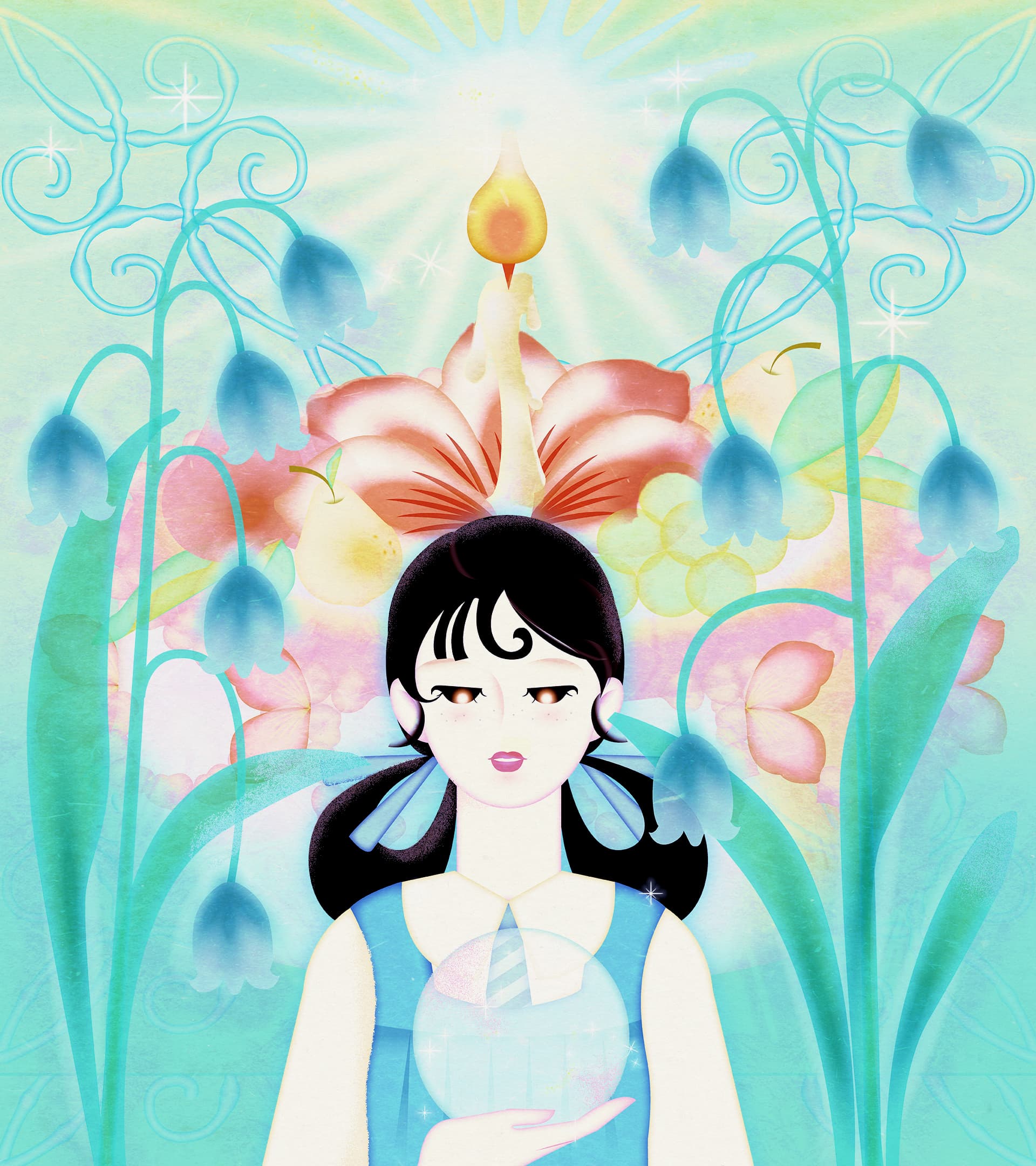
Illustration by Vanilla Chi
Published
The first time I ever visited Paris, I had just turned 13 and hated everything about myself. But that was why I loved being in Paris. I could sublimate my disappointment with the seeming lack of good in my own life into a love for the city around me. I would accept living in proximity to greatness, beauty, and intelligence if I could not achieve it on my own.
Paris has served as my benchmark for growth. When I returned this summer, 19 and with much-improved French, I no longer felt half-baked. I watched the city open itself up to me as I slowly learned to do things alone, talk to strangers, and seek out beauty—not because I felt I lacked it, but because it made me happy. I decided that this summer in Paris would mark the end of my teen years, not my birthday in November.
I reasoned that by picking an end, by voluntarily relinquishing my teenhood, I would no longer fear 20 when it inevitably entered my spirit and rearranged my life around its presence. Yet, I woke up each morning daunted. The light of the horizon would burn itself into the wall above my head as the sun came up, sallying forth the new day with a heightened aggression I hadn’t noticed before. I would turn over between the sheets of my floor-level twin bed, which my mother jokingly referred to as a “pallet,” and shield my gaze. Is it better to face 20 now or later?
I’ve never been one to dread birthdays, but turning 18, then 19, felt unceremonious and inconsequential. I didn’t quite understand the mechanics of living in the sliver of the Venn diagram between teen and adult. I drove myself to the pediatrician in June, where she, having known me since infancy, reminded me to test my drugs if I felt like doing them. At the shooting range, I was too young to rent a handgun, but old enough to shoot an AK-47 (they let me pick whatever target I wanted, and I chose hot pink). My passport photo was taken when I was 14. The girl in the photo looks shocked, scared, and so different from me that I am detained at customs; “C’est n’est pas la même fille.”
I’m not fully convinced that any season of our lives is truly distinct from the others. Teenhood feels so arbitrary: seven glorified years defined only by the suffix that accompanies them. But in living them in their sublime and fledgling beauty, I’ve come to understand that the rose of teenhood by any other name would be just as sweet.
I wonder if I’ll be able to remember being a teenager with color, or whether this season of my life is truly distinct from the next. But this is a necessary thought exercise. If I can’t remember being a teenager now, there’s no guarantee I’ll be able to remember it later on. This is the only thing my psychology professor last semester taught me that I cared enough to carry with me: Memories must breathe to stay alive. You are the sole diver responsible for scooping them from the sea floor and resurfacing them, nourishing them with the light of day and attention. This way, they can sink safely down to be recovered once again, when you are older and really need them.
When I attempted to recall the last seven years from my bed on the floor, my mind’s eye projected upon my consciousness imagined films, collaged and pasted together from disparate, contradictory memories. I pictured myself driving aimlessly to the shore this June with a girl I haven’t spoken to in years; competing in a middle school tennis match, not against girls from a rival school, but against my first kiss and his best friend; playing Schubert at a piano recital for my all-girls sleepaway camp that morphs into my last day of high school. All of these scenes inexplicably took place in the peach orchard at the local farm. Incoherent as they were, I could only look upon these teenage dreams with the greatest happiness. I have made myself at home in life’s late spring and early summer. I have tamed the wily garden, once too warm with passion, precocious, and bursting with unsure beauty, and I’m scared to lock the gate behind me forever.
Despite my warm feelings toward my teen years, when my youngest sister turned 13 this past July, I was hesitant to text her to celebrate. Texting her has always felt like an inappropriate form of communication. This is likely because when I turned 13, I had no way to text anybody—I still emailed my friends to gossip and received invitations to birthday parties by mail. My sister texts more people than anyone I know, serving as the technological heartbeat of her seventh-grade class. I can only imagine that she has a command over the metallic static that wafts unforeseen between cell towers, structuring her and her friends’ social lives. And yet, I want very badly to hold her hand when I speak to her. I’ve always seen touch as the true channel for understanding, the landline before there was a landline, grounded not under grass between poles but in flesh and trust.
It was nine in the morning in Paris and three in the morning in New Jersey. Suddenly, when faced with my sister’s impending teenhood, the concept of being a teenager was no longer as pleasant—its realities scared me. I wasn’t sure if I wanted to be the person to initiate her into teenhood’s harsh bittersweetness, this strange covenant with oneself to embarrass oneself over and over, to find beauty in the incomplete, and to grow painfully and unceasingly.
So far, she’s doing all right. Actually, she’s faring much better than I did. I don’t doubt that her pool parties, soccer matches, growing Brandy Melville collection, and recent school trip to the Poconos are full of the very same laughter, dreaminess, and idleness that I hold onto dearly. But her teenhood, and the teenhood of the kids her age, will look different from mine. My friend Tess has younger sisters, too. On the subway back from a wine bar, she asks, “What does their nostalgia even look like? Watching YouTube on a thicker iPad than the one they have now?”
She’s right to note that our early teenage years were marked by the shedding of the analog world. If you had a computer, you could do anything: find those ruffled skirts that everyone wore, follow the day in the life of a Victoria’s Secret Angel, look up your history teacher’s voter registration, comb through Craigslist’s missed connections. At her age, I felt as though the internet was a game of hide-and-seek, a graceful cyber-hunt that I embarked on with excellent typing skills. The internet, once a glamorous, dangerous, and wonderful scavenge, is now a constant algorithmic deluge, overfeeding and indulging unconscious consumption.
Teen girls are increasingly less awkward, more beautiful, and older-looking. Every day, my sister and I are told we look more and more alike, which makes me glow with pride. Yet I have the sneaking suspicion that it’s not her rising age to blame but her access to influence. The minds of young girls have always been sensitive to information, but so are their faces—drown them in encounters, bathe them in bright lights, let the ponies of their consciousness explore the hills and valleys of childhood cancer, Turkish plastic surgery, homesteading, and AI drone warfare, and watch their guises be transformed. An excess of images and a dearth of mental fortitude. You can roll their pink Silly Putty minds over the continuous scroll of disheartening content, and they will absorb the dark marks.
Being a teenager is seven years of navigating through fog. We were all once at the helm of our ships, feeling unsure and invincible, searching for ourselves. My sister’s teenage dreams are hopes yet to be fulfilled, the search for the bravery to remain constant in a changing world, and an endless search for fun. I can’t remember if mine were ever fulfilled or not, and I’m not sure I care. I will keep my teenage dreams in snowglobes that I will shake when I need courage. I will turn 20 on November 15, and this day will be only slightly different from the ones that came before, and I will be so much more than satisfied.