The Cost of Pleasure
Where want meets need, small pleasures become acts of dignity, memory, and connection in dying.
By Leah Rae Hulgin
Illustration by Jiyung Lee
Published
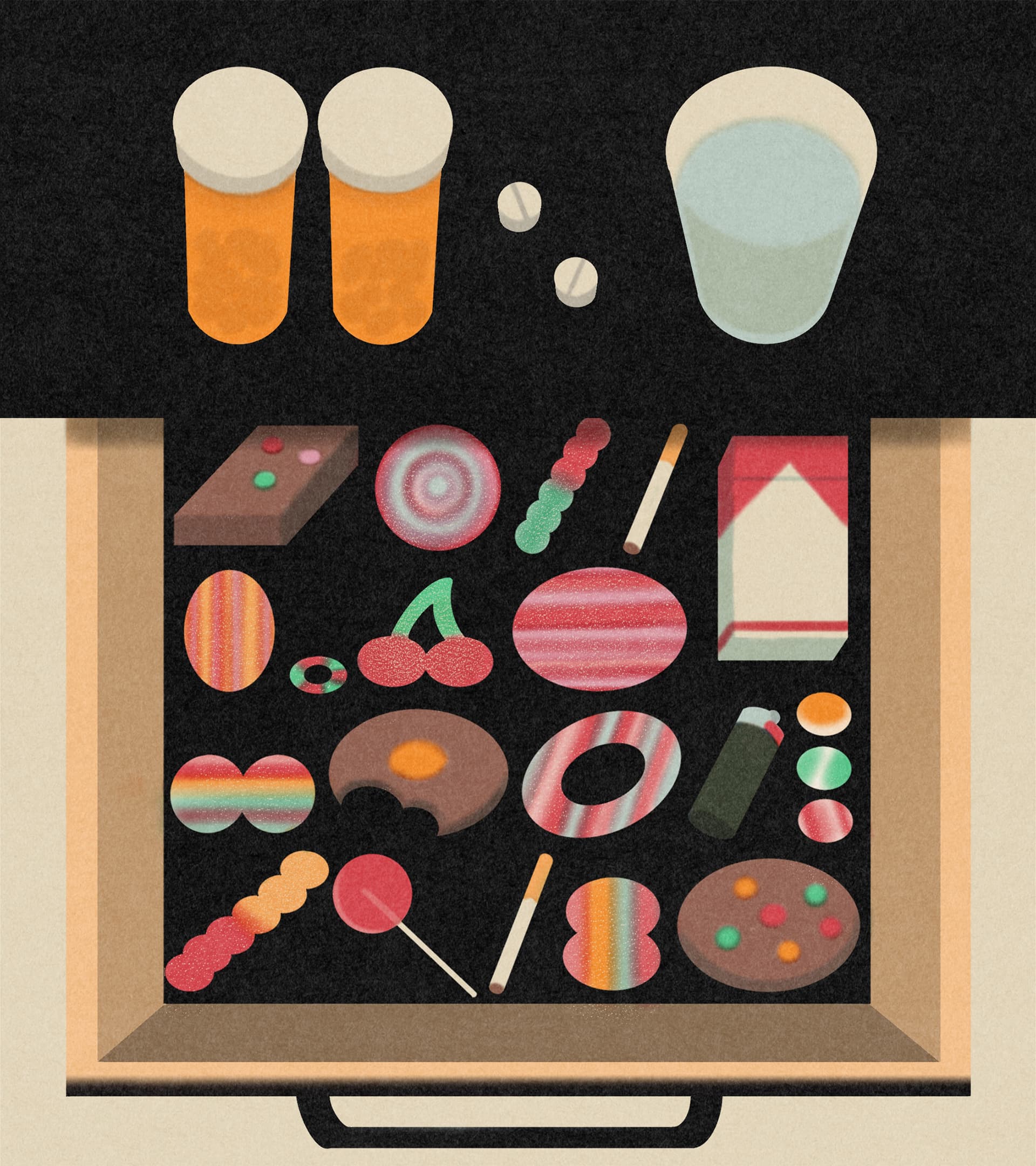
Evan had two requests on the day that he died: candy and a cigarette. He laid in the hospice bed in front of the bookcase, where pain medication, gauze pads, and extra sheets blocked the view of his cookbooks and recipe notes—relics from a pre-cancer life. At 31 years old, pancreatic cancer had aged him beyond recognition. I sat in an armchair next to Evan’s bed, where I’d spent hours each day, grateful to watch the rise and fall of his chest, knowing it would soon stop. He’d spent the last seven months getting the medication he needed through a port attached to his chest. But a need is not necessarily a want. The difference between a want and a need for the living is not the same for the dying. The dying, when reflecting on their life, rarely mention they were grateful to have fulfilled only their basic survival needs. I’d struggled to understand the difference between a want and a need for most of my life. The first phrase I uttered (demanded, rather) as a baby was I need it. Ironically, what I needed was candy. When I became Evan’s caregiver, the line between want and need became more blurry. What Evan had said he needed at certain times I’d call wants in the name of extending what little health he had left. Needs were a means of survival and became my priority; anything else was superfluous. But I was not the one who was dying. What I failed to see was that it wasn’t the candy or the cigarette that he wanted, but simply to fill the end of his life with pleasure.
He opened his eyes and looked at me for a moment. He could no longer speak with much coherence, so we held silent eye contact as I willed his opioid fog to break. He took a deep breath in and told me what he needed: “Candy.”
Evan lived a life of excess. He lived to pursue pleasure and instill pleasure in those he loved. He was a professional chef. His job required him to eat delicious meals and diligently analyze flavors. But bi-weekly chemotherapy severely dulled his tastebuds. It was a devastating blow. Salt became harsh. Spice became metallic-tasting. The only flavor profile he could taste was sweetness. His diet was reduced to mostly sugary foods his doctors forbade.
Evan could eat candy with abandon, but pancreatic cancer came with rules. Sugar was one of few things that allowed him a taste of his pre-cancer life. Before the cancer, I never thought twice about him settling on the couch with several flavors of brightly packaged sour gummies because his happiness was my happiness. Once medical intervention became a necessity of Evan’s life, it was suggested that what was once lighthearted pleasure became consequence-riddled vice. It became easy in my role as caretaker to forget that I was his partner, that I could remind him of joy when he needed it. I lost all sense of who I was before Evan’s illness. I was not a medical professional but I began to act as one, insisting he sip chalky nutrition shakes in lieu of ice cream, and nuts instead of gummy bears. This did not bring me pleasure; Evan’s existence did. I did what the doctors implied might extend his life. But doctors treat illnesses that afflict a person, not necessarily the person. It was my responsibility to fold this new layer of Evan’s existence into the whole, to recognize the illness as not all that he was.
I looked at Evan in his bed, a dying man asking for a child-like treat. I couldn’t give him what he wanted and I hated myself for it. The shelves in our pantry, once filled with sugary snacks and half-eaten bags of candy, now held soups, saltines, mixed nuts, and more bags of lentils than we knew what to do with. “What kind of candy?” I asked. He looked at me, seemingly asking me to read his mind. I’d been by his side for over ten years. I knew he preferred fruity candy to chocolate and sour to sweet. He then asked for a candy that didn’t exist. He sighed deeply and closed his eyes again. I know now that he wasn’t really asking for candy, he was asking that my love for him be not only the grief it was quickly becoming. I was asking him how to do that.
An obituary doesn’t include the manner of death, but the way a person lived: their people, their passions, their definition of ecstasy. As Evan drew closer to death, all I saw was the cancer taking his life. No amount of medication will allow the dying to evade their loved ones’ pain. When, on the last day of his life, Evan asked for things that brought him joy, it was as if he was reminding me that his death was not the whole of his life. I’d been urging him to live in ways that weren’t authentic to the life he’d built. To follow the orders of the doctors–even those that stripped him of pleasure. I wanted him to continue to fight, despite both of us knowing he had fought all he could.
He sat up again, raised one hand, and mimed flicking a lighter. I’d been watching him light cigarettes for a third of my life at that point. I knew what he wanted but I wanted him to say it. I waited. “Where’s my lighter?” he asked. I didn’t answer right away, and he looked at me more intensely. “I need a cigarette,” he added.
I hesitated for a moment. A smoker since the age of thirteen, he’d stopped seven months prior, after receiving his diagnosis. A few months into his treatment, he’d found a rogue Marlboro Red in his car, and it was as if he was seeing an old friend with whom he’d longed to reconnect–a life he’d forgotten was his. He kept it in his car, savoring the final cigarette, and didn’t tell me about it until he’d already smoked it.
I walked to the coffee table and opened a drawer, fishing through the thoughts and prayers cards that had piled up. At the bottom of the drawer was a pack of Marlboro Lights, presumably an emergency pack I kept there, a social smoker for years. I opened the pack, pulled one out, grabbed a lighter, and walked to Evan. I regretted what I’d done in the preceding months. I cannot know if any of it gave him more time. Even if it had, what was the point of extending a life stripped of pleasure? I would have taken care of Evan for years longer if given the chance, but, in that moment, I longed to be his partner again. I wanted to give him back the autonomy I felt I had taken from him.
It didn’t matter at that point that we were inside and smoking was an outdoor activity. What mattered was that he could die any moment, but in this moment he was alive and deserved pleasure despite his pain. I lit the cigarette, took a drag, handed it to Evan, and became his partner again. Evan closed his eyes as he took the cigarette between his lips. He inhaled, let out a cough, and handed it back to me. A tiny cloud of smoke, his last pleasure, filled our apartment hours before he breathed his last breath. Nothing, by then, was forbidden.