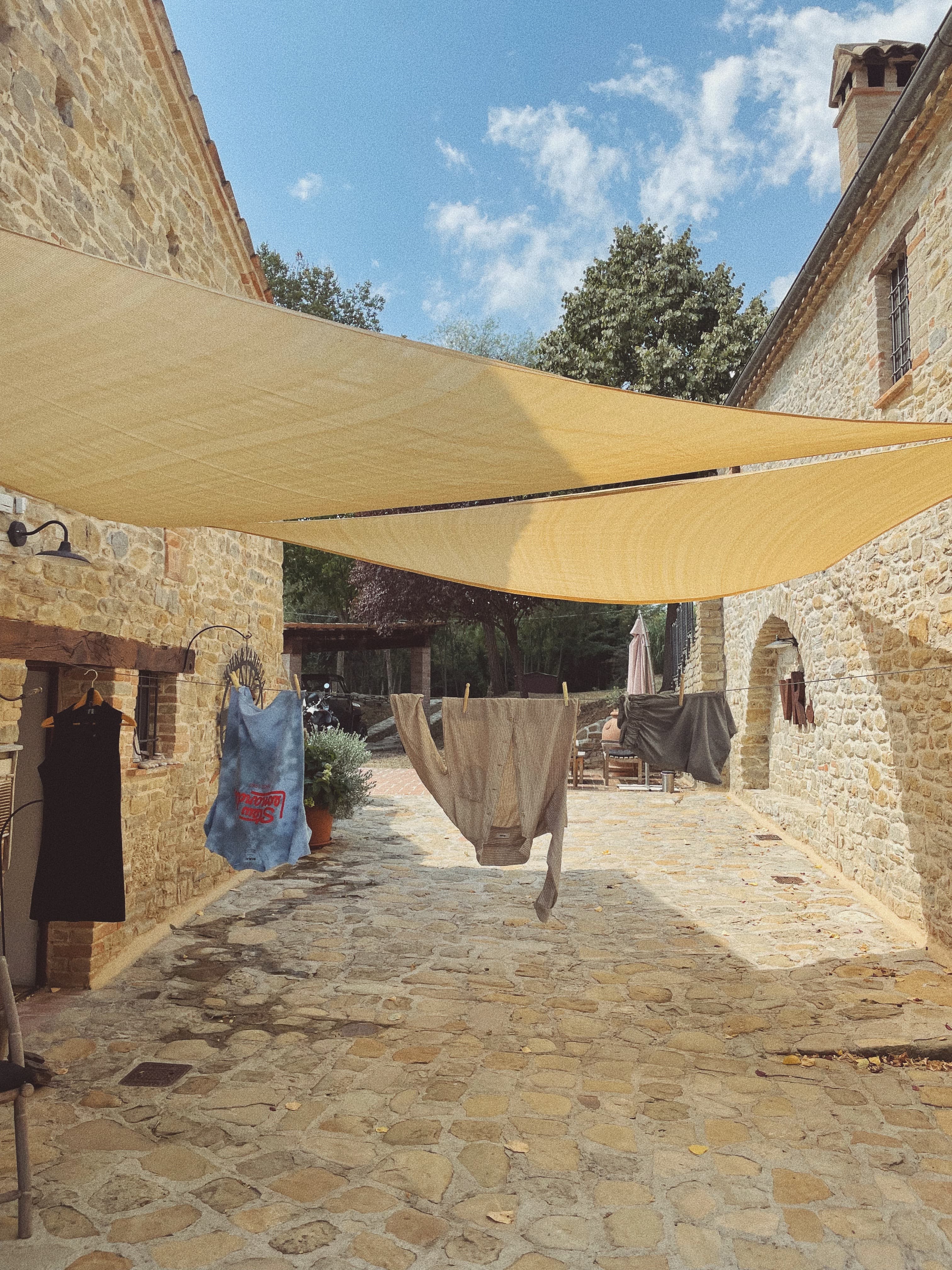
Once upon a time, we dried our linens on clotheslines. Hang drying is just one example of many disappearing romantic yet banal tasks—one that mostly exists outside of America today.
Published
I like to take my time doing laundry. In the same way that opening the windows and cleaning the house can be ritualistic and provide some semblance of spiritual solace, the time I spend with my clothes, my towels, my sheets and pillowcases has become strangely precious. On sunny days, which are more common in Valencia, I take my wet clothes up a flight of stairs to the roof where six long laundry lines are strung for occupants to hang dry their washing.
I like wooden clothespins the best because they are usually smaller than the plastic ones, so they leave less of an imprint. Hanging the clothes, smoothing them and fastening them to the line takes me between five and ten minutes, depending on how much washing I have. I like to clip pants by their cuffs so there’s no line in the middle of the waist, shirts and sweatshirts by their ends, too, I flip hoods inside out, why, I’m not sure exactly, and socks share a single clip.
Before returning to my apartment to continue my day, I usually stop and take a picture or video of the hanging laundry because I find it romantic. (Am I okay?) My little underwear and socks dangling, my sleeves waving, my sheets like sails. In the wind, the Levante from the East, my laundry looks less like a disruption than it does an element of nature itself. When they are dry, I swear I can feel how much happier they are, much like I am after a day in the sun. Recharged or revitalized by the attention. I press a t-shirt to my face and smell not only the floral, powdery detergent, but the air, the heat of the cotton, time itself made sniffable. I inhale a slow imprint of the day on the fabric. That warmth is comfort, time can be comfort, and I’m reminded that both are earthly.
Life in Europe has made hang drying easier. Hang drying in New York meant using an indoor clothes horse even in the summer months. Once, my super on Charles Street asked me to bring my washing inside off the fire escape. Why? I asked. The unit upstairs is empty. Not for the sake of the fire escape, he texted. For the neighborhood.
America has embraced the hegemony of the automatic drying machine for nearly seventy years. Called the “world’s greatest wife saver” by the Kentucky Power Company in 1958, the marketing of these dryers in the second half of the twentieth century was not-so-shockingly directed towards housewives as an appliance tantamount to a kind of women’s lib. Husband-friendly, in fact, the dryer did them a favor, offering an easing of the domestic labor burden that fell to their wives.
The companies made every claim they reasonably could in order to convince the public the machines were worth the investment. Promises of safer or gentler drying, of the end to 'washday worry,' even the power to erase the weather. “Rain or shine, it’s Easy dryin’ in any weather, day or night!” It didn’t take long for the dryer to become symbolic of a happy home. “How a new Hamilton washer and dryer can get a marriage off on the right foot. And keep it that way.”
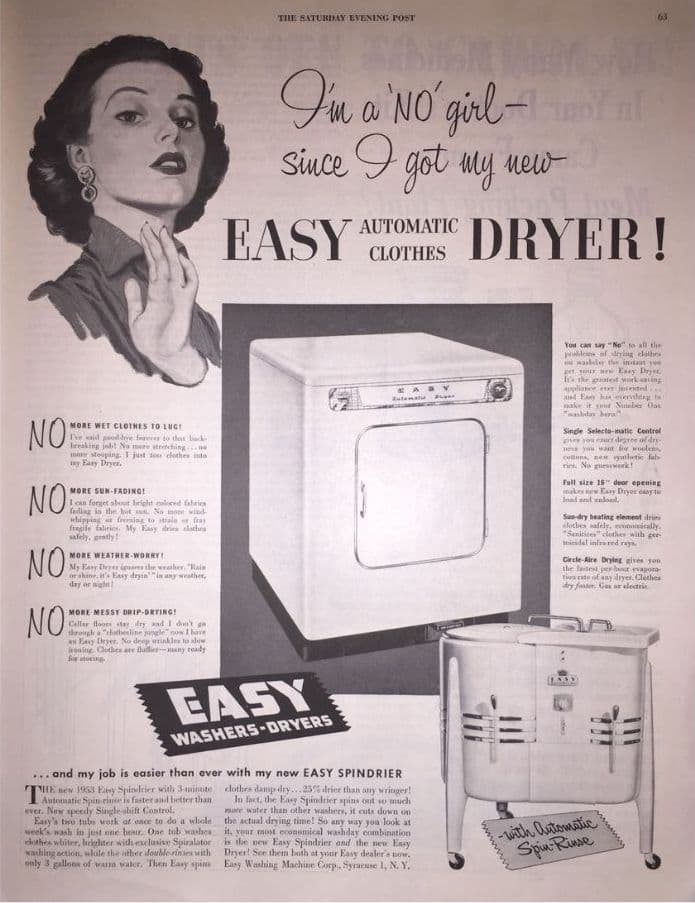
General Electric automatic dryer advertisement, The Saturday Evening Post (c. 1957).
Long before automatic dryers promised to spare us twenty minutes of effort, people believed that objects needed air and light to stay fresh, clean and alive. Bedding was aired, clothes were warmed by the sun, rugs were laid out to receive the day. It was maintenance, a ritual of life. People used to recognize that intimate objects accumulate memory, become “inhabited,” as the French philosopher Gaston Bachelard might describe it, and can become companions through the slow, repeated contact of living among them. A sun-dried sheet, a towel warmed by summer wind: these functional fabrics are inhabited, holding warmth that we put there and that the world returned to us.
Outside of the U.S., hang drying laundry is ubiquitous. My brother even has a small laundry line outside the window of his high-rise apartment in Hong Kong—terrifying for the clothes, but they tend not to complain. The Japanese still air out their futons for freshness. In Sweden, there’s a verb, vädra, for airing out. Lüften in German. Chronically online Americans are calling opening their windows “burping the house” now. Winter or not, people like fresh air. People seem to enjoy contact with the planet they live on.
Iconic lesbian and total mensch Robby Hoffman has an insightful joke in her stand-up set. “You ever realize you grew up poor because you like a hard towel?” Hoffman’s comedy often explores the class mobility she’s experienced, and while her charming demeanor gives us permission to laugh, the joke also lands because it names something lodged in the body for all of us: the softness of a towel. To Hoffman, a hard towel is a memory.
In parts of the United States, outdoor laundry lines are restricted by HOAs or local zoning codes, often on the grounds that they are unsightly or unsafe, sometimes going as far to cite strangulation risk. These concerns feel faintly absurd when contrasted with cities like Venice, where laundry hangs openly, crisscrossing picturesque streets in some of the most beautiful urban neighborhoods in the world. Perhaps these American regulations are less a zoning quirk than a reflection of our deeper cultural allegiance to convenience and the appearance of wealth, or at the very least, a kind of bourgeois shame around the visibility of domestic labor. Who decides what’s “unsightly,” anyway? As of today, there are only 19 states in the United States that protect the “Right to Dry.”
Not only is the tactile experience of our textiles lost in pursuit of convenience or bizarre suburban regulation, but the reality is that the textiles themselves are lost, too. Recent reports from the EPA have indicated the average American produces around 37 kilograms of textile waste per year (nearly 82 pounds), whereas Europeans are producing closer to 16 kgs. I mean, your clothes are getting tossed around a tin drum, scorched with an arid, desert level heat once a week. Medium to high drying cycles expose your clothing to between 55-71 degrees. (That’s 130-160 degrees Fahrenheit for my American brethren.) For reference, the Sahara can reach up to 58. Do we really expect them to last?
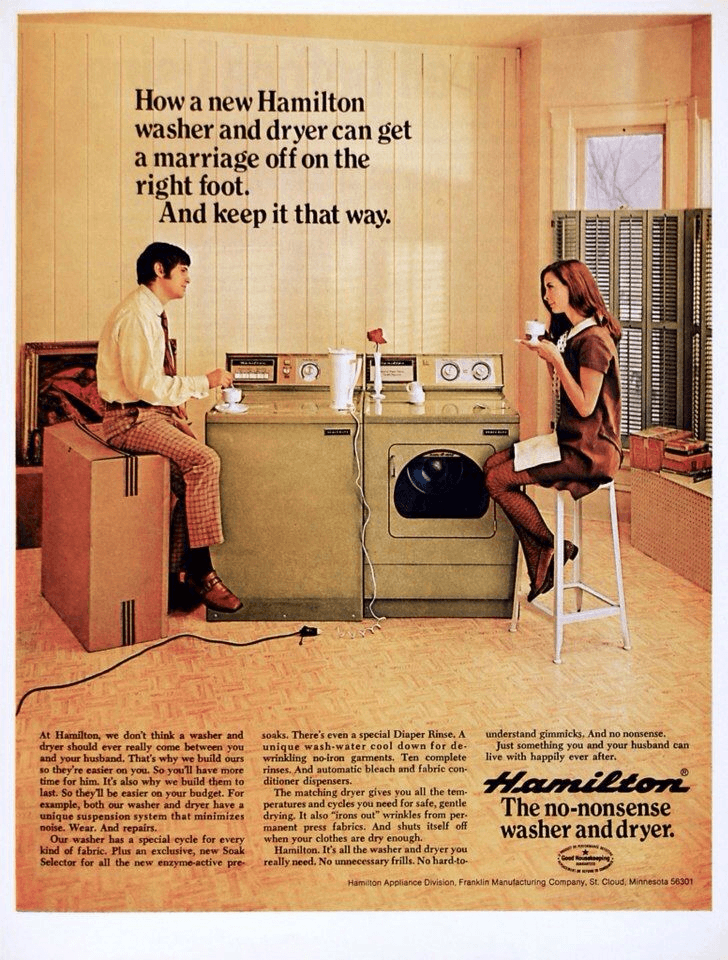
Hamilton Appliance Division, “How a new Hamilton washer and dryer can get a marriage off on the right foot.” Print advertisement, ca. 1960s.
The waste generated by wealthy nations is then shipped off as “second-hand” to developing nations. In places like Kenya, reporting and research have shown that a substantial share of imported second-hand clothing, often estimated at around a third, is unsellable and ends up in landfills or open dumps.
But this is not an environmentalist screed. I’m not smart enough for that. I know we will not save the planet if we eliminate dryers. Sooner or later, though, we will need to choose which inconveniences we’d prefer not to automate. Which human experiences are not worth erasing. How might refusing efficiency, even something small like that of the dryer, change how we live? What if we could reclaim the mundanity of taking care of our clothing as a meaningful act of life?
Convenience removes us from the rhythms that once tuned us to our lives. Dryers promise to ignore the weather. They have the power to erase the elemental. They erase the heaviness of your wet cotton t-shirt, too, of your duvet, they change the size and color of your favorite jeans, they shrink your wool if you forget to pull it out. Dryers turn warmth into a commodity provided by a machine and not something free, something that surrounds us. We’ve accepted dryers will slowly ruin things we love because we've been conditioned to believe that care for these things, itself, is drudgery, and not its own unique pleasure.
In pop culture, resistance to this genre of the puritanical efficiency zeitgeist is appearing in art that resonates with us, even if at first, it’s perceived as a kind of rebellion or alternative to modernity. When Rosalía took Flamenco music and introduced it to trap in El Mal Querer, or when she wrote a waltz about a fuckboy with La Perla, when the strings start their nimble movement at the beginning of Reliquia, she makes the same argument I intend to about laundry lines: that human texture is what carries us: our feelings, our stories, our memories. It recognizes the size and scope of our feelings, it moves us, it’s how we know each other. It puts us in contact with our own lives. Rosalía’s insistence that her music is pop, and the widely positive critical and public reception that proved her right, suggest that slowness and craft don't have to be niche or avant-garde in our world, but can and probably deserve to be central.
Vicenzo Latronico’s buzzy Perfection, a 2025 Booker International Prize Nominee, brilliantly skewers the early to late 2010’s millennial and their/our obsession with aesthetics and beauty, to the extent that it has made many readers (like me) question why they actually like the things they like. Are my tastes just curated expressions of who I think I ought to be? Why do I like natty wine and anchovies? Am I only fixated on hang drying laundry because it is aesthetically beautiful to look at? Is this essay a cope for my economic status?
These are fair questions that deserve fair answers, though such skepticism does not account for the knowledge of the body, and for the merits of the beautiful and tactile systems that have long oriented us as a civilization. The existential emptiness of Perfection, if anything, confirms all that is lost when one’s own life is ignored in the process of living. Though the beautiful and the inhabited need not be at odds.
Comfortingly, Perfection reimagines the 1965 novel Les Choses by Georges Perec, which means that Anna and Tom's preoccupation with beautiful objects, like Jerôme and Sylvie's sixty years earlier, isn't a uniquely millennial disease. Materialism is not new. We are not any more consumed by beauty than other generations—we just have a feed of editorialized images in our pockets to peruse whenever we have a moment of attention to divide. Ultimately, social media doesn’t make us all connoisseurs of culture so much as unconscious consumers of people, places, and things.
But what a beautiful picture cannot show is the warmth of the t-shirt on my face, or the feeling of climbing into a bed with freshly laundered sheets. Nor can a dryer bring me closer to my belongings, though it might spare me a few minutes of labor. I love the excuse for ten minutes of fresh air, communing with the sun and the wind and my things. A dryer cannot conjure my mother and the summer morning we spent clipping our clothes to a line we’d strung up in the backyard. Hang drying remains one area of life in which the beautiful and the inconvenient happen to overlap, and since I have a choice in the matter, I have no need to apologize for preferring both, particularly if it means bearing witness to my own life.
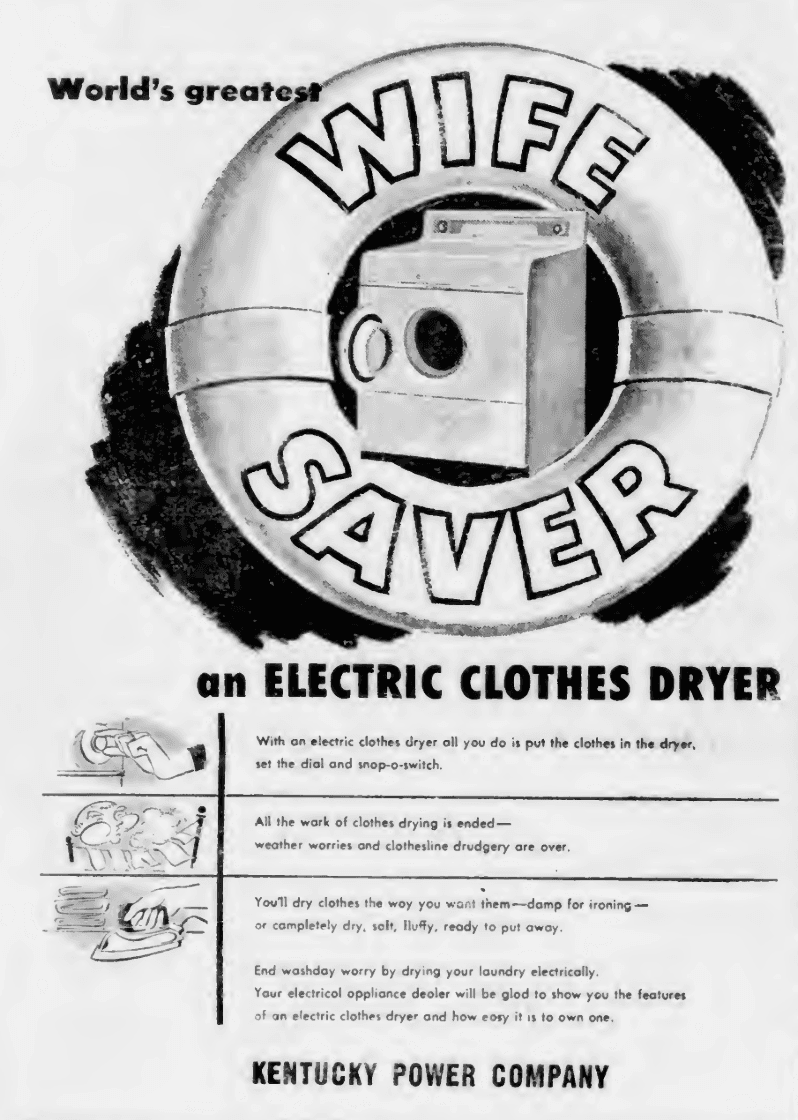
World’s Greatest Wife Saver, Kentucky Power Company electric clothes dryer advertisement, The Saturday Evening Post (1958).